


 Location
 Login
Login
TL;DR:
- Electric bikes improve pace of play and reduce environmental impact on golf courses.
- Selection criteria focus on speed, stability, battery life, noise, and turf safety.
- Proper rider orientation and strategic pilot programs are essential for successful adoption.
Golf course managers are under real pressure right now. Rounds are taking too long, younger players want a greener experience, and traditional gas carts are getting harder to justify on both environmental and cost grounds. Electric bikes have emerged as a serious alternative, and this guide walks you through the selection criteria, top models, side-by-side comparisons with carts, and clear scenario-based recommendations so you can make the right call for your operation.
Table of Contents
- Key criteria for selecting electric bikes for golf courses
- Top electric bike models for golf courses
- Electric bikes vs. golf carts: A detailed comparison
- Situational recommendations: Which option fits your course?
- Our take: What most golf course managers miss about electric bikes
- Explore electric bike and cart solutions for your golf course
- Frequently asked questions
Key Takeaways
| Point | Details |
|---|---|
| Faster play | Electric bikes can reduce round times by 25-30%, improving flow and player satisfaction on courses. |
| Greener operations | E-bikes emit far less CO2 than carts, supporting sustainability and attracting eco-conscious golfers. |
| Player independence | Individual bikes let players travel directly to their shot, speeding pace and personalizing experience. |
| Best-fit scenarios | Electric bikes shine on short, flat courses; carts are superior for hills, heavy loads, or dual riders. |
| Modern appeal | Electric bikes help golf courses attract millennials and seniors, updating the course’s image. |
Key criteria for selecting electric bikes for golf courses
Before you look at any specific model, you need a solid set of criteria. Buying an electric bike for a golf course is not the same as buying one for commuting, and the differences matter in ways that are easy to underestimate.
Speed and agility are the first considerations. Golf courses need vehicles that can move players efficiently between holes without disrupting the flow of play or damaging fairway turf. Most golf-suitable e-bikes travel between 15 and 20 mph, which is fast enough to keep pace of play moving but controlled enough to stay safe around other golfers.
Environmental impact is increasingly a selling point, not just an ethical consideration. Research shows e-bikes emit just 4.9g CO2 per person-mile compared to 274g for cars, and courses using them report measurably faster play. If your facility is marketing sustainability to attract younger members, that number is worth putting on paper. Understanding the broader electric cart benefits can also help you frame the conversation with stakeholders.
Rider stability and safety deserve more attention than they usually get. Single-rider bikes are generally more stable than two-up configurations, and they address pace of play more directly since each golfer travels directly to their own ball. For courses with older members, look for bikes with lower step-through frames, wider tires, and robust braking systems.
Maintenance and total cost of ownership matter over a multi-year fleet horizon. E-bikes have fewer moving parts than gas carts, which reduces scheduled maintenance. Battery replacement cycles, charging infrastructure costs, and parts availability should all factor into your budget analysis.
Here is a quick checklist of criteria to apply when evaluating any electric bike for your fleet:
- Battery range: 36 miles or more per charge to cover a full 18-hole round
- Motor output: 500W minimum for manageable hill assist on moderate grades
- Payload: Enough to carry the rider, a golf bag, and basic accessories
- Noise level: Under 60 decibels to preserve the course atmosphere
- Frame durability: Rust-resistant materials built for outdoor daily use
- Charging time: 4 to 6 hours to allow overnight turnaround between rounds
Pro Tip: Look for pedal-assist (also called pedelec) models that let players choose how much motor support they want. Some golfers prefer the light exercise of pedaling with a motor assist, while others want a fully electric ride. A bike that accommodates both keeps your fleet versatile and appeals to a wider range of players. You can also review how electric vehicles for golf operations are being integrated at forward-thinking facilities for broader context.
With clear criteria in mind, let’s explore top electric bike options suitable for golf course operations.
Top electric bike models for golf courses
Not every e-bike belongs on a golf course. The market is flooded with commuter and mountain bike models that lack the cargo capacity, stability, or battery range that a golf course environment demands. Here is what to look for in each category and why it matters.
Single-rider cargo e-bikes are the most practical starting point for most courses. These bikes typically feature a rear rack or integrated frame system that holds a standard golf bag securely. Look for models with 500W to 750W motors, at least a 48V battery system, and fat tires (3 to 4 inches wide) for turf-friendly traction. Wider tires distribute the load across a larger footprint, which is better for fairway preservation.
Pedal-assist hybrid models sit in the sweet spot between full electric and traditional cycling. Players can pedal lightly with motor assist on flat stretches, which appeals strongly to the segment of golfers who see the walk as part of the game. These models tend to be lighter, which makes them easier to store and transport. The electric cart vs gas comparison is useful here because it highlights how operational costs shift when you move away from combustion engines, and the same math applies when comparing e-bikes to gas carts.
Cargo-forward utility e-bikes are a newer category worth watching. These have a front cargo platform or extended frame designed to carry a bag in front of the rider, improving weight distribution. Some models also include USB charging ports, integrated lighting, and digital displays showing battery level, speed, and trip distance.
Key features to evaluate across all model types:
- Battery life and warranty terms from the manufacturer
- Noise level under load (motor noise at full assist)
- Braking system quality (hydraulic disc brakes are preferable on wet courses)
- Saddle height adjustability for riders of different heights
- Accessories: kickstand stability, handlebar bag mount, reflectors
Research comparing e-bikes to shared golf carts shows e-bikes are superior for pace of play, individual control, fun, and exercise while also being quieter and greener than traditional options. That combination is hard to ignore if your course is trying to attract players in their 30s and 40s.
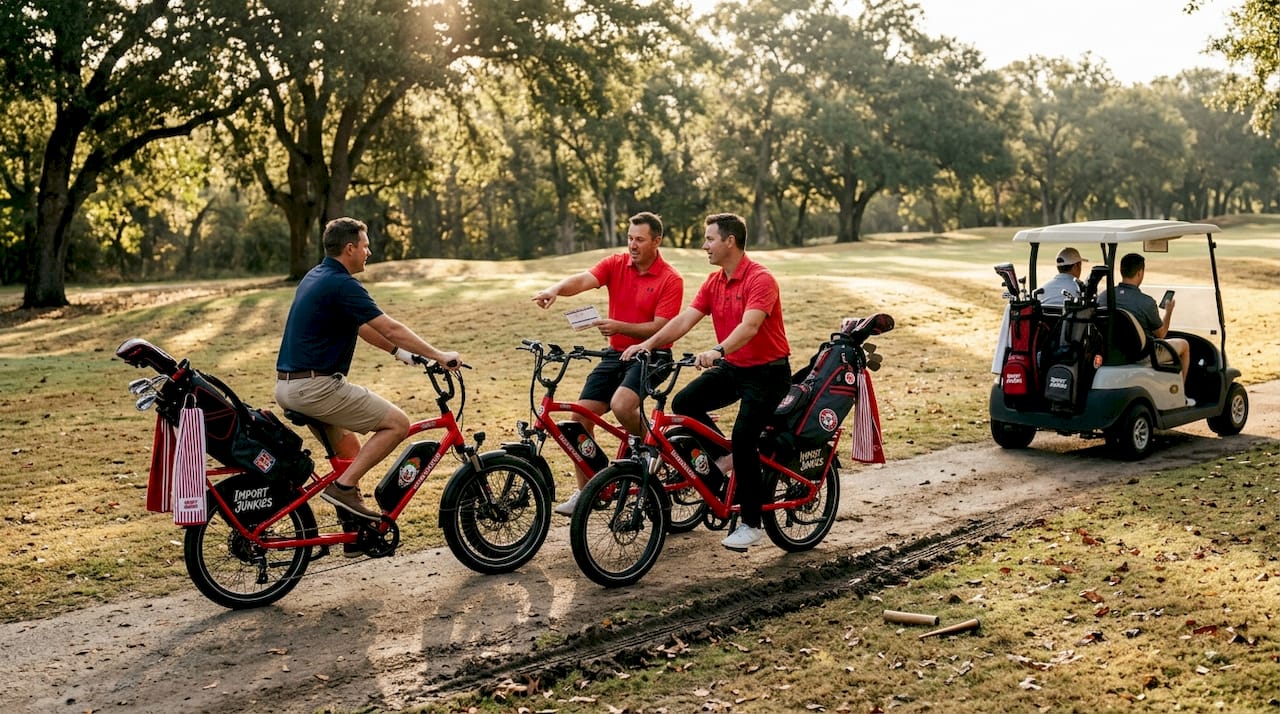
Pro Tip: Do not overlook cargo capacity when you demo a model. Bring an actual golf bag to the test and load it onto the rack before you commit. A bag that slides or shifts during turns creates a safety issue and a frustrating player experience. Check golf cart load capacity specs as a baseline comparison when evaluating how bikes stack up for carrying gear.
Now, let’s see how electric bikes stack up against traditional options in a side-by-side comparison.
Electric bikes vs. golf carts: A detailed comparison
This is where managers often get stuck. Carts are familiar, and many courses have invested heavily in cart fleets. The question is not whether to eliminate carts entirely but whether e-bikes should be added, or whether they should replace carts in specific contexts.
| Feature | Electric bike | Electric golf cart | Gas golf cart |
|---|---|---|---|
| Speed (avg.) | 15 to 20 mph | 12 to 15 mph | 14 to 19 mph |
| Emissions | 4.9g CO2/person-mile | Near zero (electric) | 274g CO2+/person-mile |
| Noise level | 50 to 55 dB | 55 to 65 dB | 70 to 85 dB |
| Load capacity | 1 rider + 1 bag | 2 riders + 2 bags | 2 riders + 2 bags |
| Maintenance cost | Low | Medium | High |
| Turf impact | Very low | Low to medium | Medium |
| Player control | Individual | Shared | Shared |
| Cost per unit | $1,500 to $4,000 | $6,000 to $12,000 | $5,000 to $10,000 |
“Single-rider e-bikes have sped play by 25 to 30% on courses addressing golf’s decline in participation, giving each player direct control over their pace without waiting for a cart partner.” (Electric golf bike ultimate guide)
The data shows e-bikes are lighter and more agile, emit less CO2, but carry less load and are less stable for two riders than carts handling heavy loads. That is not a knock against bikes. It is simply context that should drive your decision about which tool fits which scenario.
Where electric bikes clearly win:
- Courses with a pace-of-play problem
- Facilities targeting younger or fitness-focused demographics
- Operations with sustainability goals and membership messaging around those goals
- Short to mid-length courses where battery range is not a concern
Where golf carts remain the better choice:
- Courses with steep elevation changes where rider balance is a safety concern
- High-volume days when two-rider carts maximize the number of players per vehicle
- Facilities where many players need to transport extra gear, trolleys, or equipment
- Senior-heavy memberships where rider confidence on a bike is lower
For a broader look at how these vehicles fit different property types, the cart vs ATV comparison offers a useful framework for thinking about terrain and utility trade-offs.
After reviewing their comparative strengths, the next step is to recommend best-fit scenarios for each option.
Situational recommendations: Which option fits your course?
Every course is different, and that is exactly why blanket recommendations fall short. Here is a practical, scenario-based framework to guide your decision.
-
Short, flat courses (under 6,000 yards, minimal elevation): Electric bikes are an excellent primary transport option here. Riders can reach their ball quickly, pace of play improves dramatically, and the turf impact is minimal. Courses in this category also stand to gain the most from the environmental marketing angle since the CO2 reduction is most visible relative to their scale.
-
Large, hilly courses with high weekend traffic: Golf carts remain the more practical choice for the majority of your players. That said, you can introduce a small e-bike fleet for players who specifically request them on flatter portions of the routing. A hybrid approach gives you flexibility without abandoning your existing cart infrastructure.
-
Courses with a growing millennial or Gen Z membership base: This is where e-bikes can be a real differentiator. Research shows 67% of millennials prioritize sustainability when making purchasing or membership decisions. Offering e-bikes as an option signals that your facility is thinking forward, and it gives those players a more active, engaging round.
-
Facilities with a strong senior membership: A mixed fleet works best. Carts remain the primary vehicle for players who need stability and comfort, but pedal-assist bikes with lower frames and wider seats can appeal to active senior golfers who want a lighter, more outdoorsy experience. Test with a small batch before scaling.
-
Resort or destination courses: These venues often want to create a distinct experience. E-bikes can become part of the brand, featured in marketing materials and paired with specific tee time packages. The combination of speed, sustainability, and novelty works well in that environment.
To put the environmental case in concrete terms: e-bikes produce just 4.9g CO2 per person-mile compared to 274g for cars. At a course running 200 rounds per weekend, the cumulative emissions reduction over a season is substantial. Courses report that greener, quieter operation attracts younger and senior players alike, which directly affects membership retention and new player acquisition. Reviewing used golf cart strategies can also help you phase in e-bikes while managing budget by offsetting costs through a smart used-cart strategy.
With these best-fit recommendations in mind, let’s share a candid perspective on what actually works and potential pitfalls.
Our take: What most golf course managers miss about electric bikes
Here is something that rarely comes up in product catalogs or vendor conversations: the biggest barrier to successful e-bike adoption on golf courses is not the technology. It is the transition.
Managers consistently underestimate how much rider orientation matters. E-bikes are not intuitive for everyone, especially golfers who have ridden carts for 20 years. A player who is not comfortable on a bike will have a poor experience and then tell other members. That one bad ride does more damage to your e-bike program than any spec shortcoming. Budget for a proper orientation session. Even 15 minutes of supervised riding before someone heads to the first tee makes a meaningful difference in confidence and enjoyment.
The second thing managers miss is the image value. E-bikes are not just a transportation choice. They are a statement about what your course is becoming. Facilities that frame e-bike adoption as part of a broader modernization story tend to get better member buy-in than those that introduce them as a cost-cutting move. The storytelling matters.
Third, measure everything when you pilot. Track pace of play per hole, player feedback scores, and bike utilization rates before you scale. A pilot on three or four holes with 20 to 30 players gives you real data that is far more valuable than any vendor estimate. The broader shift toward EV transformation in golf is happening, and courses that pilot carefully are the ones that scale successfully.
Pro Tip: Run your pilot on a Tuesday or Wednesday morning with players you trust to give honest feedback. Weekend rounds have too many variables. A controlled mid-week test gives you cleaner data on pace, comfort, and operational logistics.
Explore electric bike and cart solutions for your golf course
If you are ready to move beyond theory and start evaluating actual equipment, Import Junkies has you covered. We carry a range of vehicles built for practical, real-world use, not just showroom appeal.

For course managers looking to pilot an e-bike program, our electric bike for golf is a solid starting point, offering pedal-assist functionality, a 500W motor, and a frame built for daily outdoor use. If you need a cart-based solution or want to run a mixed fleet, check out our electric golf cart options, which include multi-seat utility configurations well-suited to golf course operations. Browse the full catalog of golf course vehicle solutions to find the right mix for your course layout, player demographics, and budget. Our team is available to answer questions and help you match equipment to your actual operational needs.
Frequently asked questions
How do electric bikes improve pace of play on golf courses?
Electric bikes allow each player to travel directly to their own ball rather than sharing a cart with a partner, which speeds up play by 25 to 30% compared to shared cart arrangements. The individual control eliminates the time lost waiting for a cart partner to finish their shot before moving.
Are electric bikes more sustainable than golf carts?
Yes. Electric bikes produce far less CO2 and operate at significantly lower noise levels than gas carts. At 4.9g CO2 per person-mile versus 274g for cars and zero emissions at point of use, they are the most environmentally friendly motorized option currently available for golf course transport.
Can electric bikes handle hilly or large golf courses?
Flat and moderate terrain suits e-bikes well, but steep elevation changes or high-volume courses present real challenges. As research confirms, bikes are lighter and more agile but less stable for two riders and less practical than carts for heavy loads or significant hills. A mixed fleet approach is usually the right answer for courses with varied terrain.
What are the main safety concerns with electric bikes on golf courses?
Rider stability is the primary concern, especially for players who are not confident cyclists. Beyond that, bikes are less stable for two riders and require route planning to avoid steep grades, blind turns, or obstacles that would not be a concern in a cart. Rider orientation before the first use and clearly marked bike-friendly routes both reduce risk significantly.
Recommended
- How electric vehicles transform golf facility operations – Saferwholesale || Import Junkies || Great Sports
- Why choose electric golf carts? Benefits for golfers and courses – Saferwholesale || Import Junkies || Great Sports
- Used golf carts: Save money, go green, get more done – Saferwholesale || Import Junkies || Great Sports
- Electric Golf Cart vs Gas: Which Wins? – Saferwholesale || Import Junkies || Great Sports


