


 Location
 Login
Login
Class 1 e-bikes give you pedal-assist only, with help capped at 20 mph. Class 2 e-bikes add a throttle for on-demand power, still capped at 20 mph for motor assist, and both fall under the same federal 750 W rated motor limit. Pick Class 1 if you want the widest access to trails and shared paths. Pick Class 2 if you want throttle help for stop-and-go riding or physical limitations that make constant pedaling tough, noting that local rules on throttle use can vary.
TL;DR:
- Most Class 1 e-bikes rarely reach their 20 mph assist limit during practical riding, with motor help often ceasing below that speed on steep inclines or varied terrain.
- Throttle-equipped Class 2 e-bikes are legal nationwide but often face trail restrictions, especially on natural surface routes, due to safety and predictability concerns.
- Federal regulations set a 750 W continuous motor power cap for low-speed bikes, influencing class definitions and avoiding registration requirements; higher wattage claims are often peak outputs.
- Local rules and trail signage can restrict or ban throttle use regardless of state-wide allowances, so riders should verify regulations before hitting specific paths.
- Choosing between Class 1 and Class 2 should be driven by the intended riding environment, not by performance metrics, with safety and legal compliance as primary considerations.
Table of Contents
- Ebike Class 1 vs Class 2: A Quick Side-by-Side
- What Does Class 1 Actually Mean?
- What Does Class 2 Actually Mean?
- Where Can You Actually Ride Each Class?
- How Do You Choose Between Class 1 and Class 2?
- Why This Guide Treats Class as an Access Decision
- What Buyers Consistently Get Wrong
- Ready to Find Your Fit? Browse Import Junkies’ Lineup
- Where to Verify Class Rules and Local Access
- Sources
- FAQ
Ebike Class 1 vs Class 2: A Quick Side-by-Side
Before you dig into the mechanics of pedal sensors and motor wattage, you probably just want the short version. Here’s how the two most common e-bike classes stack up against each other, and where each one tends to shine.
- Class 1: Pedal-assist only, no throttle, assist cuts off at 20 mph, generally allowed on the widest range of bike paths, mountain bike trails, and multi-use routes.
- Class 2: Pedal-assist plus a throttle, assist and throttle both cap at 20 mph, allowed widely across states but sometimes restricted from specific shared-use paths or singletrack trails.
- Class 1 best for: trail riders, commuters who want a workout with backup power, and anyone riding routes managed by land agencies with strict access rules.
- Class 2 best for: city riders dealing with constant stop lights, delivery or cargo use, and riders who need occasional throttle assistance due to joint pain, fatigue, or mobility limits.
Think about a rider commuting through downtown traffic, stopping at every intersection. A throttle on a Class 2 bike lets them get moving again without waiting for the pedal sensor to catch up, which matters more than it sounds when you’re wedged between a bus and a delivery van. Now think about someone hitting a wooded rail-trail on a Saturday morning. That rider is far more likely to find a “Class 1 only” sign at the trailhead than a blanket ban on throttles, because land managers overwhelmingly favor the pedal-assist-only category for shared natural surface routes.
Both classes share the same underlying motor rules. What separates them is how you access that power, and that distinction drives almost every legal and practical difference covered in the rest of this guide.
What Does Class 1 Actually Mean?
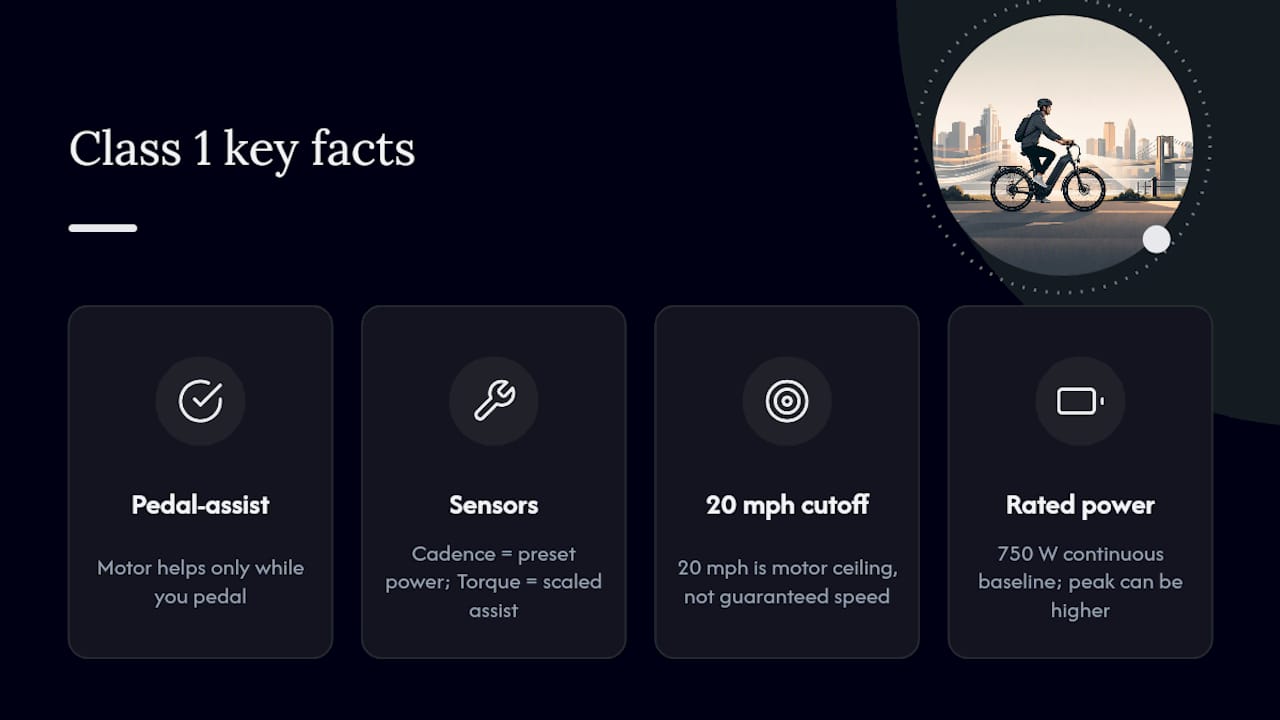
Class 1 e-bikes only give you a boost while you’re pedaling. Stop pedaling, and the motor stops helping. That’s the entire concept, and it’s why Class 1 bikes get treated more like traditional bicycles than any other e-bike category.
Most Class 1 systems use one of two sensor types. A cadence sensor detects that your pedals are turning and delivers a preset amount of power, regardless of how hard you’re actually pushing. A torque sensor measures how much force you’re applying and scales the assist to match, which produces a smoother, more natural-feeling ride. Torque sensors tend to show up on pricier models because the hardware and tuning are more sophisticated, but neither sensor type changes the bike’s legal classification.
Here’s a detail that surprises a lot of new buyers: many Class 1 bikes rarely reach their 20 mph assist cutoff in real-world riding. A commuter grinding up a steep hill in a low gear might only hit 12 or 14 mph even with full assist engaged, because motor power and rider effort combine rather than override each other. The 20 mph figure is a ceiling on motor assistance, not a guaranteed cruising speed. Once you cross that threshold, the motor simply stops contributing, and you’re pedaling under your own power like on any analog bike, just now with extra weight from the battery and motor.
Rated Motor Power: The 750 W Baseline
Federal guidance treats low-speed electric bicycles as bicycles rather than motor vehicles when they meet specific motor and speed thresholds, and that guidance sets the baseline at 750 watts of rated continuous motor power. “Rated” is the operative word here. A motor rated at 750 W can often produce short bursts well above that figure, called peak wattage, without violating the classification. It’s the sustained, continuous rating that regulators use to draw the line, not the number printed in bold on a marketing page.
Statistic Callout: The three-class system was built specifically so e-bikes meeting the 750 W and speed thresholds get treated like bicycles, avoiding registration, title, and insurance requirements that apply to mopeds and motorcycles, according to PeopleForBikes.
That legal framing explains why land managers lean toward Class 1. A park district or national forest office doesn’t want to police throttle-triggered speed bursts on a shared trail with hikers and equestrians. Pedal-assist-only bikes behave predictably: no motor input without pedaling, no surprise acceleration, and a natural speed ceiling that mirrors a fit cyclist’s effort. That predictability is a major reason Class 1 shows up as the default allowed category on multi-use paths across the country.
Pro Tip: If you’re shopping for a trail bike and the listing doesn’t specify a sensor type, ask directly. Torque-sensor bikes cost more but feel far more natural on technical terrain, where sudden jolts of cadence-based power can throw off your balance.
What Does Class 2 Actually Mean?
Class 2 e-bikes carry everything Class 1 offers, plus a throttle that moves the bike without any pedaling at all. The motor assist still caps at 20 mph, whether that power comes from pedaling or from twisting or pressing the throttle. That shared speed limit is easy to miss, and it trips up a lot of first-time buyers who assume “throttle” means “faster.”
Throttles generally come in two styles. A thumb throttle sits on the handlebar and you press it with your thumb, similar to a dirt bike or ATV control. A twist throttle works like a motorcycle grip, rotating to deliver more power. Some throttles are on/off, delivering full power the instant you engage them, while others are variable, letting you meter out exactly how much push you want. Variable throttles feel more controllable in tight urban spaces, while on/off throttles are simpler and cheaper to manufacture.
Where Throttle-Only Riding Runs Into Trouble
Throttle-only operation is legal everywhere Class 2 bikes are allowed, but the same 20 mph cutoff applies whether you’re pedaling or not. Some riders assume a throttle unlocks a higher top speed. It doesn’t. What it changes is effort, not velocity.
Access is where things get more complicated. Class 2 bikes are permitted in all 50 states, though specific multi-use paths and natural surface trails often restrict throttle use even when they allow Class 1 bikes. The reasoning tracks back to predictability again: a throttle can produce a sudden burst of speed from a standstill, which unsettles other trail users far more than the gradual buildup of a pedal-assist system. Rail-trail authorities and mountain bike associations frequently write throttle bans directly into their access rules, even on routes that welcome Class 1 riders without hesitation.
Despite those restrictions, throttle assistance solves real problems that pedal-assist alone doesn’t:
- Riders managing knee, hip, or back issues who need power on demand rather than a gradual ramp-up.
- Cargo e-bike operators hauling groceries, tools, or delivery loads who need reliable low-speed torque from a dead stop.
- Commuters navigating heavy stop-and-go traffic where restarting from every red light adds up over a workday.
- Anyone riding in hilly urban terrain who wants guaranteed power at intersections without waiting on cadence sensors to catch up.
Pro Tip: If mobility is your main concern, test a throttle in person before buying online. Thumb throttles are easier to modulate at low speeds, which matters if you need fine control while starting from a full stop on a slope.
Where Can You Actually Ride Each Class?
The federal government sets the baseline that classifies low-speed e-bikes as bicycles, but it doesn’t dictate where you’re allowed to ride one. That job falls to states, cities, counties, and the specific agency managing the land under your tires. PeopleForBikes built the three-class model precisely to give states a consistent template to adopt, but adoption and enforcement vary enough that assuming your state matches your neighbor’s rules is a mistake.
The Federal Baseline vs. Local Reality
At the federal level, meeting the 750 W and 20 mph thresholds keeps your bike classified as a bicycle rather than a motor vehicle. That’s the floor every state builds on. From there, states decide things like:
- Whether Class 2 throttles are banned on specific rail-trails, greenways, or park paths.
- Helmet requirements by age (many states require helmets under 18, some require them for all riders regardless of class).
- Minimum age limits, particularly for Class 2 and Class 3 bikes.
- Whether local land managers can post additional restrictions beyond the state statute.
Local land managers, including city park departments and national forest offices, hold direct authority to restrict throttle use or ban certain classes on their own trails, independent of what the state statute says in general. A state might permit all three classes statewide while a specific rail-trail authority bans throttles outright on its own signed policy.
A Five-Step Route Check Before You Buy or Ride
- Search “[your state] electric bicycle law” to find the state statute defining the three classes and any age or helmet requirements.
- Check the specific trail or path’s managing agency website (city parks department, county forest preserve, rail-trail conservancy) for posted e-bike rules.
- Look for physical signage at trailheads. Many multi-use paths post class restrictions directly at access points, and that signage is legally enforceable even when it’s more restrictive than the state default.
- Call ahead if the website is unclear. A five-minute phone call to a ranger station or parks office beats a $250 ticket or a confiscated bike.
- Re-check annually. Local e-bike ordinances are still evolving in a lot of jurisdictions, and rules that allowed throttles last year can tighten after user complaints.
The Switchable-Mode Warning
Some e-bikes ship with software that can switch between Class 1, Class 2, and Class 3 modes, unlocking higher assist speeds up to 28 mph. That flexibility sounds appealing, but it creates real legal exposure if a dealer ships the bike with a higher-speed mode already unlocked. A bike set to Class 3 mode loses access to trails and paths that only permit Class 1 or 2, and riding it in that unlocked state on a restricted path is a straightforward violation, whether or not you realize the mode is active. Before you buy a switchable bike, get written confirmation from the seller about which mode it ships in and how mode-locking is verified.
How Do You Choose Between Class 1 and Class 2?
Your riding environment should drive this decision far more than horsepower envy or spec-sheet bragging rights. Class isn’t a performance tier. It’s an access category, and buying the wrong one for your typical route means fighting local rules instead of enjoying the ride.
Match the Bike to the Rider
- Trail rider: Default to Class 1. Broader access to mountain bike trails and natural surface paths outweighs the convenience of a throttle you likely can’t legally use there anyway.
- City commuter: Class 2 usually wins. Stop-and-go traffic rewards throttle-assisted starts, and most urban bike lanes and streets don’t restrict throttle use the way natural trails do.
- Mobility-limited rider: Class 2, without much debate. On-demand throttle power removes the pedaling requirement entirely when joints or stamina make cadence-based assist unreliable.
- Cargo or utility rider: Class 2, for the low-speed torque a throttle delivers from a dead stop under load.
Questions to Ask Before You Buy
- What’s the rated continuous wattage, not the peak wattage? Manufacturers frequently advertise peak numbers well above the rated figure used for legal classification, and that gap can mislead a buyer into thinking they’re getting more legal headroom than they actually are.
- Does the bike carry a visible class label, as required in most states that have adopted the three-class model?
- Is the throttle variable or on/off, and does it work independently of pedaling or only as a boost while pedaling?
- Is the bike switchable between classes, and if so, which mode does it ship in?
- What’s the warranty and return policy if the bike turns out to be misclassified or mislabeled?
Red Flags Worth Walking Away From
Vague wattage claims (“up to 1,000 W!”) without a clear rated continuous figure deserve suspicion. So does a listing with no class sticker or class designation anywhere in the description. And if a seller advertises a top speed above 20 mph for a bike marketed as Class 1 or Class 2, that’s either a labeling error or a switchable bike shipped in an unlocked mode, neither of which you want to discover after your first ticket. Import Junkies’ electric bike buying guide walks through additional model-specific comparisons if you want to go deeper before committing to a purchase.
Pro Tip: Print or screenshot the product listing’s stated wattage and class before you buy. If a dispute ever comes up with a local ranger or officer, having the manufacturer’s own claim in writing protects you.
Why This Guide Treats Class as an Access Decision
Some sellers offer e-bikes alongside other low-speed vehicles like scooters and utility carts, and one pattern shows up again and again in customer questions: buyers assume a higher class or bigger motor number automatically means a better bike. It doesn’t. It means different legal treatment, different trail access, and sometimes a bike that’s technically illegal to ride on the exact route someone bought it for.
That’s the honest, use-case-driven lens this guide applies. Rather than ranking Class 1 against Class 2 like one beats the other, the goal is matching the legal category to where you actually plan to ride. A comparison of e-bike models built for 2026 buyers, and the broader low-speed electric vehicle buying guide covering scooters, trikes, and utility vehicles, both reflect that same approach: start with your route and your body, then work backward to the spec sheet.
Customer support is available for buyers who aren’t sure which class fits their commute, trail system, or mobility needs. Rather than pushing whichever model carries the highest margin, the recommendation process starts with a simple question: where are you actually going to ride this thing?
What Buyers Consistently Get Wrong
Most buying guides treat Class 3 as the “upgrade” and Class 1 as the entry-level option, which misreads the whole system. Class 1 isn’t a lesser bike. It’s the category with the broadest legal welcome mat, and for a huge share of American riders, that access matters more than a throttle ever will.
The bigger blind spot is switchable-mode bikes. Reviews rarely dwell on the legal risk of a dealer shipping a bike already unlocked into a faster mode, but it’s the single easiest way to end up riding illegally without knowing it. Ask for that confirmation in writing before you hand over payment.
If you take one thing from this guide, make it this: decide your primary riding environment first, then shop the class that fits it. A trail rider buying Class 2 for the throttle novelty, or a commuter buying Class 1 and missing the light-to-light convenience a throttle offers, both end up with a bike that fights their daily routine instead of supporting it.
— Gary
Ready to Find Your Fit? Browse Import Junkies’ Lineup
Some retailers stock e-bikes and low-speed electric vehicles built for exactly the two use cases this guide walks through: throttle-friendly city and utility riding, and pedal-driven models suited to broader path access. Instead of guessing at wattage claims from a listing with no class label, buying from a seller who states specs plainly and offers customer support can help match a bike to your commute or trail plans.
If throttle-assisted power for stop-and-go riding or cargo hauling is what you’re after, the 500 Watt Wizzer electric motor scooter e-bike offers pedal and throttle operation at a rated 500 W, comfortably under the federal cap. Browse the full lineup or reach out to customer service with your route and riding needs, and get pointed toward the model that actually fits how you plan to use it.
Where to Verify Class Rules and Local Access
Rules on speed thresholds, motor wattage, and trail access change by jurisdiction, so confirm details directly with primary sources before you buy or ride.
- FTC guidance on electric bikes for the federal motor power and speed baseline.
- PeopleForBikes policy and laws page for the model three-class legislation and state adoption status.
- Bicycling’s class system explainer for a plain-language breakdown of all three classes.
- Your state DMV site and the specific park district, forest office, or trail authority managing your planned route, since local signage often overrides general state defaults.
Sources
- Policies and laws - Electric Bikes | PeopleForBikes
- Class 1 vs 2 vs 3 E-Bikes Explained (2026) — Ebike Oracle
- Classes of E-Bikes: Understanding the Three Class System | Bicycling
FAQ
Should I Get a Class 1 or Class 2 E-Bike?
Choose Class 1 if you plan to ride mountain bike trails or shared natural-surface paths, since it typically gets the broadest access. Choose Class 2 if you commute in stop-and-go traffic, haul cargo, or need throttle assistance for mobility reasons.
Can a Class 2 E-Bike Go Over 20 mph?
Motor assist on a Class 2 bike, whether from pedaling or the throttle, caps at 20 mph under the federal classification. You can pedal faster under your own power, but the motor won’t help you exceed that speed.
What States Allow 1,000 W E-Bikes?
A motor rated above 750 W generally falls outside the federal low-speed e-bike classification, which can push the bike into moped or motor-vehicle categories depending on the state. Rules vary widely, so confirm your specific state’s wattage threshold before buying a bike advertised near or above 1,000 W.
Is a 25 mph E-Bike a Class 3?
Class 3 e-bikes provide pedal-assist up to 28 mph, so a bike assisting above the 20 mph cap for Class 1 and Class 2 usually points to a mislabeled bike or one running in an unlocked, non-compliant mode, which is worth confirming with the seller before you buy.


