


 Location
 Login
Login
TL;DR:
- Understanding e-bike classes and local regulations ensures legal and optimal riding experiences.
- Matching bike features like motor type and design to your riding style improves performance and satisfaction.
- Considering battery capacity, maintenance, and proper dealer support helps ensure long-term reliability.
Browsing through dozens of electric bikes online can feel like staring at a wall of specs with no clear way to compare them. Motor wattage, battery capacity, torque ratings, and bike classes all compete for your attention, and picking the wrong one means spending real money on a bike that doesn’t fit your actual life. This guide cuts through the noise by walking you through e-bike classes, motor types, battery specs, price tiers, and buying strategies so you can make a confident, well-informed decision whether you’re commuting to work or hitting weekend trails.
Table of Contents
- Understand electric bike classes and regulations
- Match your electric bike to your riding style
- Evaluate motor types, torque, and performance
- Battery, range, price, and maintenance essentials
- Test riding, dealer selection, and purchase tips
- What most electric bike buyers miss (and how to avoid it)
- Explore electric bike options and accessories
- Frequently asked questions
Key Takeaways
| Point | Details |
|---|---|
| Class matters | Selecting the right e-bike class ensures you comply with local laws and optimizes your biking experience. |
| Match use to features | Choose accessories and bike type based on whether you commute or ride outdoors for the best performance. |
| Torque beats wattage | High torque motors are more effective for hills and quick starts than high watt ratings. |
| Test before buying | A test ride and choosing a reputable dealer are essential for getting the right fit and reliable service. |
| Maintenance counts | Understanding battery life cycles and motor upkeep prevents unexpected costs and disappointment. |
Understand electric bike classes and regulations
Before you look at a single spec sheet, you need to understand how electric bikes are legally classified in the United States. The class system determines where you can ride, how fast you can go, and what features your bike must have. Skipping this step can leave you with a bike that’s restricted from your favorite trail or bike path.
According to Consumer Reports, e-bikes fall into three main classes. Class 1 bikes use pedal assist only and top out at 20 mph. Class 2 bikes add a throttle and also cap at 20 mph. Class 3 bikes use pedal assist up to 28 mph and are often restricted from shared paths and trails.
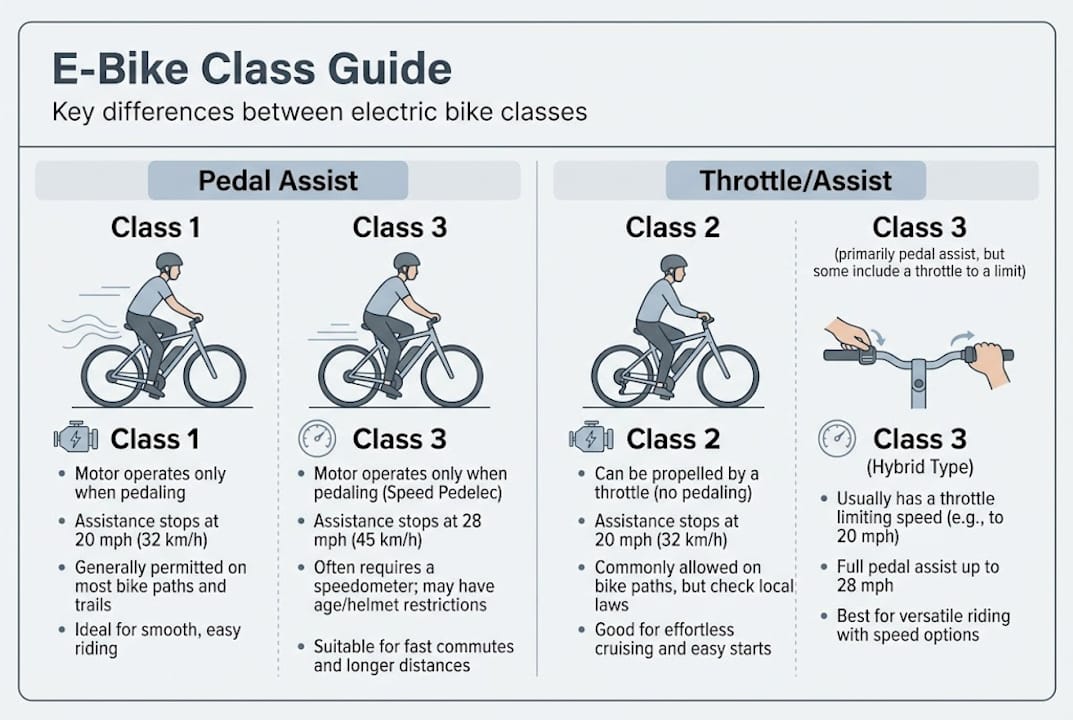
Here’s a quick breakdown:
| Class | Max Speed | Throttle | Common Use | Typical Restrictions |
|---|---|---|---|---|
| Class 1 | 20 mph | No | Trails, bike paths | Fewest restrictions |
| Class 2 | 20 mph | Yes | Commuting, casual | Some trail bans |
| Class 3 | 28 mph | No | Road commuting | Often banned on shared paths |
Key points to keep in mind before you buy:
- Class 1 bikes are the most universally accepted and allowed on the widest range of trails and paths
- Class 2 bikes offer throttle convenience but face restrictions in some parks and protected areas
- Class 3 bikes are built for speed and road use but are often prohibited on multi-use trails
- Local laws vary by state and municipality, so always verify regulations in your area before purchasing
Understanding these distinctions also connects to broader street legal e-vehicle considerations that apply across scooters, golf carts, and similar vehicles. If you’re already familiar with street legal scooter requirements, you’ll notice the same logic applies here. Even golf cart legal requirements follow a similar framework of speed limits and permitted zones.
Match your electric bike to your riding style
Now that you understand the e-bike classes, the next step is matching the right bike to your riding goals. The features that make a great commuter bike are often very different from what you need on a gravel trail or mountain path.

For commuters, upright geometry, racks, fenders, lights, hydraulic brakes, and puncture-resistant tires are essential, and your range needs to cover 20 to 50 miles round-trip to handle a full workday without charging at the office. A bike that looks sleek but lacks a rear rack or integrated lighting is going to create daily frustrations fast.
For outdoor and recreational riders, gravel and mountain-style e-bikes with suspension, wider tires, and high torque are the priority. You need a bike that can absorb rough terrain and push through climbs without draining the battery in the first hour.
Commuter must-haves:
- Integrated front and rear lights
- Rear rack or mounting points for panniers
- Fenders for wet weather riding
- Hydraulic disc brakes for reliable stopping power
- Puncture-resistant tires rated for pavement
- Step-through or low-step frame for easy mounting in work clothes
Recreational essentials:
- Front suspension fork or full suspension for trail riding
- Wide, knobby tires for grip on dirt and gravel
- High torque motor (60 Nm or above) for climbing
- Larger battery capacity for extended trail sessions
- Dropper post compatibility for aggressive trail use
- Durable frame geometry built for off-road stress
Weather and terrain also play a major role in your selection. If you live in a hilly city, a Class 3 bike with strong assist will serve you better than a flat-terrain commuter model. If you ride in rain regularly, sealed bearings and water-resistant wiring become non-negotiable features rather than nice-to-haves.
Pro Tip: To estimate your real-world range, take the manufacturer’s stated range and reduce it by 30% if you ride in hilly terrain, use maximum assist, or weigh over 200 lbs. That gives you a more realistic number to plan around.
For additional electric scooter commuting tips that translate well to e-bike commuting strategy, it’s worth reviewing how experienced riders plan their routes and charging schedules. The Bird A-Frame eBike is a strong example of a well-rounded commuter option with a 500-watt motor, 50-mile max range, embedded dash display, and removable battery.
Evaluate motor types, torque, and performance
Having defined your lifestyle fit, let’s dig into the technology that powers these bikes and determines their real-world performance. Two motor types dominate the market: hub motors and mid-drive motors. Each has a distinct performance profile.
Hub motors are located in the front or rear wheel hub. They’re simpler, quieter, and less expensive to maintain. Hub motors work well for flat commutes and casual riding but can struggle on steep climbs because they don’t leverage the bike’s gearing system.
Mid-drive motors sit at the bottom bracket (the center of the bike where the pedals attach). They work through the bike’s drivetrain, which means they use your gears efficiently and deliver far better climbing performance. The tradeoff is higher cost and more drivetrain wear over time.
When it comes to performance, torque measured in Newton-meters (Nm) matters more than wattage for acceleration and climbing. Here’s a practical breakdown:
| Terrain Type | Recommended Torque | Best Motor Type |
|---|---|---|
| Flat urban commuting | 40 to 50 Nm | Hub motor |
| Moderate hills and mixed terrain | 60 to 90 Nm | Mid-drive |
| Steep climbs or cargo hauling | 100+ Nm | Mid-drive |
“Cold weather can reduce your motor’s effective output and battery efficiency simultaneously, which compounds range loss. Torque sensor systems, which measure how hard you’re pedaling and respond proportionally, feel far more natural than cadence sensors and give you better control on technical terrain.” This is why experienced riders consistently recommend torque sensor bikes for anyone planning to ride varied or hilly routes.
Pro Tip: Always ask whether a bike uses a torque sensor or a cadence sensor before buying. Cadence sensors simply detect whether you’re pedaling and apply a fixed assist level. Torque sensors respond to your actual pedaling effort, which feels smoother and more intuitive, especially on climbs and descents.
The Bird V-Frame eBike offers a 500-watt motor with a 50-mile max range and an embedded dash display, making it a practical option for riders who want solid performance without stepping into premium pricing territory.
Battery, range, price, and maintenance essentials
Once performance is covered, it’s time to understand battery, pricing, and maintenance, which all impact your long-term satisfaction with the bike you choose.
Battery capacity is measured in watt-hours (Wh). A 500 to 750 Wh battery is typical for commuter and recreational e-bikes, delivering a real-world range of 30 to 70 miles on mixed terrain. That range shifts based on assist level, hills, rider weight, and temperature. If you need more range, look for bikes with larger battery packs or models that support a second battery.
How to compare battery and price before you buy:
- Calculate your round-trip commute or typical ride distance and add 20% as a buffer
- Compare battery Wh ratings across models in your price range, not just motor wattage
- Check whether the battery is removable for convenient indoor charging
- Confirm the battery brand and whether replacement packs are available and affordable
- Factor in total ownership cost, including the price of replacement batteries after 500 to 1,000 charge cycles
Key stats to keep in mind:
- Most quality e-bike batteries last 500 to 1,000 charge cycles before capacity drops noticeably
- Budget e-bikes typically cost under $1,500 and use hub motors with basic features
- Mid-range bikes fall between $2,000 and $4,000 and usually include mid-drive motors and better components
- Premium models exceed $5,000 and offer advanced suspension, high-torque motors, and premium finishing
These price tiers and battery cycle benchmarks are consistent across the industry and help you set realistic expectations before you walk into a shop or add a bike to your cart.
Maintenance tips to keep your e-bike running reliably:
- Clean and lubricate the chain every 100 to 150 miles, more often in wet conditions
- Inspect brake pads monthly and replace them before they wear to the metal backing
- Store the battery at 40 to 80% charge if you won’t be riding for more than two weeks
- Check tire pressure before every ride, since underinflation increases rolling resistance and reduces range
- Mid-drive bikes require more frequent drivetrain service due to higher chain and cassette stress
For broader EV maintenance insights that apply across electric vehicles, the same principles of battery care and drivetrain attention translate directly to e-bike ownership.
Test riding, dealer selection, and purchase tips
You’ve narrowed down your options. Now it’s time to finalize your choice and make sure your investment is protected. This stage is where many buyers rush and end up with regret.
A test ride is essential for checking fit, assessing the bike’s weight (most e-bikes weigh 40 to 60 lbs), evaluating brakes, and confirming that included accessories meet your needs. Never skip this step if you have access to a local dealer or demo event.
What to do during a test ride:
- Ride on a slight incline to test how the motor responds under load
- Brake firmly at moderate speed to assess stopping power and lever feel
- Shift through all gears while under assist to check for smooth transitions
- Sit in your natural riding position and verify that reach, saddle height, and handlebar position feel comfortable
- Test the display and controls while riding to confirm they’re intuitive and readable in daylight
Red flags to watch for when evaluating dealers:
- No test ride option or demo bikes available
- Vague answers about battery brand, warranty terms, or replacement parts availability
- No physical address or service department listed
- Pressure to buy immediately without time to compare options
- Missing documentation such as UL certification for the battery or charger
Buying from a reputable dealer protects you when something goes wrong. Warranty claims, software updates, and replacement parts all depend on having a reliable source. The same logic applies whether you’re buying an e-bike or following a step-by-step e-scooter buying process. If you’ve ever used an inspect used vehicle guide for a golf cart purchase, you already understand how important pre-purchase inspection is to long-term satisfaction.
What most electric bike buyers miss (and how to avoid it)
Here’s the honest truth: most first-time e-bike buyers focus on the wrong numbers. They compare wattage figures and assume higher is always better. In practice, a 750-watt hub motor with a cadence sensor will feel sluggish and unnatural on a hill, while a 500-watt mid-drive with a torque sensor will feel powerful and responsive on the same climb. Wattage tells you the motor’s ceiling, not its real-world behavior.
The second thing buyers consistently underestimate is maintenance cost. Mid-drive motors are excellent performers, but they accelerate wear on chains, cassettes, and chainrings because they apply motor force directly through the drivetrain. If you’re buying a mid-drive bike and riding it hard several times a week, budget for more frequent drivetrain replacements than you would on a traditional bicycle.
Cold weather is another factor that catches riders off guard. Range can drop noticeably in winter, and if you’re relying on your e-bike for a daily commute, that gap matters. Planning your route with a 20 to 25% range reduction in cold conditions is the kind of practical thinking that separates prepared riders from frustrated ones. Reviewing electric scooter insights from year-round commuters reinforces this point consistently.
Finally, don’t underestimate the value of a torque sensor test ride before you commit. Riders who switch from cadence sensor bikes to torque sensor bikes almost universally prefer the latter. It’s a feature that’s hard to appreciate on paper but immediately obvious the moment you ride.
Explore electric bike options and accessories
Ready to take the next step? At Import Junkies, we carry a range of electric bikes and e-bike-style vehicles suited for both commuters and recreational riders, with competitive wholesale pricing and straightforward online purchasing.

Whether you’re looking for a reliable daily rider or something with more personality, options like the Wizzer e-bike moped and the Chopstick electric scooter offer 500-watt motors with pedal capability, giving you flexibility across different riding conditions. Browse our full selection, compare specs side by side, and reach out to our team if you need guidance before you buy.
Frequently asked questions
How far can I ride an electric bike on one charge?
Most electric bikes deliver a real-world range of 30 to 70 miles per charge, depending on battery size, terrain, assist level, and rider weight. Manufacturer claims often reflect ideal conditions, so plan conservatively.
What is the difference between hub and mid-drive motors?
Hub motors are simpler and more affordable, making them ideal for flat routes and everyday commuters, while mid-drive motors outperform on hills and technical terrain but require more drivetrain maintenance over time.
How much do electric bikes cost?
Electric bikes range from under $1,500 for basic hub models to over $5,000 for premium performance options, with the most popular mid-range models falling between $2,000 and $4,000.
Why is torque more important than watts for electric bikes?
Torque in Newton-meters determines how effectively a motor accelerates and climbs, especially on hills, making it a far more useful performance indicator than peak wattage for real-world riding.
Does cold weather affect my electric bike’s battery range?
Yes, cold weather reduces range by 15 to 25% because lithium-ion batteries lose efficiency in low temperatures, so plan your rides with a buffer during winter months.
Recommended
- Low Speed Electric Vehicle Buying Guide – Saferwholesale || Import Junkies || Great Sports
- How to buy electric scooters: 5 steps to avoid mistakes – Saferwholesale || Import Junkies || Great Sports
- Best Electric Scooter for Commuting – Saferwholesale || Import Junkies || Great Sports
- Scooter types guide: Choose the right model in 2026 – Saferwholesale || Import Junkies || Great Sports


