


 Location
 Login
Login
TL;DR:
- Conduct thorough inspections of batteries, frame, and safety systems to avoid costly repairs.
- Use documentation and minor repairs as negotiation tools, and be prepared to walk away.
- Experienced buyers rely on quick assessments and test drives to evaluate overall cart health.
Buying a used golf cart can save you thousands of dollars compared to purchasing new, but only if you know exactly what to look for before you hand over any money. A cart that looks clean on the surface can hide expensive battery problems, frame damage, or worn-out brakes that turn a great deal into a costly mistake. Whether you’re a golfer looking for a personal ride or a small business owner needing an affordable utility vehicle, the inspection process is the same. This guide walks you through every key check, from gathering your tools to spotting red flags and negotiating a fair price.
Table of Contents
- What to bring and what to know before you inspect
- Step-by-step inspection: exterior, tires, and frame
- How to assess the battery, wiring, and power system
- Testing brakes, steering, and essential safety systems
- Red flags and negotiation tips: what to do if you spot issues
- What most guides miss: experience-based shortcuts and buyer wisdom
- Find quality inspected golf carts and utility vehicles
- Frequently asked questions
Key Takeaways
| Point | Details |
|---|---|
| Preparation is crucial | Bringing the right tools and records makes used golf cart inspection more thorough and confident. |
| Batteries need careful testing | Battery condition can determine half of an electric cart’s value and future reliability. |
| Safety first | Always test brakes, steering, and lights before any purchase to avoid costly or dangerous surprises. |
| Red flags can save money | Spotting and negotiating issues upfront can help you avoid bad deals and get better pricing. |
| Professional help matters | Bringing a second expert or friend gives added protection and buying confidence. |
What to bring and what to know before you inspect
Start by preparing yourself and gathering the right information. It makes inspecting the golf cart much easier and more effective. Walking into a used cart inspection without a plan is one of the most common mistakes buyers make.
Understanding the type, age, and previous use of the golf cart narrows your inspection focus and helps you ask the right questions. A cart used on a private property for two years is very different from one that spent five years on a commercial golf course.
Tools and items to bring:
- Notepad and pen for recording observations
- Flashlight to inspect undercarriage and tight spaces
- Voltmeter to test battery voltage on electric carts
- Tire pressure gauge
- Camera or smartphone for photos
- A copy of the seller’s listing for reference
Documents to request from the seller:
- Maintenance and service records
- Bill of sale or title
- Battery age and replacement history
- Original purchase receipt if available
| Feature | Electric cart | Gas cart |
|---|---|---|
| Battery check needed | Yes, critical | No |
| Engine inspection | No | Yes, critical |
| Charging system check | Yes | No |
| Fuel system check | No | Yes |
| Typical running cost | Lower | Higher |
| Inspection complexity | Moderate to high | Moderate |
Also review golf cart legal requirements for your area before buying, especially if you plan to use the cart on public roads or in a neighborhood.
Pro Tip: Always request to view the cart in full daylight and after it has been sitting idle for several hours. A cart that has been warmed up or recently charged can mask problems that only show up cold.
Step-by-step inspection: exterior, tires, and frame
With your tools ready, you’re set to begin the physical inspection, starting where major issues often hide: the exterior and frame. Checking for rust, frame damage, and tire wear is essential to avoid dangerous or costly repairs down the road.
How to inspect the exterior and frame:
- Walk around the entire cart and note any cracks, dents, or mismatched paint panels.
- Crouch down and look along the frame rails for bends, welds, or signs of previous collision repair.
- Check the undercarriage with your flashlight for rust, corrosion, or loose bolts.
- Press firmly on each corner of the cart body to test for flex or unusual movement.
- Inspect the roof and windshield for cracks or poor-fitting replacements.
Tire and suspension checks:
- Look at tread depth on all four tires. Uneven wear often points to alignment or suspension problems.
- Check the sidewalls for cracking, which indicates age even if tread looks fine.
- Push down on each corner of the cart to test shock absorber response.
- Look for bent A-arms or loose tie rods under the front end.
| Visible defect | What it may mean | Estimated repair cost |
|---|---|---|
| Surface rust on frame | Age or storage issues | $50 to $300 |
| Deep frame cracks or bends | Collision or structural failure | $500 or more |
| Uneven tire wear | Alignment or suspension issue | $100 to $400 |
| Cracked body panels | Impact damage | $75 to $250 per panel |
| Worn shock absorbers | Heavy use or age | $150 to $350 |
When choosing a golf cart, keep in mind that structural repairs are rarely cheap and can quickly eat into any savings from buying used.
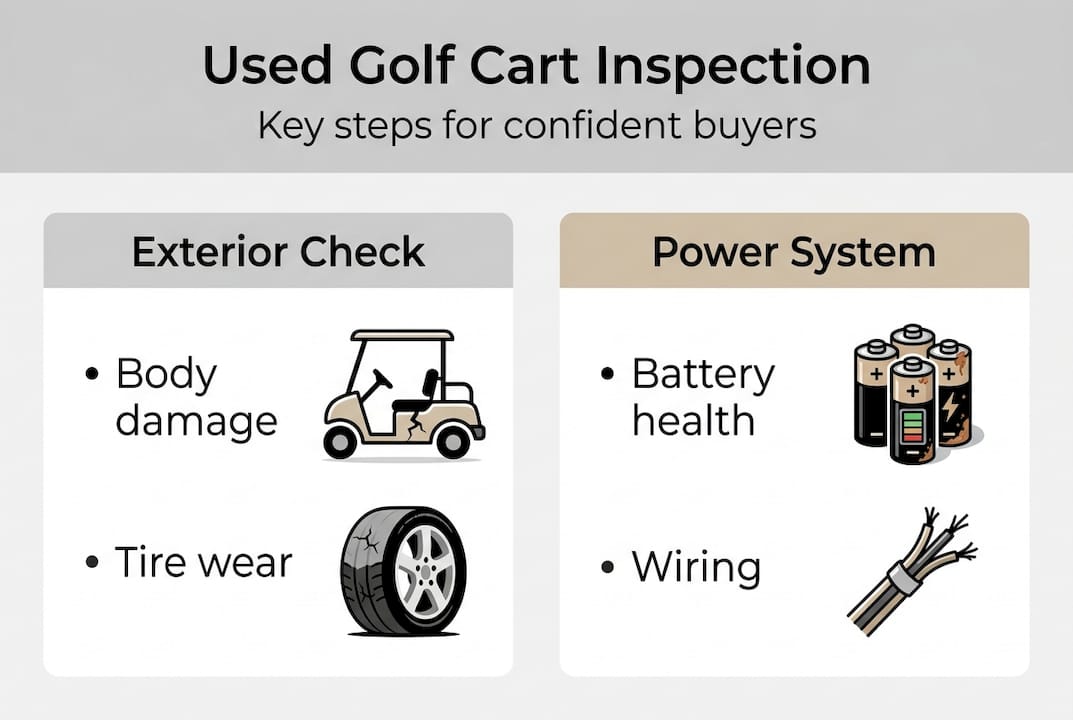
Pro Tip: Take clear photos of every questionable area you find. These images become useful tools during price negotiation and give you documentation if problems appear after purchase.
How to assess the battery, wiring, and power system
After covering the cart’s outer hardware, turn to its heart: the batteries and the power system. These components demand special attention because they carry the highest replacement cost of any part on an electric golf cart.
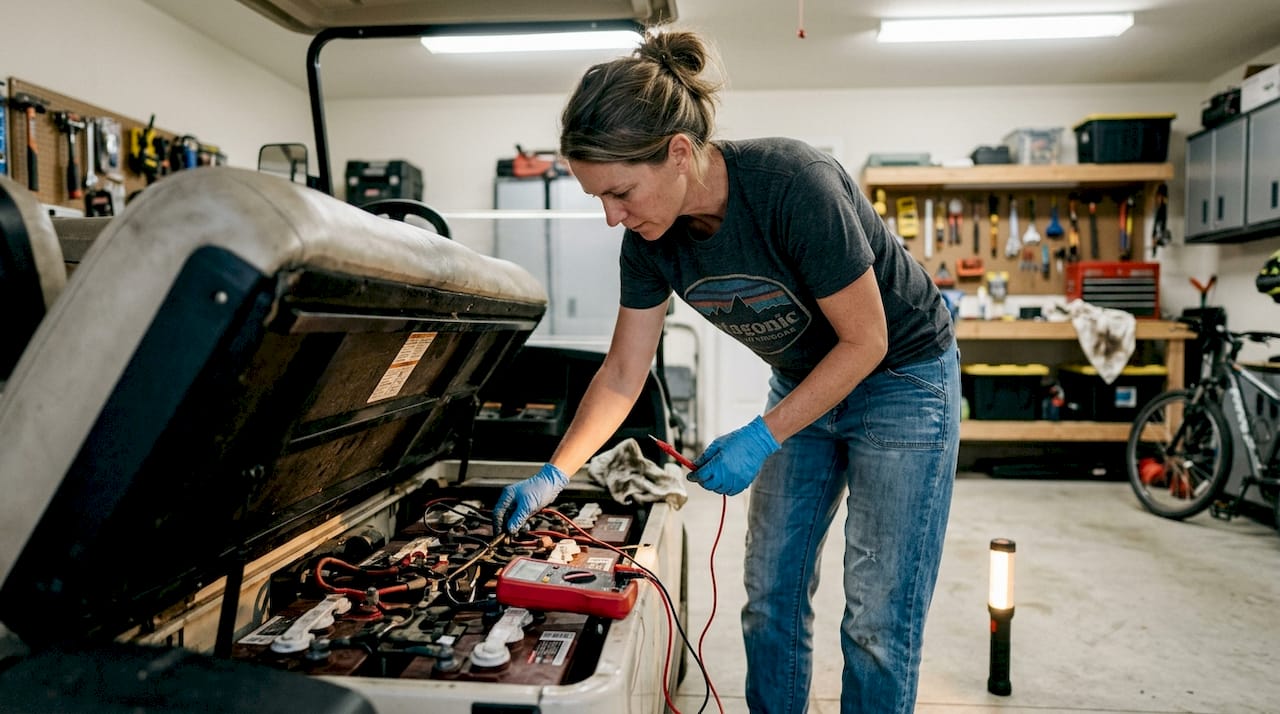
Batteries can be up to half the value of an electric golf cart, making a thorough assessment absolutely critical before you commit to buying.
Battery inspection steps:
- Locate the battery bank and look for white or blue corrosion on terminals.
- Find the date codes stamped on each battery. Batteries older than four to five years may need replacement soon.
- Check water levels in flooded lead-acid batteries. Low water signals poor maintenance habits.
- Use your voltmeter to test each battery individually. A fully charged 6-volt battery should read at least 6.3 volts.
- Ask to see the cart fully charged, then take it for a short drive to observe how quickly voltage drops.
“A full battery replacement can cost several thousand dollars, so careful testing is vital before you finalize any purchase.”
Also inspect the wiring harnesses running from the batteries to the motor and controller. Look for frayed insulation, taped-over repairs, or burn marks. Check the charging port for corrosion or damage. Poor wiring repairs are a red flag that the cart has had electrical problems in the past.
When comparing electric vs gas golf carts, remember that gas models shift the inspection focus to the engine, carburetor, and fuel lines instead. If you want a lower-maintenance starting point, browse electric mini golf carts that come ready to use.
Pro Tip: Use a voltmeter on every battery cell, not just the pack as a whole. One weak cell can drag down the entire system and shorten the life of the remaining batteries significantly.
Testing brakes, steering, and essential safety systems
With the cart’s power and exterior reviewed, the next step is to ensure every ride will be safe and reliable. These checks are often skipped by first-time buyers, and that oversight can lead to accidents or expensive repairs.
Brakes and steering are safety essentials; neglecting them leads to accidents and expensive repairs that could have been avoided with a five-minute check.
Brake inspection steps:
- Sit in the cart and press the brake pedal firmly. It should feel solid with no sponginess.
- Drive the cart slowly and apply the brakes. The cart should stop straight without pulling to one side.
- Listen for grinding or squealing sounds, which indicate worn brake pads or drum contact.
- Test the parking brake separately to confirm it holds the cart on a slight incline.
Steering check:
- Turn the steering wheel slowly from lock to lock and feel for binding or rough spots.
- Check for excessive play. More than two inches of free movement before the wheels respond is a concern.
- Listen for clunking sounds when turning, which can mean worn tie rod ends or kingpin bushings.
Other key golf cart safety requirements to verify:
- Headlights and taillights function correctly
- Horn works
- Seatbelts are present and latch securely
- Emergency brake engages and releases smoothly
- Mirrors are intact if required in your area
“Never finalize your purchase until the safety systems perform reliably. A cart that fails a brake or steering check is not a project vehicle, it is a liability.”
Red flags and negotiation tips: what to do if you spot issues
The inspection is nearly complete. Now you need to know how to interpret your findings to protect yourself and get the best deal possible.
Many buyers discover expensive issues after purchase because they overlook warning signs during inspection. Knowing which problems are deal-breakers and which are negotiating tools puts you in control.
Walk away if you see any of these:
- Severe frame cracks, bends, or evidence of major collision damage
- Electrical burn marks on wiring, controllers, or battery terminals
- Missing title or bill of sale
- No maintenance records and seller cannot explain the cart’s history
- Batteries that are more than six years old with no replacement plan offered
- Brake failure or complete steering play during the test drive
If the issues are minor, use them as negotiation tools. A set of tires that need replacement, for example, costs $150 to $300. Ask the seller to reduce the price by that amount or replace them before the sale closes. The same logic applies to battery corrosion, worn brake pads, or cracked body panels.
Reviewing price expectations for used golf carts before your visit gives you a solid baseline so you know whether the asking price is reasonable given the cart’s condition.
Most used golf carts that sell quickly have clear documentation and pass all major safety and mechanical checks. If a seller is pushing you to decide fast, that pressure is itself a warning sign worth taking seriously.
Pro Tip: Don’t rush. If a cart has major issues and the seller won’t negotiate, be ready to walk away. There are always more listings, and a patient buyer almost always gets a better deal.
What most guides miss: experience-based shortcuts and buyer wisdom
Even after following all of the technical steps above, true confidence in a purchase comes from applying real-world judgment that most checklists don’t capture.
Here’s what experienced buyers know: surface-level checks take time, but a professional can assess a cart’s overall health in about three minutes by focusing on battery terminal condition, frame symmetry, and how the cart responds when you first power it on. Those three data points tell a story faster than any visual walkthrough.
A 10-minute test drive reveals more than an hour of conversation with the seller. Pay attention to how the cart accelerates from a stop, whether it pulls during braking, and how the steering feels at speed. Unusual vibrations, hesitation, or noise during the drive are signals no seller’s description will mention.
Don’t let a low sticker price cloud your judgment. Value the documentation and a clean inspection history more than the asking price. A cart with full service records priced $300 higher than a mystery unit is almost always the better buy.
For additional real-world buyer tips on selecting the right cart for your situation, it helps to review what experienced owners prioritize before committing.
Pro Tip: Bring a trusted friend or a mechanic when possible. A second pair of eyes catches things you might miss when you’re focused on talking to the seller or managing paperwork.
Find quality inspected golf carts and utility vehicles
Now that you know how to inspect carts yourself, consider saving time by browsing options that have already passed rigorous checks. Buying from a reputable source removes much of the guesswork and gives you confidence from day one.

At Import Junkies, we carry a wide range of electric and gas options built for both recreational and utility use. Whether you need a workhorse like our inspected 400cc GVX Gas Golf Carts or a clean, ready-to-ride electric utility golf cart, our inventory is priced competitively and available to purchase directly online. Skip the uncertainty of private listings and shop vehicles you can trust.
Frequently asked questions
What is the most expensive part to replace on a used golf cart?
The battery pack is typically the most costly part to replace, especially in electric carts. Batteries can make up half the value of a golf cart, so always test them thoroughly before buying.
How can I tell if a used golf cart has frame damage?
Check for rust, uneven wear, or structural bends under the cart, and compare all corners for level alignment. Frame damage and rust are critical to check for both safety and repair cost reasons.
How do I know if a golf cart’s brakes are safe?
Test the brakes at low speed for firm stopping, no grinding noises, and no drifting to either side. Brakes and steering are fundamental safety checks that should never be skipped, and a technician should verify them if you have any doubt.
Are gas golf carts generally easier to inspect than electric ones?
Neither type is simpler overall. Electric carts require more battery checks, while gas vs electric models each have distinct inspection points, so both need careful and thorough review.
Can I negotiate the price if I find problems during the inspection?
Yes, any documented issue is a valid bargaining point. Use repair cost estimates to ask for a price reduction, or request that the seller address the problem before you finalize the purchase price.
Recommended
- Street Legal Golf Cart Requirements Explained – Saferwholesale || Import Junkies || Great Sports
- Best Golf Cart for Neighborhoods: What to Buy – Saferwholesale || Import Junkies || Great Sports
- Electric Golf Cart vs Gas: Which Wins? – Saferwholesale || Import Junkies || Great Sports
- 48V Electric Golf Cart 4 Seater Renegade Edition Utility Golf UTV – Saferwholesale || Import Junkies || Great Sports


