


 Location
 Login
Login
TL;DR:
- Lifted golf carts increase ground clearance, tire size, and off-road capability.
- They offer enhanced utility, towing, and customization for varied terrains and tasks.
- Proper installation, maintenance, and understanding local laws are essential for safe use.
Most people picture a golf cart rolling quietly across a manicured fairway. That image misses a much bigger story. Lifted golf carts have grown into serious off-road vehicles, neighborhood cruisers, and workhorse utility machines that handle terrain a standard cart would never survive. Whether you want to explore trails, manage a large property, or simply stand out in your community, a lifted golf cart gives you options that a flat-course model simply cannot. This guide covers what makes a cart lifted, why it matters, how it compares to a standard model, and exactly what to look for before you buy.
Table of Contents
- What makes a golf cart ‘lifted’?
- Benefits of lifted golf carts
- Comparing lifted vs standard golf carts
- Customization and safety considerations
- Tips for choosing and owning a lifted golf cart
- An expert perspective on lifted golf carts
- Find your perfect lifted golf cart
- Frequently asked questions
Key Takeaways
| Point | Details |
|---|---|
| Lifted golf cart defined | A lifted golf cart uses a modified suspension to increase ground clearance for off-road or customized uses. |
| Key benefits | Lifted golf carts are more versatile, offering better performance on rough terrain and room for unique modifications. |
| Comparison with standard | Lifted models are more capable but usually cost more and require extra maintenance and attention to handling. |
| Safety first | Always prioritize safety, proper installation, and legal requirements when customizing or driving a lifted golf cart. |
| Smart buying tips | Check the quality of lift kits and accessories and seek professional help if you’re unsure during your purchase. |
What makes a golf cart ‘lifted’?
A standard golf cart sits low to the ground and runs on small tires sized for smooth pavement or groomed turf. That setup works fine on a golf course, but it limits what the cart can do anywhere else. A lifted golf cart is different by design.
A lifted golf cart uses a lift kit to increase ground clearance and accommodate larger tires. The lift kit itself is a collection of brackets, spacers, and sometimes new suspension components that physically raise the cart’s frame higher off the ground. There are two main approaches: a suspension lift, which modifies the entire suspension system for a smoother ride on rough terrain, and a body lift, which raises only the body of the cart without changing the suspension geometry.
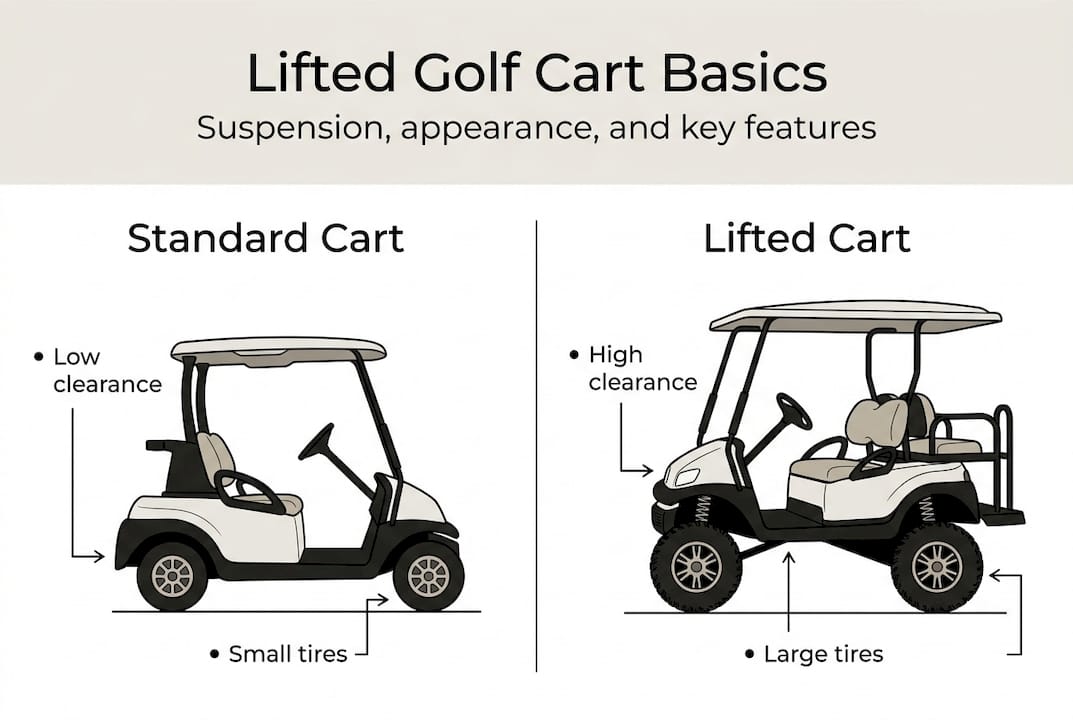
Here is a quick look at what typically changes when a cart gets lifted:
| Feature | Standard cart | Lifted cart |
|---|---|---|
| Ground clearance | 4 to 5 inches | 8 to 12 inches |
| Tire size | 18 to 20 inches | 22 to 26 inches |
| Terrain capability | Flat surfaces | Rough, uneven ground |
| Visual profile | Low, compact | Taller, more aggressive |
Common modifications that come with a lift include:
- Larger, knobby off-road tires
- Upgraded wheels in aluminum or steel
- Extended fender flares to cover the wider tires
- Heavy-duty axles for added load capacity
- Rear cargo racks or utility beds
Pro Tip: If you are buying a pre-lifted cart, always confirm whether it uses a suspension lift or a body lift. Suspension lifts generally deliver better ride quality and stability on uneven ground, which matters a lot if you plan to go off-road regularly.
The visual difference is obvious the moment you stand next to one. A lifted cart sits noticeably taller, the tires are wider and more aggressive, and the overall stance looks closer to a small UTV (utility task vehicle) than a golf cart. That appearance is not just cosmetic. It reflects real mechanical changes that affect how the cart performs.
Benefits of lifted golf carts
With a clear definition in place, it is worth looking at why so many buyers are choosing lifted models over standard ones. The advantages go well beyond looks.
Lifted golf carts can handle rougher terrain and carry heavier loads, which opens up use cases that standard carts simply cannot fill. That practical advantage is the core reason lifted carts have gained so much popularity outside of golf courses.
Here are the main benefits you will notice:
- Off-road performance: The added ground clearance lets you cross gravel paths, grassy fields, muddy trails, and uneven surfaces without bottoming out.
- Improved visibility: Sitting higher gives the driver a better sightline, which is useful on large properties, farms, or crowded event spaces.
- Increased carrying capacity: Many lifted carts come with reinforced frames and cargo beds that support heavier payloads for hauling tools, equipment, or supplies.
- Towing capability: Some lifted models include tow hitches and are rated to pull small trailers, making them useful for landscaping or event setup work.
- Customization potential: The lifted platform is a natural starting point for accessories, meaning you can build a cart that fits your exact needs.
Lifted golf carts are no longer a niche product. They are practical utility vehicles that work on farms, ranches, large residential properties, campgrounds, and anywhere else a standard cart would struggle.
When you compare electric vs gas golf carts, the lifted format applies to both power types. Electric lifted carts are quieter and lower in operating cost. Gas lifted carts, especially four-wheel-drive models, deliver more raw power for steep inclines and heavy towing. Your terrain and workload should drive that choice.
Pro Tip: If you primarily use your cart on flat neighborhood roads with occasional light trails, an electric lifted model will likely meet your needs and cost less to run over time. Reserve a gas or four-wheel-drive model for genuinely demanding terrain.
Comparing lifted vs standard golf carts
Now that you understand the benefits, a direct comparison shows exactly where lifted carts pull ahead and where standard carts still make sense.
| Category | Standard golf cart | Lifted golf cart |
|---|---|---|
| Purchase price | Lower | Higher |
| Ground clearance | 4 to 5 inches | 8 to 12 inches |
| Terrain range | Paved/groomed only | Off-road capable |
| Ride comfort on pavement | Smoother | Slightly firmer |
| Maintenance complexity | Simpler | Moderate |
| Customization range | Limited | Extensive |
| Typical users | Golf courses, resorts | Farms, trails, neighborhoods |
Standard golf carts are lighter and often less expensive, while lifted models offer more versatility for buyers who need to go beyond paved surfaces. That price difference is real, but it reflects genuine added capability.
Here is how the two types compare across the most common buying considerations:
- Performance: Lifted carts handle varied terrain far better. Standard carts are faster and more agile on smooth surfaces.
- Cost: Expect to pay more upfront for a lifted model. Maintenance costs can also be slightly higher due to larger tires and more complex suspension components.
- Comfort: On pavement, a standard cart often rides more smoothly. A lifted cart with a suspension lift closes that gap significantly on mixed terrain.
- Maintenance: Standard carts are simpler to service. Lifted carts require periodic checks on lift kit hardware, tie rods, and larger tires.
- Use case fit: If your driving is limited to a golf course or flat neighborhood streets, a standard cart is practical and cost-effective. If you need off-road ability, a lifted model is the right tool.
The honest answer is that lifted carts are not better in every situation. They are better for a specific type of use. Knowing your terrain and purpose before you buy saves you from overpaying for capability you will never use, or underspending on a cart that cannot handle your environment.
Customization and safety considerations
Once you decide on a lifted cart, customization becomes one of the most engaging parts of ownership. The lifted platform supports a wide range of upgrades that standard carts simply cannot accommodate.
Customization allows for accessories like winches, LED lighting, and upgraded seats, which means you can configure your cart for specific tasks or personal style without major mechanical overhauls. Popular upgrades include:
- Winches: Useful for recovery if you get stuck on a trail or need to pull equipment.
- LED light bars and headlights: Essential for early morning or evening use on properties and trails.
- Upgraded seats: Bench seats, bucket seats, or rear-facing seats for passengers.
- Roof enclosures and windshields: Provide weather protection for year-round use.
- Cargo beds and racks: Add hauling capacity for tools, firewood, or gear.
Adding quality accessories to a lifted cart increases its practical value significantly. The key word is quality. Cheap parts can compromise the structural integrity of the lift kit and affect handling.
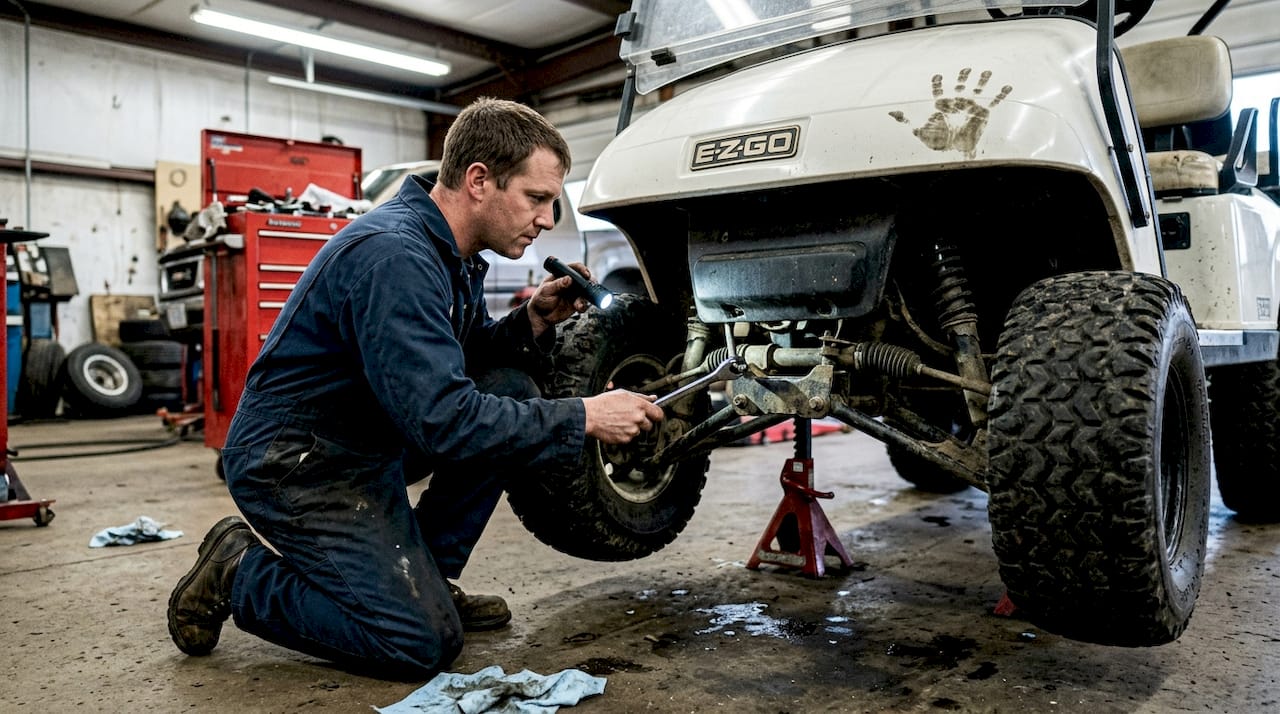
Safety is where many new owners make avoidable mistakes. A lifted cart handles differently than a standard one, especially at higher speeds or on uneven ground. The higher center of gravity means you need to take corners more carefully and reduce speed on steep slopes.
For street use, most states require specific equipment before a golf cart is considered street legal. Common requirements include working headlights and taillights, turn signals, mirrors, a windshield, and seat belts. Check your local regulations before driving on public roads.
Pro Tip: After any lift kit installation or major accessory addition, have a qualified technician inspect the steering, brakes, and suspension before you take the cart on any demanding terrain. A quick inspection can catch loose hardware or alignment issues that would otherwise become safety problems.
Long-term maintenance for a lifted cart includes regular torque checks on lift kit bolts, tire rotation, and monitoring for unusual wear on the steering components. These are not difficult tasks, but skipping them shortens the life of your investment.
Tips for choosing and owning a lifted golf cart
With safety and customization covered, here is a practical framework for selecting and maintaining the right lifted cart for your situation.
- Define your terrain first. Are you mostly on flat neighborhood streets, mixed gravel and grass, or genuine off-road trails? Your answer determines how much lift and tire size you actually need.
- Choose power type based on workload. Electric models work well for light to moderate use. For heavy towing, steep hills, or all-weather work, rugged multipurpose carts with gas engines and four-wheel drive are worth the added cost.
- Evaluate lift kit quality. Not all lift kits are equal. Look for kits made from heavy-gauge steel with a corrosion-resistant finish and hardware rated for the cart’s weight.
- Check seating and capacity. Two-seat, four-seat, and six-seat configurations are all available in lifted models. Match the seating to how many people you typically carry.
- Verify legal requirements. Before buying, confirm what your state or municipality requires for street-legal operation and whether the cart you are considering meets those standards.
- Plan for maintenance. Routine inspection and proper maintenance are vital for lift kit longevity, so build that habit from day one.
Pro Tip: When comparing two carts at similar price points, prioritize the one with a better lift kit and tires over the one with more cosmetic accessories. You can always add lights and seats later. A poor-quality lift kit is much harder and more expensive to replace.
An expert perspective on lifted golf carts
The surge in lifted golf cart popularity is not just a trend driven by aesthetics. It reflects a real shift in how people use these vehicles. We see buyers across a wide range of backgrounds, from ranchers and campground operators to suburban homeowners with large lots, all finding genuine utility in a lifted cart that a standard model could never provide.
That said, the most common mistake we see is buyers focusing almost entirely on how a cart looks and underestimating the safety and legal factors involved. A lifted cart with poor-quality hardware or an improperly installed kit creates handling problems that show up at the worst possible time.
For expert guidance on choosing the right platform, understanding the power source is just as important as the lift itself. We also see owners overlook the community and work-environment applications. A lifted cart on a farm, at an event venue, or across a large residential property adds daily value that goes well beyond weekend trail riding. Think about where you spend your time and what tasks you repeat. A lifted cart often solves multiple problems at once.
Find your perfect lifted golf cart
You now have a solid foundation for making a confident buying decision. Whether you are drawn to the off-road capability, the utility on a large property, or the ability to customize a cart that fits your lifestyle, there is a lifted model built for your needs.

At Import Junkies, we carry a range of lifted options ready to order, including the 4 seater lifted Renegade in multiple colors and the 400cc GVX Gas Golf Cart with four-wheel drive and a snow plow attachment. Browse our full golf cart selection to compare models, specs, and pricing. If you have questions about which cart fits your terrain or use case, our team is here to help you find the right match.
Frequently asked questions
What is a lift kit for a golf cart?
A lift kit is a set of parts that raises the cart’s body or suspension for more ground clearance and larger wheels. It typically includes brackets, spacers, and sometimes new suspension components depending on the kit type.
Are lifted golf carts street legal?
In many areas, lifted golf carts can be street legal if they meet local safety requirements like lights, mirrors, and seat belts. Always check your state and local regulations before driving on public roads.
How high can you lift a golf cart?
Most lift kits raise a golf cart by 4 to 8 inches, but custom setups can go higher for specialized needs. The right lift height depends on your tire size and intended terrain.
Does lifting a golf cart affect performance?
Yes, lifting improves off-road ability and traction but can change handling, so proper installation is important. On pavement, a lifted cart may feel slightly firmer and require more careful cornering.
What should I look for when buying a lifted golf cart?
Check the quality of the lift kit, tire size, accessories, and be sure it is maintained and suitable for your driving type. Routine inspection and proper maintenance are vital for lift kit longevity, so factor that into your ownership plan from the start.
Recommended
- Best Golf Cart for Neighborhoods: What to Buy – Saferwholesale || Import Junkies || Great Sports
- Electric Golf Cart vs Gas: Which Wins? – Saferwholesale || Import Junkies || Great Sports
- 48V Electric Golf Cart 4 Seater Lifted Renegade Edition Utility Golf U – Saferwholesale || Import Junkies || Great Sports
- 48V Electric Golf Cart 4 Seater Lifted Renegade Edition Utility Golf U – Saferwholesale || Import Junkies || Great Sports


