


 Location
 Login
Login
TL;DR:
- Not all scooters sold as “road-ready” are legally street legal in the U.S.
- Street legal scooters require specific safety equipment and federal certifications like DOT stamps.
- Classification varies by power, speed, and fuel type, affecting licensing, registration, and road use.
Buying a scooter and assuming it’s road-ready is one of the most common and costly mistakes new riders make. The truth is, not every scooter sold in the U.S. is legal to ride on public streets, and the rules that determine legality vary by vehicle type, motor output, speed capability, and the state you live in. Understanding these distinctions before you buy can save you from fines, registration headaches, or worse, riding an uninsured vehicle. This guide breaks down exactly what makes a scooter street legal, what safety equipment is required, how different scooter types are classified, and what you need to know before making a purchase.
Table of Contents
- Understanding street legal scooters: The basics
- Essential safety and equipment requirements
- Classifications: Electric vs gas-powered scooters
- State-by-state legal variations and edge cases
- A smarter path to affordable commuting: Beyond the basics
- Explore street legal options and utility vehicles
- Frequently asked questions
Key Takeaways
| Point | Details |
|---|---|
| Legal features required | Scooters need lights, signals, mirrors, and DOT/FMVSS-compliant equipment to be street legal. |
| Classification matters | Electric and gas scooters are regulated differently based on power, speed, and engine size. |
| State rules vary | Legal requirements for registration, licensing, and helmets depend on your location. |
| Edge cases = extra duties | If a scooter exceeds standard limits, it will be treated as a motorcycle, requiring more equipment and legal steps. |
| Buying smart saves money | Micromobility e-scooters offer the lowest ongoing costs and easiest compliance for urban commuting. |
Understanding street legal scooters: The basics
The term “street legal” gets used loosely, but it has a specific meaning when it comes to motorized scooters. A street legal scooter is a two-wheeled motorized vehicle, gas or electric, that complies with federal, state, and local laws to operate on public roads. That definition sounds simple, but the compliance part is where most buyers run into trouble.
To be street legal, a scooter must be equipped with specific hardware that meets government safety standards. These aren’t optional upgrades. They are baseline requirements that determine whether a vehicle can legally leave your driveway and enter public traffic. The street legal requirements for scooters share some overlap with those for golf carts and low-speed vehicles, which is useful context if you’re comparing options.
Here are the core equipment features a street legal scooter must have:
- Headlights that illuminate the road ahead at night
- Taillights and brake lights visible to drivers behind you
- Turn signals front and rear
- Rearview mirrors on both sides
- A working horn
- Reflectors on the front, rear, and sides
- DOT-approved tires (Department of Transportation)
- A speedometer in many states
Scooters generally fall into three main categories: stand-up electric scooters, sit-down gas-powered mopeds, and scooter-style motorcycles. Each category is treated differently under the law. Stand-up electric scooters are often classified as micromobility devices and face fewer restrictions in most states. Gas mopeds occupy a middle ground, requiring more documentation in many places. Scooter-style motorcycles are regulated the same as full motorcycles.
Important: A scooter sold as “street legal” by a retailer does not automatically mean it meets your specific state’s requirements. Always verify the certification labels on the vehicle and cross-check with your state’s DMV guidelines before riding.
Look for labels like “FMVSS compliant” (Federal Motor Vehicle Safety Standards) or a DOT stamp on tires and helmets. These labels indicate the vehicle or component has passed federal safety testing. If a scooter lacks these markings, it may be intended for off-road or private property use only.
Essential safety and equipment requirements
With the basics of street legality covered, it’s important to understand the specific safety requirements that apply when riding on public roads. These requirements come from two levels: federal standards that apply nationwide, and state-level rules that add additional layers.
At the federal level, the FMVSS (Federal Motor Vehicle Safety Standards) sets baseline requirements for motorized vehicles. For scooters and mopeds, this means required scooter safety features such as lighting systems, reflectors, and braking performance must meet defined thresholds. DOT approval on tires and helmets indicates compliance with these federal benchmarks.
According to street legal scooter compliance guidelines, key requirements include headlights, taillights, brake lights, turn signals, a horn, mirrors, and reflectors, all of which must meet DOT or FMVSS standards where applicable.
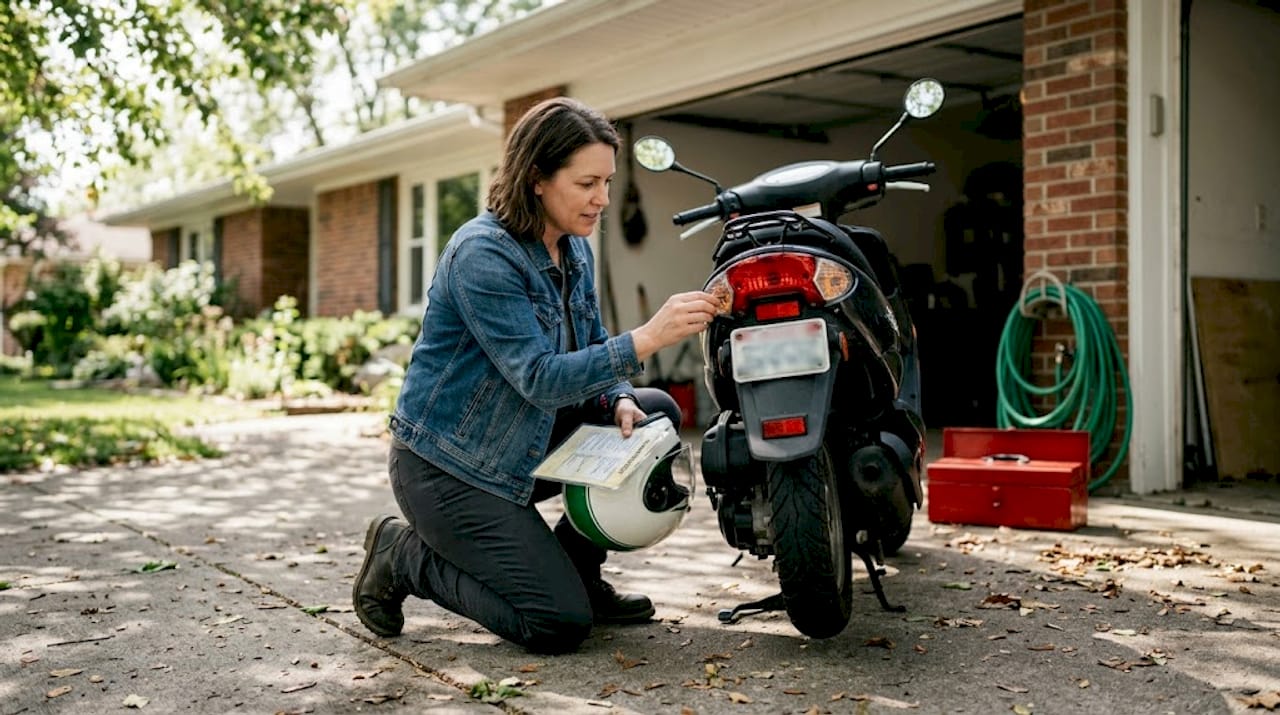
Here’s a quick comparison of street legal versus off-road scooter equipment:
| Feature | Street legal scooter | Off-road scooter |
|---|---|---|
| Headlights | Required | Not required |
| Turn signals | Required | Not required |
| DOT tires | Required | Not required |
| Horn | Required | Not required |
| Mirrors | Required | Not required |
| Registration plate mount | Required | Not required |
The differences are significant. An off-road scooter may look nearly identical to a street legal model but lack the electrical systems and certified components that make public road use lawful.
- Check for a VIN (Vehicle Identification Number) plate, which is required on street legal vehicles
- Look for DOT stamps on tires
- Confirm the scooter has a working electrical system for lights and signals
- Ask the seller for the certificate of origin or title documentation
Pro Tip: Before purchasing any scooter marketed as street legal, photograph the certification labels and run the VIN through your state’s DMV lookup tool. This takes five minutes and can prevent serious legal problems later.
State-level rules build on federal standards. Some states require additional equipment like a rearview mirror on both sides, specific lighting brightness levels, or even a license plate light. Knowing what your state adds on top of federal minimums is just as important as knowing the federal baseline.
Classifications: Electric vs gas-powered scooters
Knowing what equipment is required is only part of the picture. How a scooter is legally classified determines what license you need, whether registration is required, and what roads you can ride on. Classification depends primarily on motor output, top speed, and fuel type.
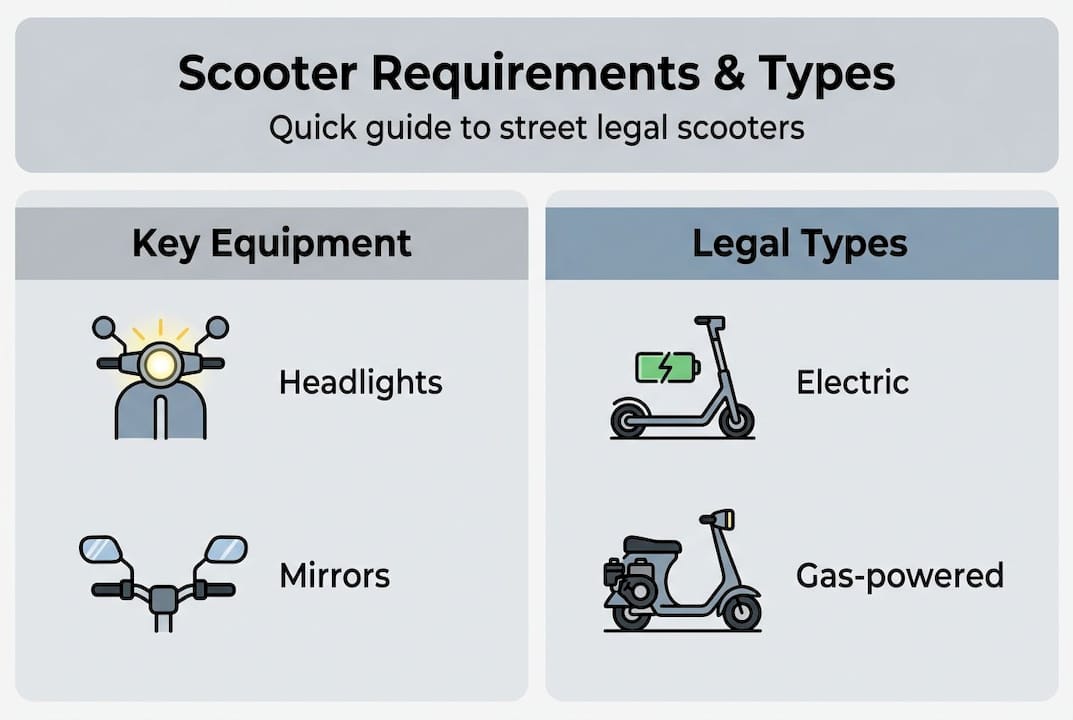
Electric scooters are often classified as micromobility devices when they meet specific thresholds. According to 2026 e-scooter legal guidelines, stand-up electric scooters with a motor at or below 750W and a top speed at or below 20 mph qualify as micromobility in most states. This classification typically means no registration, no license requirement, and no insurance mandate, though rules vary.
For a deeper look at best electric scooters for daily use, it helps to understand these thresholds before comparing models.
Gas-powered mopeds follow a different set of rules. As outlined in moped vs scooter classifications, gas-powered scooters and mopeds typically have engines at or below 50cc, top speeds at or below 30 mph, and in some states, must have pedals to qualify as a moped. Registration, a standard driver’s license, and sometimes insurance are commonly required.
Here’s how the classifications break down:
| Type | Motor/engine | Top speed | License needed | Registration |
|---|---|---|---|---|
| Electric micromobility | 750W or less | 20 mph or less | Usually none | Usually none |
| Gas moped | 50cc or less | 30 mph or less | Standard DL (varies) | Often required |
| Scooter-style motorcycle | Over 50cc or 750W | Over 30 mph | Motorcycle endorsement | Required |
For buyers considering low-speed vehicle buying tips, understanding these thresholds helps narrow the right category before shopping.
Here’s the progression of requirements as scooter power increases:
- Micromobility electric scooter (750W or less, 20 mph or less): Fewest requirements, most accessible for casual commuters
- Gas moped (50cc or less, 30 mph or less): Mid-level requirements, registration common, basic license often needed
- Motorcycle-class scooter (exceeds either threshold): Full motorcycle licensing, registration, insurance, and DOT equipment required
Knowing where your target scooter falls on this scale before you buy prevents surprises at the DMV.
State-by-state legal variations and edge cases
Now that classifications are clear, it’s worth examining how regional laws and edge cases play out in the real world. State laws governing scooters are not uniform, and the differences can be significant enough to affect your buying decision entirely.
According to 2026 e-scooter state laws, 48 out of 50 states allow electric scooters, but Pennsylvania effectively bans them due to registration complications. Adults are generally not required to wear helmets in most states, but minors are almost universally required to wear one. Passengers are typically prohibited on single-rider scooters, and bike lanes are preferred or required in many jurisdictions.
Key state-level variations include:
- Helmet laws: Some states require helmets for all riders; others only for riders under 18
- Age minimums: Several states set a minimum age of 16 or 18 to operate a scooter on public roads
- Lane use rules: Some states restrict scooters to bike lanes or roads below a certain speed limit
- Insurance requirements: Gas mopeds often require liability insurance; electric micromobility scooters usually do not
- Passenger rules: Most states prohibit carrying a passenger on a single-seat scooter
Know before you ride: Some cities and counties layer their own restrictions on top of state law. A scooter legal under state rules may still be banned on certain roads or in specific districts. Always check local ordinances, not just state statutes.
The edge cases matter too. As noted in moped vs motorcycle classification, any scooter exceeding 750W (electric) or over 50cc engine displacement and 30 mph (gas) is generally reclassified as a motorcycle. That reclassification triggers full motorcycle licensing, mandatory registration, insurance requirements, and DOT-compliant equipment across the board.
Pro Tip: If you’re comparing an electric vs gas scooter for commuting, factor in not just the purchase price but the ongoing cost of registration, insurance, and licensing requirements based on your state.
Off-road scooters present their own risks. Riding an off-road model on public streets, even briefly, exposes you to fines and liability issues because these vehicles lack the certified equipment required by federal low-speed regulations. Modified scooters, where someone adds lights after the fact, often don’t meet the certification standards required for legal road use. The modification has to meet the standard, not just look like it does.
A smarter path to affordable commuting: Beyond the basics
Here’s what most buying guides won’t tell you directly: the cheapest scooter to buy is rarely the cheapest scooter to own and ride legally. A low-cost gas moped might save you a few hundred dollars upfront, but once you factor in registration fees, insurance premiums, and the cost of a motorcycle endorsement in some states, that savings disappears quickly.
Electric micromobility scooters, when they fall within the 750W and 20 mph thresholds, often deliver the lowest total cost of ownership for urban commuters. No gas, minimal maintenance, and in most states, no registration or license required. That’s a meaningful advantage if your commute is under 15 miles each way.
That said, we’d encourage you to resist the urge to buy based on classification alone. A scooter that technically qualifies as micromobility but has poor range, weak brakes, or no weather protection may not serve you well in practice. Check the best electric scooters for commuting to compare real-world specs alongside legal classification. Certification labels matter. Practical range matters. And knowing your state’s specific rules before you purchase matters more than anything else on this list.
Explore street legal options and utility vehicles
If you’re ready to move from research to purchase, Import Junkies carries a range of street legal and compliant vehicles worth exploring. Whether you’re looking for an electric option or a gas-powered utility vehicle, the catalog covers a wide range of needs and budgets.

Browse electric golf cart options for low-speed street legal use, or check out the gas utility vehicle selection if you need more power and versatility. For the full range of scooters, carts, ATVs, and specialty vehicles, visit the full vehicle catalog and filter by the type that fits your commute, your state’s rules, and your budget. Buying the right vehicle from the start is always easier than correcting a mistake after the fact.
Frequently asked questions
What are the minimum safety features for a street legal scooter?
A street legal scooter must have headlights, taillights, brake lights, turn signals, a horn, mirrors, and reflectors that meet DOT or FMVSS standards. Missing any of these makes the vehicle non-compliant for public road use.
Do all states require registration and licensing for street legal scooters?
No. Electric scooters under 750W typically do not require registration in most states, but gas-powered mopeds often do. Always verify your state’s specific requirements before riding.
When does a scooter become classified as a motorcycle?
Any scooter exceeding 750W or 50cc engine displacement, or capable of speeds above 30 mph, is generally reclassified as a motorcycle, requiring full licensing, registration, insurance, and DOT-compliant equipment.
Are off-road scooters street legal?
No. Off-road scooters lack the required lights, signals, and DOT-certified tires needed for public road use. Adding aftermarket lights does not automatically make them compliant.
Do minors need helmets to ride street legal scooters?
Yes. While adults are often exempt from helmet requirements in many states, minors are almost universally required to wear a helmet when operating or riding on a scooter.
Recommended
- Street Legal Golf Cart Requirements Explained – Saferwholesale || Import Junkies || Great Sports
- Low Speed Electric Vehicle Buying Guide – Saferwholesale || Import Junkies || Great Sports
- Best Electric Scooter for Commuting – Saferwholesale || Import Junkies || Great Sports
- Four Passenger Electric Golf Car Street Legal LSV Low Speed Vehicle Go – Saferwholesale || Import Junkies || Great Sports


