


 Location
 Login
Login
TL;DR:
- Golf carts are ideal for flat surfaces, short distances, and quiet operation; UTVs handle rough terrain and heavy loads.
- Choose based on your terrain, load needs, and whether street legal features are necessary.
- Hybrid models offer a middle ground but require careful matching to your actual usage demands.
Utility trucks and golf carts might look similar at first glance, especially when both are rolling across a job site or a campground. But treating them as interchangeable is one of the most common and costly mistakes buyers make. The wrong choice can leave you stuck in the mud, literally, or paying for power you never use. Whether you manage a landscaping crew, run a golf course, or just want a reliable vehicle for your property, the differences between these two categories matter more than most guides admit. This article breaks down the real distinctions in performance, functionality, and long-term value so you can buy with confidence.
Table of Contents
- Understanding the basics: What defines a utility truck vs. golf cart?
- Performance showdown: Power, durability, and terrain capabilities
- Functionality for outdoor and business use: What’s best for your needs?
- Nuanced choices and hybrid options: Making the smartest investment
- Our perspective: What most guides miss about choosing the right vehicle
- Explore utility trucks and golf carts for your needs
- Frequently asked questions
Key Takeaways
| Point | Details |
|---|---|
| Know your terrain | Choose utility trucks for rough, demanding environments and golf carts for light, smooth surfaces. |
| Match the load | Heavy hauling and high payloads favor UTVs, while golf carts excel at maneuverable, short trips. |
| Hybrid option value | Hybrid golf carts can fill the gap for moderate needs, but verify compatibility with your daily tasks. |
| Long-term investment | Align your vehicle choice with how you’ll use it most to maximize longevity and return. |
Understanding the basics: What defines a utility truck vs. golf cart?
With the context set, let’s clarify what each vehicle actually does and how it differs from the other.
Golf carts are light-duty vehicles built for flat surfaces, short distances, and low-speed transport. They were originally designed for golf courses and have since expanded into neighborhoods, resorts, warehouses, and recreational properties. Most run on electric motors or small gas engines, and they prioritize smooth, quiet operation over raw power. They are easy to operate, simple to maintain, and generally affordable.
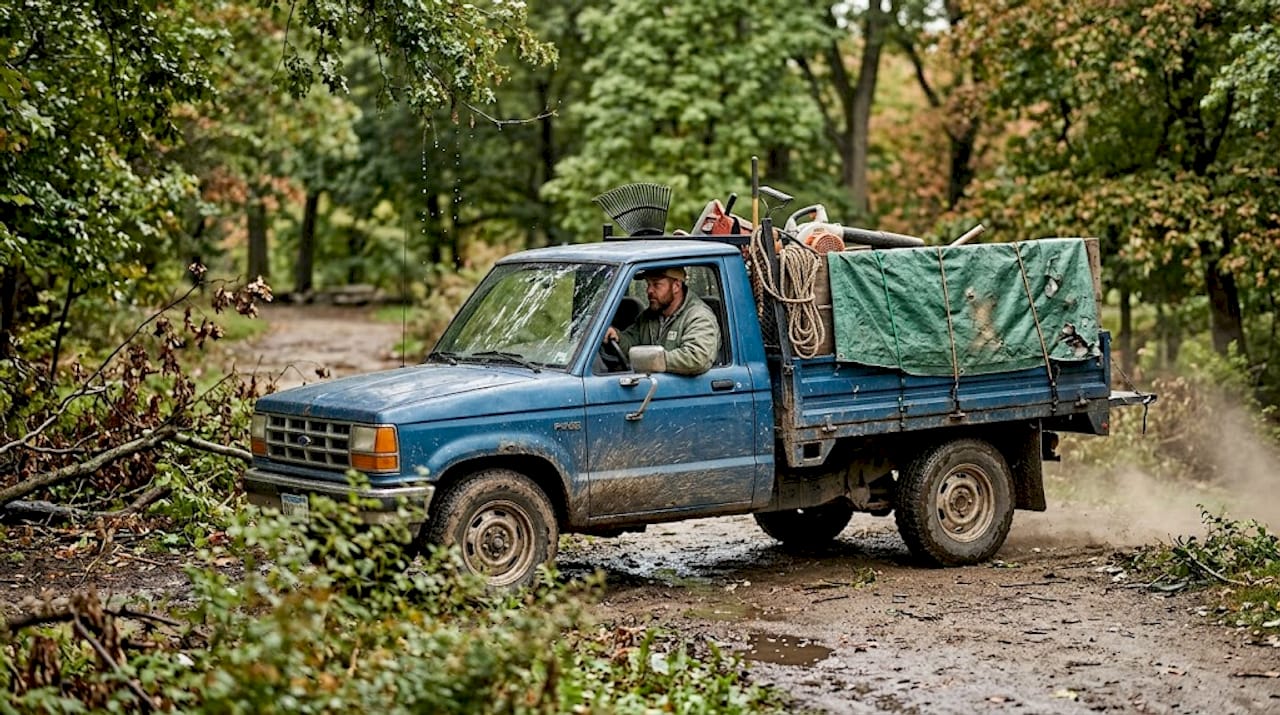
Utility trucks, often called UTVs (utility task vehicles) or commercial utility carts, are a different category entirely. Utility trucks are heavy-duty vehicles designed for industrial, off-road, and rugged terrain use, with engine output ranging from 13 to 15 HP, 4WD capability, ground clearance between 7 and 12 inches, towing capacity from 1,500 to 4,000 lbs, and payload capacity from 800 to 1,600 lbs. That is a significant jump from the typical golf cart, which handles payloads closer to 400 to 600 lbs on flat ground.
The mechanical differences are just as important as the numbers. Golf carts use simple 2-speed transmissions and basic suspension setups, while UTVs rely on CVT (continuously variable transmission) systems, robust multi-link suspension, and roll cages built for operator safety in rough conditions. Understanding golf cart engine types helps clarify why electric golf carts are ideal for quiet, low-maintenance use while gas-powered UTVs are built for endurance.
Here is a quick comparison of the two categories:
| Feature | Golf cart | Utility truck (UTV) |
|---|---|---|
| Engine output | 3-7 HP | 13-15 HP |
| Ground clearance | 3-5 inches | 7-12 inches |
| Payload capacity | 400-600 lbs | 800-1,600 lbs |
| Towing capacity | 500-1,000 lbs | 1,500-4,000 lbs |
| Transmission | 2-speed or direct drive | CVT |
| Safety features | Basic frame | Roll cage, harness |
Key design differences at a glance:
- Golf carts: low ground clearance, light frame, quiet motor, street-legal potential
- UTVs: high clearance, reinforced chassis, roll cage, 4WD, heavy towing
- Golf carts suit flat terrain and short trips; UTVs suit rough terrain and heavy work
Pro Tip: If your primary surface is paved or compacted gravel and your loads stay under 500 lbs, a golf cart will likely serve you better and cost less to operate long-term.
Performance showdown: Power, durability, and terrain capabilities
Now that you know the technical distinctions, let’s see how these vehicles stack up in actual use, especially where performance counts.
Raw numbers only tell part of the story. How a vehicle performs under real conditions, with a full load, on uneven ground, or over a long shift, is what separates a smart buy from a regrettable one.
Golf carts are purpose-built for controlled environments. They handle flat surfaces and short distances efficiently, and their electric versions are nearly silent, which matters in residential areas or indoor facilities. But push them outside their design parameters and problems follow. Golf carts fail on rough terrain and heavy loads, with frame damage risk increasing significantly when used outside their intended operational area. Electric golf carts also lose range in cold weather, which is worth factoring in if you operate year-round in northern climates.
UTVs flip that equation. They are built to absorb punishment, handle steep inclines, and carry heavy loads across unpredictable surfaces. Gas-powered UTVs are especially well-suited for extended uptime because you refuel in minutes rather than waiting hours for a charge. That matters when you are running multiple shifts or working in remote locations without charging infrastructure.
Here is how the two vehicles compare across key performance metrics:
| Performance factor | Golf cart | Utility truck (UTV) |
|---|---|---|
| Top speed | 15-25 mph | 25-60 mph |
| Terrain handling | Flat/paved only | Off-road, steep, rough |
| Load endurance | Low | High |
| Cold weather range | Reduced (electric) | Consistent (gas) |
| Noise level | Low | Moderate to high |
| Refuel/recharge time | Hours (electric) | Minutes (gas) |
Where each vehicle excels and where it falls short:
- Golf carts excel at quiet, low-speed transport on flat surfaces for short distances.
- UTVs excel at hauling heavy loads, navigating rough terrain, and operating for extended periods.
- Golf carts become a liability when used for sports equipment transport across uneven outdoor fields.
- UTVs become overkill and expensive to operate when the job only requires light, flat-surface transport.
A UTV on a smooth warehouse floor is like using a pickup truck to deliver mail. It works, but you are burning more fuel and budget than the task requires.
Before you finalize your decision, review a utility vehicle checklist to make sure your choice aligns with your actual operating conditions.
Pro Tip: If you operate in both flat and rough terrain environments, consider keeping one vehicle type for each context rather than forcing one vehicle to do both jobs poorly.
Functionality for outdoor and business use: What’s best for your needs?
Having compared raw performance, let’s turn to day-to-day utility, what do these vehicles offer for your outdoor lifestyle or business tasks?
The right vehicle depends heavily on your primary environment and the tasks you repeat most often. A golf course superintendent has different needs than a campground operator or a landscaping company owner. Golf carts excel in maneuverability, street-legality as LSVs or NEVs, quiet operation, and short trips, while UTVs are the better choice for hauling, off-road work, and heavy-duty tasks, though they are louder and less likely to qualify for street use.
Here is how each vehicle maps to common use cases:
Golf carts work best for:
- Golf courses and resort properties with paved or groomed paths
- Neighborhood and community transport where noise and speed limits apply
- Indoor warehouse or facility transport with smooth floors
- Event venues, campgrounds, and short-range personal transport
- Any situation where street legal golf cart rules allow road access as an LSV or NEV
Utility trucks work best for:
- Landscaping, construction, and agricultural operations
- Properties with hills, mud, gravel, or unpaved terrain
- Hauling tools, materials, or equipment over longer distances
- Situations requiring towing capacity above 1,000 lbs
For small business owners, the operating environment is the deciding factor. A pest control company working suburban neighborhoods may find a golf cart more practical than a UTV because it fits in driveways, runs quietly, and can carry a standard equipment load. A ranch operation or outdoor event company dealing with uneven terrain and heavy gear will find a UTV essential.
Street legality is a real consideration that many buyers overlook until it is too late. Many municipalities allow golf carts on public roads when modified to meet Low Speed Vehicle (LSV) or Neighborhood Electric Vehicle (NEV) standards. Most UTVs do not qualify without significant modification and registration costs. Review the commercial vehicle selection guide if you need help mapping your use case to the right vehicle category.
Nuanced choices and hybrid options: Making the smartest investment
Before you choose, let’s go beyond basic comparisons to strategic choices, what do experts and innovations reveal?
Not every buyer fits neatly into the golf cart or UTV category. There is a growing middle ground, and understanding it can save you from overspending or underbuying.
Hybrid utility golf carts bridge the gap between light-duty golf carts and full UTVs, offering moderate terrain handling and improved payload capacity without the full cost or complexity of a heavy-duty UTV. They are a practical option for buyers who need more than a standard golf cart but do not have the terrain demands or budget for a true UTV. That said, UTVs remain superior for demanding use cases, and no hybrid should be marketed as a full replacement if your work involves serious off-road conditions.
Long-term value comes down to matching the vehicle to your duty cycle, meaning the specific tasks, terrain, and frequency of use that define your typical workday or weekend. A vehicle that is slightly underpowered for your needs will wear out faster and cost more in repairs. A vehicle that is significantly overpowered will drain your budget in fuel, maintenance, and depreciation without adding proportional value.
Key questions to ask before you buy:
- What is the primary surface you will operate on most days?
- What is the maximum load you will carry regularly, not just occasionally?
- Do you need street access, and does your local ordinance permit it?
- How many hours per day will the vehicle be in use?
- Is charging infrastructure available, or do you need a gas-powered option?
Consider a hybrid golf cart if your terrain is moderate and your loads are in the mid-range. It may cover 80% of your needs at a fraction of the UTV cost.
Pro Tip: Avoid buying for your worst-case scenario. Buy for your most common scenario, and rent or contract out for the rare heavy-duty jobs that fall outside your vehicle’s range.
Our perspective: What most guides miss about choosing the right vehicle
Having covered everything from basics to nuanced options, here is our hard-won perspective to empower your choice.
Most buyer guides focus on spec sheets and feature lists. They tell you what each vehicle can do at its maximum capacity. What they rarely address is what you will actually do with the vehicle on a typical Tuesday.
We see buyers overbuy constantly. They read about a UTV’s 4,000 lb towing capacity and imagine every possible scenario where that might come in handy. Then the vehicle sits mostly idle because 90% of their work involves moving light loads across flat ground. That is money parked in the garage.
The smarter approach is to audit your real workload before you shop. Track what you actually haul, how far, and over what terrain for two weeks. The data will almost always point to a clearer answer than any spec comparison. Hybrid models are genuinely underrated for moderate use, but be skeptical of any model marketed as an all-purpose solution without clear performance data to back it up. Use practical buyer tips to structure your evaluation before committing.
Explore utility trucks and golf carts for your needs
Ready to put this knowledge to work? Here is where you can find the right vehicle for your unique needs.
At Import Junkies, we carry a curated selection of vehicles built for both recreational and operational use, so you are not forced to choose between value and performance. If your needs fall in the moderate range, the 48V electric golf cart utility model offers a strong balance of payload, range, and maneuverability. For demanding terrain and heavy-duty tasks, the 400cc 4x4 UTV with dump bed delivers the power and capability serious work requires.

Browse both categories directly on our site to compare specs, pricing, and availability. Our product listings include detailed performance data so you can match the vehicle to your actual duty cycle, not just your wishlist.
Frequently asked questions
Can a golf cart safely handle heavy loads or rough terrain?
Golf carts are not suited for heavy loads or rough terrain, as frame damage risk increases significantly when they are used outside their designed operational parameters. Stick to flat surfaces and loads within the manufacturer’s rated payload capacity.
Are utility trucks street legal like golf carts?
Most utility trucks are not street legal without significant modification, whereas many golf carts can qualify for road use as LSVs or NEVs with relatively minor upgrades. Always check your local ordinances before assuming either vehicle is road-ready.
What are the main maintenance concerns for each vehicle type?
Golf carts require battery management or engine upkeep and lose range in cold weather if electric, while gas UTVs offer more consistent uptime but need regular drivetrain and suspension service. Match your maintenance capacity to the vehicle’s service requirements before buying.
Is a hybrid vehicle a good alternative for moderate terrain?
Hybrid golf carts bridge the gap for moderate terrain and load demands, but verify that the specific model’s specs align with your typical usage rather than relying on general marketing claims.
Recommended
- Electric Golf Cart vs Gas: Which Wins? – Saferwholesale || Import Junkies || Great Sports
- Why choose electric golf carts? Benefits for golfers and courses – Saferwholesale || Import Junkies || Great Sports
- Best Golf Cart for Neighborhoods: What to Buy – Saferwholesale || Import Junkies || Great Sports
- Lifted golf carts: benefits, types, and how to choose – Saferwholesale || Import Junkies || Great Sports
- Specialty vehicle rental: Guide for efficient operation & automation | Nomora
- Kamioncina në Shitje Shqipëri: Udhëzues Blerje | CarPulse.al | CarPulse Albania


