


 Location
 Login
Login
TL;DR:
- Choosing the right utility terrain vehicle depends on matching features like drivetrain flexibility, towing capacity, and safety gear to your specific needs. Essential considerations include selectable 2WD/4WD modes with differential lock, a durable cargo bed, effective suspension, and safety equipment such as roll cages and harnesses. Budget, use case, and desired accessories like winches and street-legal equipment should guide your purchase to ensure durability, utility, and compliance.
Choosing the right utility terrain vehicle (UTV) — also commonly called a side-by-side — takes more than picking the best-looking model on the lot. The must-have features in UTVs vary significantly depending on whether you plan to haul equipment across a farm, tackle rocky trails on weekends, or do both. Get this decision wrong and you end up with a machine that’s either underpowered for your work or overbuilt for your budget. This guide breaks down every feature category that matters, so you can match the right specs to your actual needs before you spend a dollar.
Table of Contents
- Key Takeaways
- 1. Must-have features in UTVs start with drivetrain and traction control
- 2. Towing and hauling capacity
- 3. Suspension and ground clearance
- 4. Engine output and top speed
- 5. Essential safety features for UTVs
- 6. Street-legal equipment requirements
- 7. Winch and hitch capabilities
- 8. Electric power steering and undercarriage protection
- 9. Cargo bed lighting and accessory power outlets
- 10. Feature comparison by use case
- 11. Buying tips for different budgets
- My take on what actually matters when you buy a UTV
- Find the right UTV at Importjunkies
- FAQ
Key Takeaways
| Point | Details |
|---|---|
| Drivetrain flexibility matters most | Selectable 2WD, 4WD, and differential lock modes handle varied terrain far better than a single-mode system. |
| Safety gear is non-negotiable | Roll cages, harnesses, and seat belts protect occupants and are increasingly required by state law. |
| Street-legal prep requires specific equipment | About 20 states allow UTVs on public roads, but only with horns, mirrors, lighting, and a windshield. |
| Use case shapes your feature list | Utility buyers should prioritize towing and cargo capacity; recreation-focused riders should prioritize suspension and handling. |
| Convenience features become essential | Cargo lighting, accessory power outlets, and electric power steering pay off quickly in real-world daily use. |
1. Must-have features in UTVs start with drivetrain and traction control
No other feature affects daily performance more directly than how power reaches the ground. Selectable driveline modes — 2WD, 4WD, and 4WD with differential lock — give you the flexibility to shift between fuel-efficient cruising on firm ground and maximum traction in mud, snow, or steep inclines. Without that range of options, you are either burning fuel unnecessarily or getting stuck when conditions change.
Differential lock is the feature many first-time buyers overlook. Standard 4WD still allows wheels to spin independently, which can be a problem when one side loses contact with the ground. Differential lock forces all four wheels to turn together, which is what you actually need when crossing creek beds or working on uneven slopes.
Pro Tip: If you are buying a UTV for property work, confirm that diff lock engages at low speed and disengages automatically at higher speeds. Some budget models require manual disengagement, which creates a handling hazard on firm ground.
2. Towing and hauling capacity
Towing and payload specs separate genuine work machines from recreational vehicles with a truck bed glued on. The 2026 John Deere Gator TE 4x2 tows up to 600 lbs, which is a useful reference point for light property tasks. Mid-range utility UTVs typically handle between 1,500 and 2,000 lbs of towing capacity, while heavy-duty models push past that. Bed payload capacity is a separate number and equally important. Many models advertise towing but fall short on usable cargo bed weight.
Look for a tilt-bed design if you plan to use the cargo area regularly. Dumping loose materials manually wastes time and puts strain on your back. A hydraulic or hand-actuated tilt bed changes how useful the vehicle actually is. According to utility-focused buyer guidance, work-focused UTVs prioritize reliable towing, durable drivetrains, and heavy-duty cargo beds over raw horsepower numbers.
3. Suspension and ground clearance
Suspension is where recreational and utility needs converge. A poorly tuned suspension makes rough terrain punishing for both the operator and the cargo. For trail riding, you want independent rear suspension with enough travel to absorb large hits without bottoming out. For farm or property use, you want a system that stays planted under load and does not wallow when the bed is full.
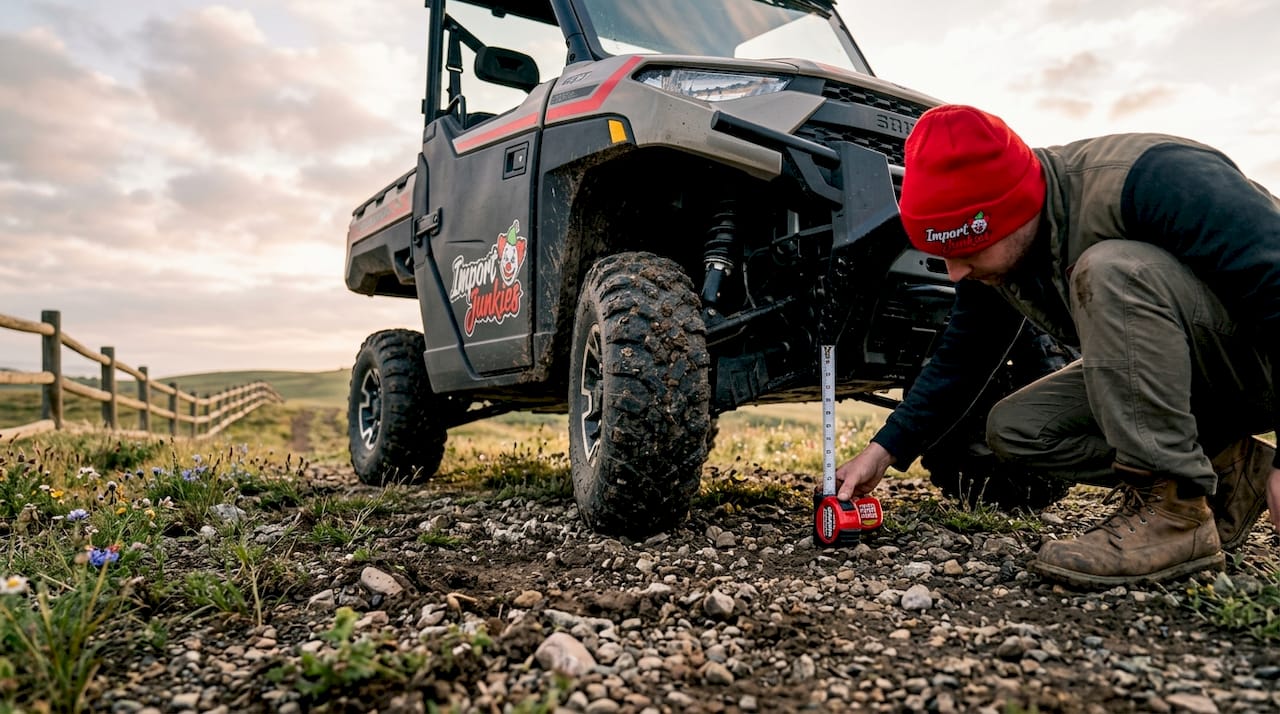
Ground clearance matters just as much. Most capable UTVs offer between 10 and 14 inches of clearance. Below 10 inches and you start compromising on rocky or root-covered trails. Check the stated clearance with a full load, not just empty. Some manufacturers list clearance at curb weight only, which paints a more favorable picture than real-world use delivers.
4. Engine output and top speed
Top speed is often the first spec buyers compare, but it is rarely the most useful one for daily tasks. The Honda Pioneer 700-4 tops out around 45 mph with selectable drive modes. That is a practical ceiling for most work and trail applications. Sport models can reach 70+ mph, but those speeds rarely make sense outside of designated performance areas.
What matters more than top speed is low-end torque and throttle response under load. A UTV that feels strong at 15 mph while pulling a trailer is worth more than one that screams to 60 mph empty. If you plan to use your UTV for property maintenance tasks, prioritize torque specs over peak speed ratings.
5. Essential safety features for UTVs
Safety equipment is where many buyers cut corners and regret it fast. A full roll cage is non-negotiable. Beyond that, consider these layered protection features:
- Four-point harnesses or three-point seat belts secured to the roll cage frame
- Nets or doors on the cab opening to prevent limb ejection during a rollover
- Fire extinguisher mount within reach of the driver
- First aid kit storage in a weatherproof compartment
- Helmet compatibility with the roof clearance of the cage design
The roll cage, harnesses, and helmets are critical across both off-road and trail environments, and trail operators in many states require them as a condition of entry. Starting June 2026, seat belt use in UTVs is mandatory in certain regions, so checking local regulations before you buy is worth doing now rather than after delivery.
6. Street-legal equipment requirements
Approximately 20 states permit UTVs on most roads with proper equipment installed. If you want that flexibility, you need more than a roll cage. The standard street-legal equipment list includes a horn, side mirrors, turn signals, brake and tail lights, headlights, a license plate light, and a windshield. Some states also require DOT-rated tires, insurance, and registration paperwork specific to UTVs.
Street-legal compliance is not optional for dual-use riders who want to cross public roads between trails or properties. Equipment you bolt on later often costs more than factory-installed options, so if street use is in your plans, look for models that come pre-equipped or have a street-legal package available from the manufacturer. Laws vary by county and city as well, so a vehicle legal in a rural county may need additional equipment inside city limits.
7. Winch and hitch capabilities
A winch does two things: it pulls you out when you are stuck, and it helps you move heavy objects without manual labor. A 4,500-lb winch paired with 12-volt accessory outlets and factory cargo lighting represents a strong baseline for utility work, as demonstrated by the Honda Pioneer 700-4’s feature set. For buyers who plan to use their UTV in remote terrain, a winch is not a luxury. It is recovery insurance.
A rear receiver hitch expands what your UTV can do significantly. Trailers, log skidders, and spreader attachments all connect through a standard 2-inch receiver. Check that the hitch is rated for your expected tongue weight, not just the overall towing capacity figure. And look for a front hitch receiver as well if you plan to run a plow blade in winter months.
8. Electric power steering and undercarriage protection
Electric power steering with torque assist reduces operator fatigue significantly on longer rides or extended work sessions. Without it, heavy terrain feedback transfers directly to the steering wheel, which wears you down faster than you expect. EPS also improves control at low speeds when maneuvering in tight spaces, like loading areas or wooded trails.
Undercarriage protection, specifically skid plates under the engine, transmission, and differentials, is what stands between your drivetrain and a field of sharp rocks. Factory skid plates are often thin. Aftermarket steel or HDPE skid plate kits add real protection without excessive weight. Buyers expecting to use their vehicle in mixed terrain applications should treat upgraded underbody protection as a standard addition rather than an optional upgrade.
9. Cargo bed lighting and accessory power outlets
Features like cargo lighting and accessory power outlets can feel secondary until you find yourself unloading equipment in the dark or trying to power a sprayer at the far end of a property. Cargo lighting and power outlets become essential for users working in low-light conditions or powering tools in the field. Factory-installed LED bed lighting is cleaner and more weatherproof than aftermarket clip-on lights. A 12-volt outlet in the bed is a different circuit from a cab outlet, and not all models include both. Verify both locations before purchase.
For riders who want to extend trail visibility or enhance safety at night, flexible LED lighting strips designed for rough terrain are worth exploring as a supplementary accessory. These mount to the bed frame or undercarriage and handle vibration far better than standard LED bars.
10. Feature comparison by use case
The essential UTV features you prioritize depend heavily on how you intend to use the vehicle. Here is how the priorities break down across three common buyer profiles:
| Feature | Utility / Work | Recreation / Trail | Mixed Use |
|---|---|---|---|
| Towing capacity | Critical | Low priority | Important |
| Suspension travel | Moderate | Critical | Important |
| Differential lock | Critical | Helpful | Critical |
| Cargo bed with tilt | Critical | Low priority | Important |
| Winch | Important | Important | Critical |
| Street-legal package | Helpful | Situational | Important |
| EPS | Helpful | Important | Critical |
| Top speed rating | Low priority | Important | Moderate |
| Skid plate protection | Important | Critical | Critical |
Utility buyers prioritize towing and cargo features while performance-focused riders focus on suspension and handling. Mixed-use buyers need both columns covered without paying for extreme specs in either direction. This table gives you a shortcut for filtering models that fit your actual needs rather than the most popular spec sheet.
11. Buying tips for different budgets
Knowing what to look for in UTVs is useful. Knowing how to filter that list against your budget is what actually leads to a good purchase. Consider these practical filters:
- Under $10,000: Focus on drivetrain reliability, basic 4WD, and a solid roll cage. Skip premium suspension and EPS. These can be added later.
- $10,000 to $20,000: Expect EPS, diff lock, and a decent cargo bed. Verify whether street-legal features are included or available as a package.
- $20,000 and above: You have access to long-travel suspension, larger towing ratings, and factory-installed winch and lighting. Confirm the accessory ecosystem is strong before committing.
Pro Tip: Before you finalize any purchase, check the availability of aftermarket parts and accessories for that specific model. A UTV with a thriving parts network stays on the road longer and costs less to maintain over time. A model with limited parts support becomes a liability fast.
Also look at the utility vehicle checklist before you finalize a decision. It helps you cross-reference your needs against specific feature availability in a structured way.
My take on what actually matters when you buy a UTV
I have spent time evaluating UTVs across farm work, trail riding, and mixed-use scenarios, and the single biggest mistake I see buyers make is shopping by horsepower and price alone. Those two numbers grab attention, but they tell you almost nothing about whether the vehicle will hold up to your specific demands.
In my experience, drivetrain flexibility and undercarriage protection determine how long a UTV stays useful. A machine with diff lock and real skid plates will outwork a higher-horsepower model that sits low and runs two-wheel drive half the time. I have seen expensive UTVs with flimsy factory skid plates develop drivetrain damage in their first season because the buyer assumed price meant durability.
The other misconception I see regularly is treating safety gear as an add-on decision. Roll cages and harnesses should be assessed during the vehicle evaluation, not after delivery. If a model’s cage design limits your helmet clearance or makes entry and exit awkward, that is a real problem you will feel every single time you use it. Safety features are part of the vehicle, not accessories you bolt on when it feels convenient.
My honest advice: build your feature list around your use case first, then find the models that meet it. You will spend less, get more utility, and avoid the regret of owning a machine that was never right for the job.
— Gary
Find the right UTV at Importjunkies
Importjunkies carries a range of utility vehicles built around the features discussed in this guide. Whether you need a work-ready machine with a plow and dump bed or a compact off-road vehicle for property tasks, there are options priced for real buyers.
The Snow Master VX is a strong example: a 400cc 4x4 utility vehicle with a factory snow plow and VX dump bed, covering the towing, hauling, and seasonal use cases in a single platform. For buyers who want a more compact form factor, the Snow Puncher Crusade delivers utility-focused capability in a tighter package. Browse the full selection at Importjunkies and filter by the features that match your specific needs.
FAQ
What are the most important features to look for in a UTV?
The most important features depend on your use case, but drivetrain flexibility (2WD, 4WD, differential lock), towing and cargo capacity, a full roll cage with harnesses, and suspension suited to your terrain cover the essentials for most buyers.
Do UTVs need to be street legal?
Not for off-road use, but if you plan to cross or travel on public roads, approximately 20 states permit UTVs on roads with required equipment including a horn, mirrors, lighting, and a windshield installed.
Is electric power steering worth it on a UTV?
Yes, especially for work use or longer rides. EPS reduces steering effort and operator fatigue significantly, and it improves low-speed maneuverability in tight terrain where heavy feedback would otherwise make the vehicle tiring to control.
What towing capacity do I need in a utility UTV?
Light property tasks are manageable with 600 to 1,000 lbs of towing capacity. For heavier farm or construction work, look for models rated at 1,500 lbs or more. Always check bed payload capacity separately from the towing figure.
Are winches standard on most UTVs?
No. Winches are offered as factory options or popular aftermarket additions. For remote terrain or recovery use, a 3,500 to 4,500-lb rated winch is a practical starting point and pairs well with a front receiver hitch if you also run seasonal attachments.
Recommended
- The ultimate utility vehicles checklist for smart buyers – Saferwholesale || Import Junkies || Great Sports
- What is a UTV? Complete guide to utility terrain vehicles – Saferwholesale || Import Junkies || Great Sports
- Best UTV for Property Maintenance – Saferwholesale || Import Junkies || Great Sports
- Your guide to every type of off-road vehicle – Saferwholesale || Import Junkies || Great Sports


