


 Location
 Login
Login
TL;DR:
- Three-wheeled vehicles, or trikes, vary significantly in purpose and design, from pedal trikes to full motorcycle builds, demanding careful selection based on intended use. Understanding differences in layout, power source, and legal classification is essential to choosing the right trike for mobility, recreation, or cargo hauling needs. The expanding popularity of electric and utility models highlights trikes’ growing role in personal transportation and commercial sectors, offering stability, accessibility, and community engagement.
Three-wheeled vehicles go by many names, and that’s exactly where most buyers get stuck. Call it a trike, a tricycle, or a three-wheeler, and you could be talking about a leisurely pedal bike, a powerful road-legal motorbike, or a cutting-edge electric cargo hauler. Each of these serves a genuinely different purpose, and choosing the wrong one means spending money on something that doesn’t fit your life. This guide covers the core definitions, layout differences, real-world benefits and drawbacks, and what to look for when you’re ready to buy.
Table of Contents
- Defining a trike: What makes it different from a tricycle or three-wheeled motorcycle?
- The main types of trike vehicles explained
- Trike vehicle layouts: Delta vs. tadpole and why it matters
- Key benefits and drawbacks of trikes compared to other vehicles
- Choosing the right trike for you: Use cases and buyer tips
- Our perspective: The trike advantage beyond the basics
- Ready to explore trike vehicles? Shop top models
- Frequently asked questions
Key Takeaways
| Point | Details |
|---|---|
| Trikes are three-wheeled | A trike vehicle simply has three wheels, and can be pedal, electric, or gas-powered. |
| Types suit different uses | Pedal trikes, electric trikes, and motorcycle trikes serve recreation, mobility, and even delivery roles. |
| Layout affects stability | Delta and tadpole layouts change how a trike handles, especially when turning or stopping. |
| Safer but not risk-free | Trikes are more stable at low speeds than two-wheelers but require care, especially in corners. |
| Match features to needs | Choose a trike based on your mobility, comfort, and intended use for the best experience. |
Defining a trike: What makes it different from a tricycle or three-wheeled motorcycle?
With the confusion around names and styles, let’s start by defining what truly makes a trike vehicle. At the most basic level, a trike is a three-wheeled vehicle, and that definition applies whether you’re talking about a child’s plastic toy, a senior’s mobility aid, or a roaring motorized cruiser. The word “trike” is simply a shortened form of tricycle, but in adult and recreational contexts, it almost always refers to a motorized or electric version rather than a pure pedal-powered ride.
The confusion deepens because the term “trike” can mean non-motorized tricycles, electric-assisted mobility e-trikes, and full three-wheeled motorcycles that are road-legal motor vehicles. All three share the three-wheel foundation but differ dramatically in speed, power, licensing requirements, and intended use.
“A trike is defined by its three-wheel foundation, but the real differences come from how it’s powered, how it’s built, and what it’s designed to do.”
Understanding that distinction upfront saves you from making a purchase that doesn’t match your actual needs. Here are the main trike types you’ll encounter in the market today:
- Pedal-powered tricycles: Human-powered, no motor, commonly used for light recreation or local errands
- Electric trikes (e-trikes): Battery-powered motor assists or replaces pedaling, used for mobility, recreation, and cargo delivery
- Three-wheeled motorcycles: Gas or electric engine, road-legal in most states, designed for touring and highway use
- Utility trikes: Heavy-duty builds for commercial delivery, hauling, or farm use, often electric-powered
For a broader look at what separates these categories before you buy, the trike buyer guide breaks down the key decision points in practical detail.
The main types of trike vehicles explained
Now that you know the definition, let’s break down the core types of trikes you’ll encounter. Power source is the first thing to sort out because it shapes everything else, from how fast you go, to where you can legally ride, to how much maintenance you’ll deal with over time.
Electric trikes are three-wheeled vehicles powered by an electric motor, often paired with pedal-assist technology that makes them popular for urban commuting and short-range delivery work. They’re quiet, low-maintenance, and increasingly available in cargo configurations that can replace a small van for last-mile delivery.
Here’s a side-by-side comparison to help you see the differences clearly:
| Feature | Pedal trike | Electric trike | Motorcycle trike |
|---|---|---|---|
| Power source | Human pedaling | Electric motor/battery | Gas or electric engine |
| Top speed | 10–15 mph | 15–28 mph | 60–90+ mph |
| Typical use | Recreation, fitness | Commuting, cargo, mobility | Touring, road travel |
| License required | No | No (most states) | Yes (motorcycle license) |
| Maintenance level | Low | Low to moderate | Moderate to high |
| Cost range | $300–$1,500 | $800–$5,000+ | $8,000–$30,000+ |
To match a trike type to your actual situation, work through these four questions:
- Do you need motorized assistance? If you have joint issues, limited stamina, or plan to cover longer distances regularly, an electric trike will serve you far better than a pedal-only model.
- Are you hauling cargo? Commercial delivery or regular shopping runs call for a cargo-spec electric trike, like the electric cargo trike, which is built for load capacity, not just personal transport.
- Do you want highway-capable speed? If you plan to ride on public roads alongside cars, you’ll need a full motorcycle trike, which requires proper registration and a motorcycle endorsement in most states.
- Is fitness a factor? Pedal-assisted trikes, including the fat tire electric trike, let you choose how much effort you put in, making them a solid option for riders who want light exercise with the security of a motor backup.
Getting this right from the beginning avoids a lot of frustration. Buying an underpowered pedal trike when you need cargo capacity, or investing in a full motorcycle trike when you only need a neighborhood cruiser, are both common and costly mistakes.
Trike vehicle layouts: Delta vs. tadpole and why it matters
Trike types are only the beginning. The way a trike is built, specifically its wheel layout, seriously affects your experience on the road or trail. There are two standard configurations in use today, and they behave very differently.
The key distinction is this: three wheels can be arranged as delta (one front wheel, two rear wheels) or tadpole (two front wheels, one rear wheel), and that arrangement changes steering feel, stability, and how the vehicle handles corners.
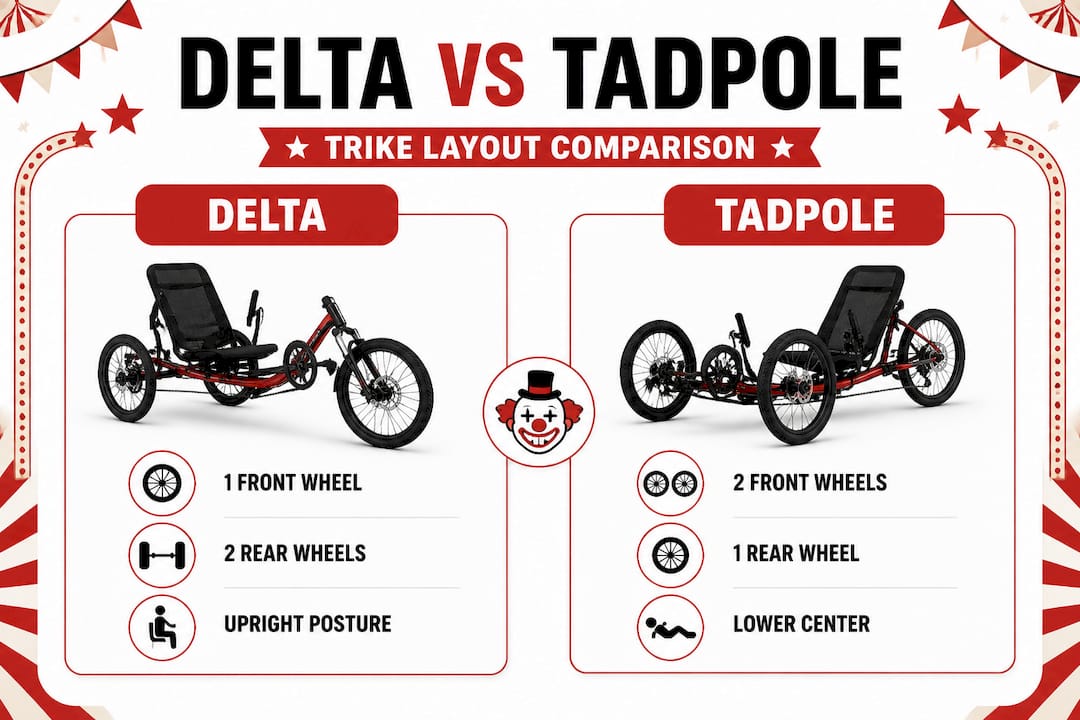
| Layout | Wheel position | Steering type | Best for |
|---|---|---|---|
| Delta | 1 front, 2 rear | Rear-drive, lean-friendly | Casual riding, mobility, upright posture |
| Tadpole | 2 front, 1 rear | Front-steer, lower center of gravity | Cornering performance, speed, sport riding |
Delta layout is what most people picture when they think of a classic tricycle. One wheel handles steering in front, while two wheels provide a stable platform in the rear. This design is easier to get on and off, especially for riders with limited mobility. It also feels more familiar because it mimics the steering of a bicycle. The tradeoff is that at higher speeds, the rear-heavy design can feel unstable in sharp corners.
Tadpole layout puts two wheels upfront, which dramatically lowers the vehicle’s center of gravity. That makes it much more confident in tight turns and at higher speeds. Many performance-oriented recumbent trikes and some electric sport models use this layout. The downside is that mounting and dismounting can be trickier, and the seated position is often reclined, which takes some adjustment.
Pro Tip: If you can, test ride both layouts before committing to a purchase. The difference in how they handle low-speed turns, stops, and acceleration is noticeable immediately, and personal preference plays a real role in which one you’ll enjoy long-term.
For buyers looking at full motorcycle-style options, reviewing the motorcycle trike layouts section of our buyer guide goes into further depth on how manufacturers approach this for road-legal builds.
Key benefits and drawbacks of trikes compared to other vehicles
Understanding the mechanics is important, but what about the real-world pros and cons of owning or using a trike? Here’s what actually matters when you’re weighing a trike against a standard bicycle or two-wheeled motorcycle.
Benefits of trikes:
- Stability at stops: Unlike a bicycle or motorcycle, a trike doesn’t require balancing at a standstill. This is a significant advantage for older riders, those returning from injury, or anyone who finds two-wheeled balance challenging.
- Comfort on longer trips: Most trike designs support an upright or semi-reclined posture, reducing strain on the lower back and wrists compared to a traditional bike.
- Easier cargo carrying: The stable platform makes it practical to add rear baskets, cargo boxes, or front storage without worrying about the vehicle tipping under load.
- Accessibility: Trikes make cycling and motorized riding available to people who can’t safely manage a two-wheeled vehicle due to age, disability, or medical condition.
- Distinctive presence: On the road or trail, trikes naturally stand out. For personal or commercial use, that visibility can be a real advantage.
Drawbacks to know before you buy:
- Larger turning radius: Two rear wheels mean wider turns, which can be awkward in tight parking lots or narrow trails.
- Less agility at speed: A two-wheeled motorcycle outperforms a trike in quick lane changes and rapid directional shifts. If you prioritize dynamic handling, a trike may feel sluggish.
- Still carries crash risk: Three-wheeled motorcycles are discussed as potentially more stable than two-wheeled motorcycles at low speeds and stops, but crash vulnerability still exists, particularly in aggressive cornering or on uneven road surfaces.
- Storage and transport: Trikes are wider than bicycles and harder to load into a standard truck bed or store in a small garage.
Pro Tip: Before you ride on public roads, check your state’s specific laws. Some states classify certain trikes as motorcycles requiring a license and registration; others classify them as bicycles or low-speed vehicles. This affects where you can legally ride and what safety gear is required. A quick look at scooter vs. trike models can also help you understand where the legal lines tend to fall between these vehicle classes.
Choosing the right trike for you: Use cases and buyer tips
With your options and their pros and cons in mind, how do you narrow down which trike fits you best? The clearest path forward is matching your primary use case to the right trike category, and then checking off the practical details from there.
-
Identify your primary need first. Are you looking for personal mobility support, recreational riding, a fitness-focused activity, or a commercial transport solution? Each of these has a different ideal trike type. A senior looking for a stable neighborhood cruiser needs a very different product than a small business owner handling last-mile deliveries.
-
Match need to type. Mobility support and recreational riding are well-served by electric trikes with pedal-assist. Fitness-focused riders often choose pedal-only or lightly assisted models to control how much physical effort they put in. Urban delivery and commercial cargo use cases are best handled by purpose-built electric cargo trikes with dedicated load capacity. Touring and road travel at highway speeds require a full motorcycle trike with proper licensing.
-
Set a realistic budget that includes ongoing costs. A budget electric trike might cost $800 to $1,500 upfront, but factor in battery replacement (typically every 2 to 4 years), tire costs, and any accessory upgrades. Motorcycle trikes carry higher upfront costs and ongoing maintenance, fuel (for gas models), and insurance expenses.
-
Check local regulations before purchase. As noted above, the term trike covers non-motorized tricycles, e-trikes, and full motorcycle-class vehicles. Each category may be subject to different laws in your state, and this affects where you can ride, whether you need a license, and what safety equipment is mandatory.
-
Prioritize a test ride. Specs on paper don’t always translate to a comfortable real-world experience. Seat height, handlebar reach, brake sensitivity, and the overall feel of the vehicle vary widely across models.
“Always verify local registration requirements and test ride any trike before buying. What works for a rider in one state or one physical condition may not suit another.”
For practical guidance on narrowing down your final choice, the expert trike tips available on our blog walk through real-world buying scenarios in detail.
Our perspective: The trike advantage beyond the basics
Before you take your next step, here’s our take on why the trike’s appeal is bigger than many realize. Most articles frame trikes as a compromise, something you choose when you can’t manage two wheels or don’t want to deal with a full car. We think that framing misses the point entirely.
Trikes are opening up active, independent transportation to a much wider group of people. Riders who stopped cycling years ago due to balance concerns, joint issues, or a fear of falls are coming back to the road on electric trikes. That’s not a compromise; that’s a genuine expansion of personal freedom. The stability of three wheels removes the anxiety that keeps a lot of adults off bikes entirely, and when you add electric assist, the vehicle becomes practical for distances that would have been too much on a pedal bike.
The commercial side of trikes is also evolving faster than most buyers realize. Electric cargo trikes are replacing short-haul delivery vehicles in urban settings, with operating costs significantly lower than a van and the ability to access routes a four-wheeled vehicle can’t. Small business owners who have made this switch often describe it as one of the most practical upgrades they’ve made to their operations.
There’s also a community dimension to trike ownership that doesn’t get enough attention. Trike riders attract curiosity and conversation everywhere they go. Local trike clubs, group rides, and online communities are active and growing. For many owners, real-world trike stories from other riders are what finally convinced them to make the purchase.
The bottom line is that trikes are not a niche product anymore. Electric models, utility builds, and performance-oriented designs are pushing this category into mainstream relevance, and buyers who research carefully are finding real long-term value in them.
Ready to explore trike vehicles? Shop top models
If you’re ready to move from research to shopping, we carry a range of trikes and three-wheeled vehicles built for different budgets and use cases.

The electric cargo trike is a strong starting point for anyone focused on utility or delivery, with a 1,000-watt motor and a cargo platform built for real-world load requirements. For leisure and open-air riding, the electric golf trike offers a comfortable, fun-to-drive option that works well for golf course use, resort grounds, and recreational property. Browse the full lineup on the Import Junkies site to compare models, check current pricing, and find the right fit for your specific needs.
Frequently asked questions
Are trike vehicles street legal in the United States?
Street legality depends on the specific type of trike and your state’s regulations. Some electric trikes are classified as bicycles or low-speed vehicles, while motorized three-wheeled motorcycles typically require registration and a motorcycle license.
How are electric trikes powered and what range do they offer?
Electric trikes use a motor powered by a rechargeable battery, typically offering a range of 15 to 50 miles per charge depending on the battery size, motor output, and how much pedal assist you use.
What’s the difference between a delta and tadpole trike?
Delta trikes place one wheel in front and two in the rear, which is more common for casual and upright riding. Tadpole layouts reverse this arrangement with two wheels up front, which generally provides better cornering stability and a lower center of gravity.
Do trikes tip over easily?
Trikes are more stable than two-wheelers at low speeds and when stopped, but they can still tip if cornered aggressively, ridden too fast over uneven terrain, or loaded unevenly with cargo.
Recommended
- Purpose of Utility Trikes: Work, Recreation, Versatility – Saferwholesale || Import Junkies || Great Sports
- 3 Wheel Motorcycle Trike Buyer Guide – Saferwholesale || Import Junkies || Great Sports
- Electric scooters: How they work, types, and benefits – Saferwholesale || Import Junkies || Great Sports
- Top 5 bvctrikes.com alternatives 2026 – Saferwholesale || Import Junkies || Great Sports


