


 Location
 Login
Login
TL;DR:
- x4 vehicles send engine power to all four wheels, enhancing traction on challenging terrains. Proper use involves manual engagement, correct shifting, and regular maintenance to prevent costly repairs. AWD operates automatically for daily pavement use, while 4x4 is designed for off-road and severe conditions requiring low-range modes.
If you’ve been shopping for trucks, ATVs, or utility vehicles, you’ve seen “4x4” everywhere. But what does 4x4 mean in vehicles, exactly? The short version: all four wheels receive engine power simultaneously, unlike a standard two-wheel-drive setup where only one axle does the work. The longer version involves transfer cases, gear ratios, and some operational rules you need to know before you engage that system in the wrong place. This guide breaks it all down, from basic 4x4 terminology to real-world use cases, so you can make a smarter buying decision.
Table of Contents
- Key Takeaways
- What 4x4 means in vehicles and how the drivetrain works
- 4x4 vs AWD vs 4WD: what actually differs
- Real-world benefits of 4x4 vehicles
- Maintenance practices that protect your 4x4 system
- Deciding if 4x4 is the right fit for you
- My take on 4x4 ownership after years of watching it go wrong
- Ready to put 4x4 to work? Importjunkies has you covered
- FAQ
Key Takeaways
| Point | Details |
|---|---|
| 4x4 means four driven wheels | All four wheels receive engine power, improving traction on difficult terrain. |
| 4x4 has multiple driving modes | Systems typically include 2H, 4H, and 4L modes, each suited to different terrain types. |
| 4x4 and AWD are not the same | AWD is automatic and pavement-friendly; 4x4 requires manual engagement and is built for off-road use. |
| Using 4x4 on pavement causes damage | Engaging part-time 4x4 on dry roads creates axle binding that leads to expensive drivetrain repairs. |
| Maintenance is low-cost prevention | Regular transfer case fluid changes are cheap and prevent failures that can cost over $2,000 to fix. |
What 4x4 means in vehicles and how the drivetrain works
The 4x4 vehicle definition starts with a simple number format. The first “4” refers to the total number of wheels. The second “4” tells you how many of those wheels are driven by the engine. So all four wheels are powered simultaneously, compared to a 2WD vehicle where only the front or rear axle receives power at any given time.
The system relies on a component called the transfer case. Positioned between the transmission and the axles, the transfer case splits engine torque between the front and rear driveshafts. This is what makes four-wheel power delivery possible. The transfer case connects to front and rear differentials, which then distribute torque to the individual wheels on each axle.
Most truck-based 4x4 systems offer three distinct modes:
- 2H (Two-wheel High): This is your normal driving mode. Power goes only to the rear axle. Use this on dry pavement for everyday travel and better fuel economy.
- 4H (Four-wheel High): Front and rear axles both receive power at normal road speeds. This mode suits loose gravel, light snow, mud, or wet grass where extra traction helps.
- 4L (Four-wheel Low): This is the serious off-road mode. 4L multiplies engine torque by roughly 2.5 to 4 times while dramatically reducing speed. You use this for rock crawling, steep hill climbs, and situations where raw pulling power matters more than speed. Common low-range ratios run around 2.72:1, while specialized vehicles like the Jeep Rubicon reach 4:1.
Pro Tip: Switching into 4L requires you to come to a complete stop and shift the transmission into neutral before engaging. Skipping this step risks transfer case gear damage that no one wants to pay for.
4x4 vs AWD vs 4WD: what actually differs
This is where most buyers get confused, and it matters more than most people realize.
AWD (All-Wheel Drive) operates automatically with no driver input required. AWD is suited for light snow or wet roads and relies on a center differential or viscous coupling to allow the front and rear wheels to spin at different speeds when cornering. You can use AWD on dry pavement every day without any mechanical concern.
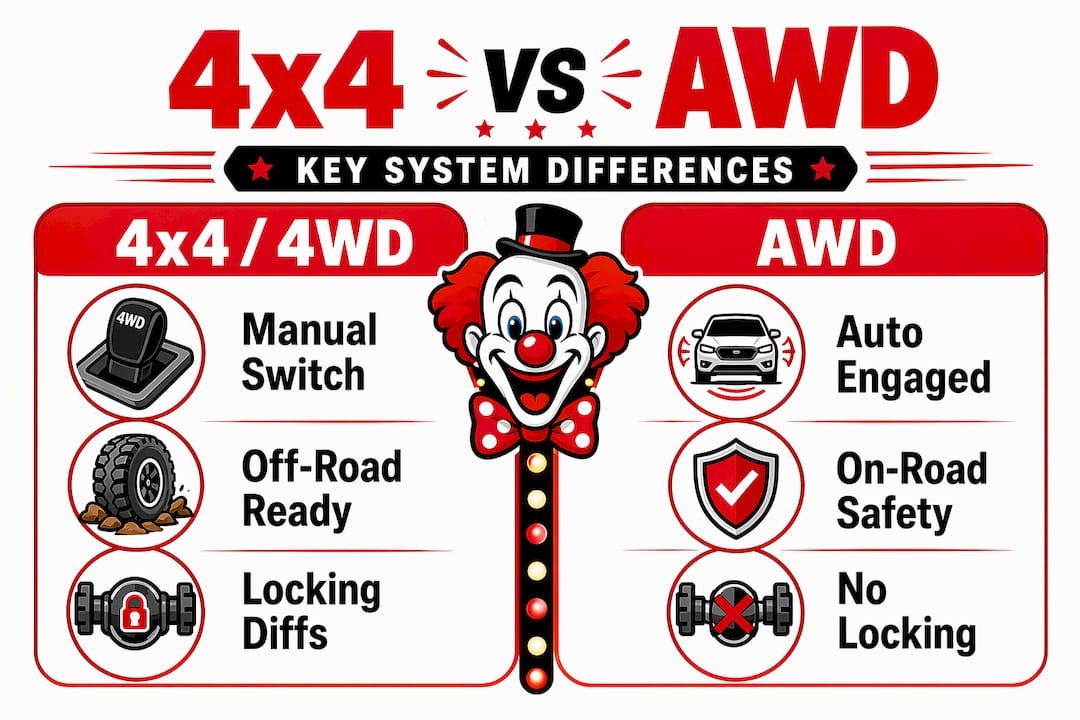
4WD and 4x4 are terms most manufacturers use interchangeably, though there is a distinction worth knowing. Part-time 4WD (the system most truck buyers encounter) locks the front and rear driveshafts together with no center differential. That rigid connection is exactly what gives you superior off-road traction. But it also means 4x4 on dry pavement causes driveline wind-up because the axles cannot rotate at different speeds through a turn. Full-time 4WD adds a center differential to solve this, making it safe on pavement while keeping all four wheels driven.
Here is a direct comparison to keep things clear:
| Feature | Part-time 4x4 | Full-time 4WD | AWD |
|---|---|---|---|
| Driver input required | Yes, manual engagement | Optional (some lock modes) | No, fully automatic |
| Best terrain | Mud, rocks, snow, sand | Mixed on and off-road | Wet roads, light snow |
| Low range (4L) available | Yes | Yes (in most systems) | No |
| Safe on dry pavement | No | Yes | Yes |
| Typical vehicle type | Trucks, ATVs, UTVs | SUVs, heavy trucks | Cars, crossovers, SUVs |
A few practical points on choosing between these systems:
- If you drive mostly on paved roads with occasional light snow, AWD or 4H is more than enough.
- If you spend time on serious trails, hauling through mud, or working in remote areas, part-time 4x4 with a low range is the right call.
- Full-time 4WD sits between the two and works well for people who regularly drive mixed terrain without wanting to manually switch modes.
If you want to explore vehicle types beyond trucks and SUVs, the off-road vehicle guide at Importjunkies covers ATVs, UTVs, and more in one place.
Real-world benefits of 4x4 vehicles
The benefits of 4x4 vehicles become obvious the moment you need them. The primary advantage is traction. 4x4 vehicles provide superior grip on uneven terrain including mud, snow, sand, and loose rock. When two wheels lose contact or slip, the other pair keeps pulling you forward.
Beyond off-road capability, 4x4 adds real value in these situations:
- Winter driving: 4H gives you stability on snow-covered roads that 2WD simply cannot match, especially on hills and turns.
- Towing on loose ground: When you are hauling a trailer on a dirt path, gravel lot, or grass field, four driven wheels maintain momentum that prevents embarrassing situations.
- Work environments: If you are operating in construction, farming, or land maintenance, 4x4 is often non-negotiable for getting tools and equipment where they need to go.
- Emergency situations: Getting unstuck from a ditch or soft shoulder is much easier when you can distribute power to all four wheels.
The limitations are equally worth knowing. 4x4 vehicles generally consume more fuel than their 2WD counterparts due to drivetrain weight and mechanical friction. Maintenance requirements go up, covering additional components like the transfer case and front differential. And the biggest mistake buyers make: engaging 4x4 on dry pavement and driving as though nothing changed.
Pro Tip: If you feel the steering go stiff or hear a grinding sensation while in 4H on pavement, that is drivetrain binding. Shift back to 2H immediately and let the system relieve stress before you drive again.
Maintenance practices that protect your 4x4 system
Understanding 4x4 specifications in vehicles means nothing if you do not follow through with basic maintenance. The transfer case is the heart of the system, and most owners ignore it until something goes wrong.
Follow this sequence to keep your 4x4 drivetrain healthy:
- Change transfer case fluid on schedule. Neglecting this fluid is the single most common cause of transfer case failure, which can cost over $2,000 to repair. A fluid change costs a fraction of that and should happen roughly every 30,000 miles, or as specified by your manufacturer.
- Engage 4L correctly every time. Come to a complete stop, place the transmission in neutral, then shift into 4L. Shifting into 4L without stopping can shear transfer case gears and cause immediate damage.
- Respect the 25 mph limit in 4L. Driving 4L above 25 mph risks overheating your transmission and damaging the low-range gears. Low range is built for slow, deliberate movement, not open-road driving.
- Inspect front CV axles and U-joints regularly. These components take additional stress in 4x4 mode and show wear before they fail. Catching a torn boot early prevents a full axle replacement.
- Exercise your 4x4 system monthly. If you rarely use 4WD, engage it briefly on a safe surface every month. This keeps seals lubricated and prevents the system from seizing from disuse.
Deciding if 4x4 is the right fit for you
The right drivetrain depends on what your driving life actually looks like, not what you imagine it might look like someday. Be honest about these factors before you buy:
- Your regular terrain: Do you drive mostly paved roads, or do you regularly encounter dirt, mud, gravel, or snow? If it is mostly pavement, AWD may serve you better without the usage restrictions.
- Your climate: Buyers in regions with severe winters or heavy rainfall get more consistent value from 4x4 or AWD than buyers in dry, flat climates.
- Your work needs: Farm work, property maintenance, and construction benefit enormously from 4x4 low-range capability. Golf course or warehouse use typically does not require it.
- Your budget: 4x4 vehicles cost more to purchase and more to maintain. If your use case does not justify those costs, a well-specified 2WD or AWD vehicle often makes more financial sense.
When 4x4 is clearly the right call: you need to operate in remote areas, carry heavy loads on unpaved surfaces, or work through seasonal snow and mud on a regular basis. When it may not be necessary: your most demanding terrain is a wet parking lot or light highway driving in winter. For a deeper comparison of utility vehicle options, the Importjunkies guide on utility vehicles explained covers uses, types, and how to match the vehicle to your actual needs.
My take on 4x4 ownership after years of watching it go wrong
I have seen the same pattern repeat itself more times than I can count. Someone buys a 4x4 vehicle because it looks capable, uses it on pavement every day in 4H, and then wonders why the drivetrain is making strange noises six months later. The capability is real. The misuse is equally real.
In my experience, the people who get the most out of a 4x4 system are the ones who treat it like a tool rather than a default setting. They use 2H on pavement, engage 4H when conditions genuinely call for it, and respect the operational rules around 4L. They also budget for transfer case fluid changes the same way they budget for oil changes. Low-cost, regular maintenance is what separates a 4x4 that lasts 200,000 miles from one that needs a drivetrain rebuild at 80,000.
My honest advice: if you spend less than 20 percent of your driving time in conditions that actually need four driven wheels, look hard at whether AWD meets your needs at lower maintenance cost. But if you work outdoors, ride trails regularly, or deal with serious seasonal terrain, a proper 4x4 system with low range is worth every dollar. Just learn how to use it correctly before you need it most.
— Gary
Ready to put 4x4 to work? Importjunkies has you covered
Knowing how 4x4 systems work is step one. Finding the right vehicle that puts that capability to practical use is step two. At Importjunkies, you will find a focused selection of work-ready 4x4 utility vehicles built for real terrain, not just weekend trail appearances.

The 400cc 4x4 UTV with Snow Plow and VX Dump Bed is a strong choice if you need a vehicle that handles both snow removal and hauling in a single machine. For something more compact, the MSA 300cc 4x4 ATV with Snow Plow delivers four-wheel-drive utility in a more maneuverable package. Both are priced for direct purchase online with no dealership markup. Browse the full selection at Importjunkies and reach out to the customer service team if you want guidance on which model fits your workload.
FAQ
What does 4x4 mean on a vehicle?
4x4 means the vehicle has four wheels and all four are driven by the engine. This gives the driver the ability to send power to every wheel, which improves traction on loose, slippery, or uneven terrain.
Is 4x4 the same as AWD?
No. AWD operates automatically and is safe on pavement every day, while 4x4 (part-time 4WD) requires manual engagement and should not be used on dry pavement due to drivetrain binding risks.
When should you use 4L versus 4H?
Use 4H for loose gravel, light snow, or muddy roads at normal travel speeds. Use 4L only for low-speed, high-torque situations like rock crawling or steep hill climbs, and stay under 25 mph.
Can 4x4 damage your drivetrain?
Yes. Using part-time 4x4 on dry pavement causes axle binding that leads to costly drivetrain repairs. Always return to 2H when you are back on solid, dry surfaces.
How often should you service a 4x4 system?
Change transfer case fluid roughly every 30,000 miles and inspect CV axles and U-joints regularly. Consistent, low-cost maintenance prevents failures that can exceed $2,000 in repair costs.
Recommended
- Your guide to every type of off-road vehicle – Saferwholesale || Import Junkies || Great Sports
- What is an off-road utility truck? A guide for buyers – Saferwholesale || Import Junkies || Great Sports
- Utility Vehicles Explained: Uses, Types, and Right Fit – Saferwholesale || Import Junkies || Great Sports
- MSA 300cc 4x4 ATV With Snow Plow UTV - Utility Style Vehicle Four Whee – Saferwholesale || Import Junkies || Great Sports


