


 Location
 Login
Login
TL;DR:
- Off-road utility trucks encompass a wide range of vehicles designed for hauling tools and supporting field work in rugged terrain, from commercial trucks to recreational UTVs. The category lacks a strict definition, but key features include high ground clearance, rugged tires, reinforced chassis, and capable drivetrain systems. Buyers should focus on specific technical specs and their actual needs rather than marketing labels to make an informed purchase.
You’ve probably seen the term “off-road utility truck” applied to everything from massive construction vehicles to compact side-by-sides sold for weekend trail riding, and that inconsistency can make it genuinely hard to shop with confidence. Whether you’re a small business owner looking for a workhorse that can handle rough property terrain or an outdoor enthusiast wanting a versatile machine that hauls gear and navigates trails, understanding exactly what this category means will save you money and frustration. This guide cuts through the confusion with clear definitions, practical comparisons, and specific advice on choosing the right vehicle for your actual needs.
Table of Contents
- Defining off-road utility trucks: What does the term mean?
- Types of off-road utility trucks: Commercial vs. recreational
- Core features of an off-road utility truck
- How to choose the right off-road utility truck for your needs
- Our perspective: What most buyers misunderstand about off-road utility trucks
- Find the right off-road utility truck with Import Junkies
- Frequently asked questions
Key Takeaways
| Point | Details |
|---|---|
| Flexible definition | Off-road utility trucks range from heavy-duty commercial rigs to consumer UTVs built for rough terrain and practical work. |
| Essential features | True off-road utility vehicles have high ground clearance, strong chassis, and rugged drivetrains. |
| Purpose-driven design | These trucks are built to support work crews or recreational users needing hauling and maneuvering on challenging terrain. |
| Not all pickups qualify | Many trucks with off-road packages are not fully equipped for demanding field work or deep off-road conditions. |
| Match needs with specs | Carefully assess key specs—ground clearance, axle articulation, towing capacity—to choose the right vehicle. |
Defining off-road utility trucks: What does the term mean?
The honest answer is that there is no single, universally standardized definition. The phrase “off-road utility truck” blends two different descriptors, “off-road” and “utility,” and each one gets applied differently depending on whether you’re reading a commercial equipment catalog or a recreational vehicle brochure.
In practice, an off-road utility truck refers to a work-oriented vehicle built to haul tools or materials and support field operations in terrain that would stop a standard vehicle. The emphasis is on both capability and function. The vehicle needs to go where pavement ends, and it needs to carry something useful once it gets there.
“An off-road utility truck isn’t a single, universally standardized vehicle type. In practice, it means a work-oriented truck or vehicle intended to haul tools and materials and support field work, with hardware and tires suited for rough terrain.”
The key hardware markers that typically define this category include:
- Rugged, aggressive tires designed for loose soil, gravel, mud, or rocky surfaces
- Reinforced chassis capable of handling uneven loads and impact from rough terrain
- Cargo capacity, whether a flatbed, dump bed, or cargo box built to carry equipment or materials
- Towing capability for trailers, implements, or small machinery
- Ground clearance high enough to clear obstacles that would damage a standard vehicle’s undercarriage
For consumers, the term often describes utility vehicle types ranging from full-size work trucks with off-road packages to smaller UTVs (utility terrain vehicles) designed for farm, ranch, or trail use. The important takeaway is that you need to look at the actual specs rather than the label on the brochure.
Types of off-road utility trucks: Commercial vs. recreational
The spectrum here is wider than most buyers expect. On one end, you have heavy-duty commercial vehicles used by municipalities, construction crews, and utility companies. On the other end, you have compact consumer UTVs built for farms, ranches, resorts, and recreational trail riding. Understanding where your needs fall on that spectrum is the first step toward choosing correctly.
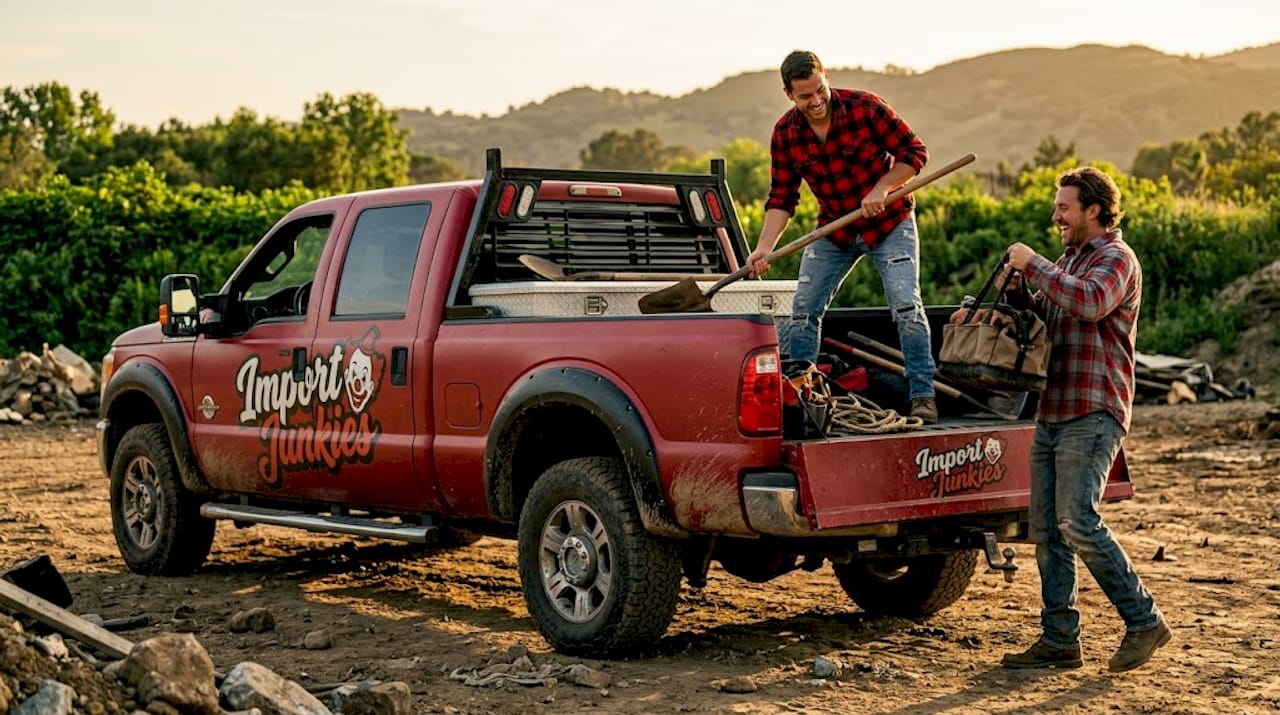
Commercial off-road utility trucks are purpose-built for field operations. Utility trucks in this class include crew support vehicles with storage compartments, mounted equipment racks, aerial lift platforms, and the power to haul heavy tools across job sites with uneven ground. These vehicles prioritize payload and durability above all else.
At the extreme end of commercial capability, some manufacturers build what are genuinely called off-road trucks in a dedicated engineering sense. Platforms like the Unimog from Mercedes-Benz use specialized portal axles, differential locks, and extreme ground clearance to handle terrain that most trucks simply cannot navigate. These are purpose-built for mining, forestry, disaster response, and military logistics. They represent a very different category from what most consumers are shopping for.
Here is a comparison of the main vehicle types in this broad category:
| Vehicle type | Primary use | Typical payload | Ground clearance | Cost range |
|---|---|---|---|---|
| Commercial utility truck | Municipal/construction field work | 1,500 to 5,000+ lbs | Moderate to high | $40,000 to $150,000+ |
| Heavy off-road platform (e.g., Unimog) | Extreme terrain, specialized operations | 3,000 to 10,000 lbs | Very high | $100,000+ |
| Full-size pickup with off-road package | Light commercial and recreation | 1,000 to 2,500 lbs | Moderate | $35,000 to $70,000 |
| UTV / side-by-side | Farm, ranch, trail, recreation | 400 to 1,500 lbs | Moderate to high | $5,000 to $25,000 |
| Mini utility truck | Small property, resort, golf course | 300 to 800 lbs | Low to moderate | $3,000 to $12,000 |
The most common consumer purchase in this general category is the UTV or side-by-side. When most small business owners and outdoor enthusiasts search for an “off-road utility truck,” they are realistically looking at this class. Understanding the difference between utility trucks vs. golf carts also matters here because some compact utility vehicles share design elements with golf carts but are built for much tougher conditions.
The numbered list below shows how vehicle selection typically aligns with use case:
- Agricultural and property management often calls for a mid-size UTV with a dump bed and 4WD capability
- Construction site support typically needs a full-size pickup or dedicated utility truck with high payload ratings
- Resort, campground, or golf course operations often use mini trucks or lighter UTVs for daily logistics
- Recreational trail riding with gear hauling suits a side-by-side with cargo capacity and off-road suspension
- Municipal or utility work requires licensed commercial vehicles with specialized mounted equipment
Using a utility vehicle checklist before you commit to a purchase can help you filter out vehicles that look like they fit but don’t deliver on the specific specs your work or recreation actually demands.
Core features of an off-road utility truck
Once you know the general category you need, it’s time to evaluate specific hardware. Not all off-road utility trucks are built the same, and the gap between a capable machine and a marketed-but-underbuilt one comes down to these core features.
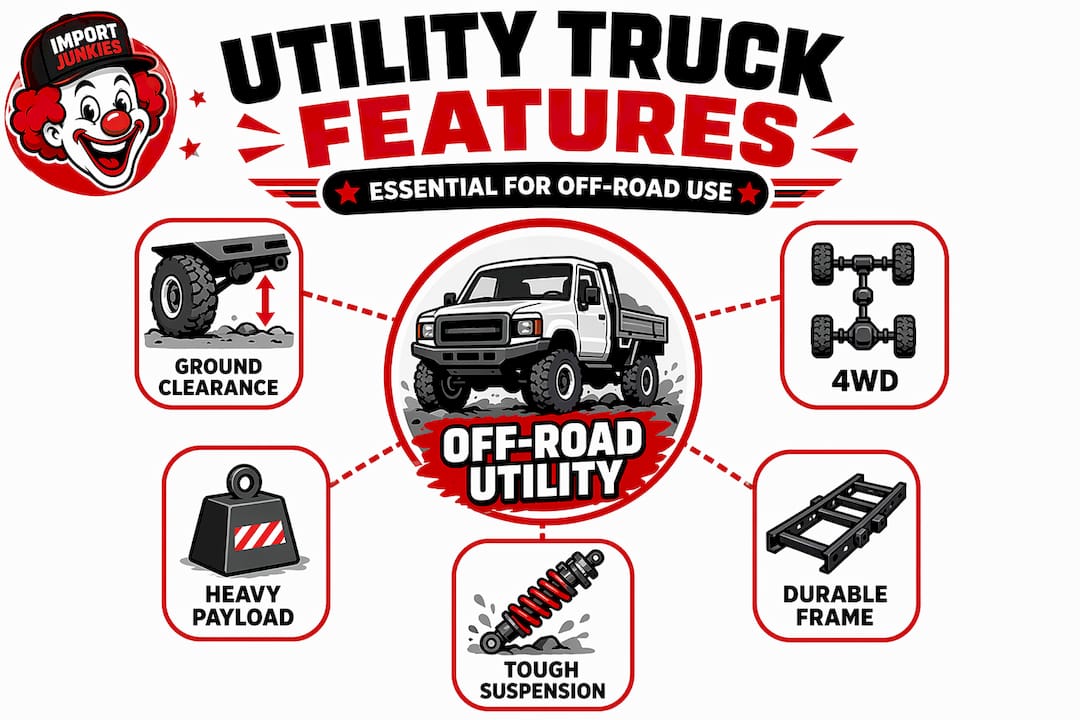
Here is a breakdown of the key specs and what they mean in practical terms:
| Feature | What to look for | Why it matters |
|---|---|---|
| Ground clearance | 8 to 12+ inches for serious terrain | Prevents undercarriage damage on rocks and ruts |
| Drivetrain | 4WD with selectable low range | Maintains traction on slopes and loose surfaces |
| Axle articulation | Independent suspension or solid axle with flex | Keeps tires in contact with uneven ground |
| Cargo capacity | Rated payload in the bed or box | Determines actual hauling ability |
| Towing capacity | Manufacturer-rated tow rating | Sets limits for trailers and implements |
| Tire type | Aggressive all-terrain or mud-terrain tread | Affects traction on loose, wet, or rocky terrain |
Off-road capable vehicles, which include 4x4 trucks, ATVs, and side-by-sides, are defined by their ability to handle natural terrain with purpose-built hardware. That distinction matters when you’re comparing a true off-road UTV with a standard pickup that just has a “trail” badge on the door.
The essential features for a genuine off-road utility vehicle include:
- High ground clearance to clear stumps, boulders, and deep ruts without damage
- Selectable 4WD for switching between pavement efficiency and off-road traction
- Cargo bed with tie-down points for securing loads on uneven ground
- Heavy-duty suspension that absorbs impacts rather than transferring them directly to the chassis and cargo
- Reliable low-end torque, which is the engine’s ability to pull a load at slow speeds, critical for climbing grades or pulling through mud
Pro Tip: Before you test drive any off-road utility vehicle, walk around it and physically measure the ground clearance with a tape measure. Manufacturers sometimes measure at the highest point of the undercarriage rather than the lowest, which can create an inflated number on paper.
How to choose the right off-road utility truck for your needs
Choosing correctly comes down to being honest about three things: where you’re going, what you’re carrying, and how much you’re willing to spend. When those three factors are clear, the right vehicle category becomes obvious.
Start by identifying your primary use. Here’s a practical decision framework:
-
Define your terrain. Is the ground flat and grassy, moderately rocky, heavily wooded with roots and mud, or something else? Mild terrain allows for lighter vehicles with standard clearance. Serious off-road terrain demands higher clearance, 4WD, and flexible axle articulation.
-
Calculate your payload needs. Add up the weight of tools, materials, or gear you plan to carry regularly. Add 20 percent buffer for safety. Then compare that number to the manufacturer’s rated payload capacity, not the estimated or approximate number listed in marketing materials.
-
Factor in towing requirements. If you’ll be pulling a trailer with equipment, animals, or materials, confirm the vehicle’s tow rating under load, meaning when it also has cargo in the bed. Rated tow capacity and real-world tow capacity under a full load can differ significantly.
-
Set a realistic budget that includes total cost of ownership. Purchase price is only part of the equation. Factor in fuel or charging costs, maintenance intervals, and parts availability for the specific brand and model you’re considering.
-
Verify the drivetrain before assuming capability. A vehicle marketed as “off-road ready” is not the same as a dedicated off-road utility vehicle. A pickup with an off-road package may handle light gravel roads without issue but struggle in deep ruts or rocky creek crossings where a dedicated UTV with proper axle articulation would handle the terrain without stress.
The smart buying checklist approach also means watching out for common buying pitfalls:
- Don’t assume a truck labeled “off-road” has the same clearance as a purpose-built UTV
- Don’t buy more vehicle than your terrain requires, since oversized trucks on mild property are harder to maneuver and more expensive to maintain
- Don’t overlook the importance of parts availability, especially for less common brands or models
- Don’t skip a test run on terrain similar to what you’ll actually use the vehicle on
Pro Tip: If you’re buying for a small business, think about whether the vehicle needs to perform multiple roles simultaneously. A dump-bed UTV with 4WD can handle materials hauling, light towing, and ground maintenance, which might eliminate the need for two separate machines and reduce your overall equipment cost significantly.
Our perspective: What most buyers misunderstand about off-road utility trucks
Here’s what we’ve seen repeatedly: buyers get drawn in by marketing language and end up disappointed by vehicles that looked capable on paper but couldn’t handle their actual conditions. The word “utility” gets attached to vehicles that have a cargo box. The word “off-road” gets stamped on trucks that have slightly larger tires than standard. Neither word alone guarantees the capability you probably need.
The real issue is that the off-road utility truck category is broad enough that sellers can technically apply the label to a very wide range of vehicles. A truck with a mild suspension lift and all-terrain tires is not the same machine as a purpose-built UTV with independent rear suspension, a rated cargo bed, and a selectable 4WD system. Both might show up in the same search results. Both might be sold with similar language.
What we advise is to build your purchase decision around specs, not descriptions. Ground clearance is a number. Payload capacity is a number. Axle articulation is a physical feature you can test. Those concrete details tell you far more than any marketing term. Reading through utility vehicle insights before you buy helps you ask the right questions before spending money.
The buyers who make the best decisions are those who arrive at the purchase knowing exactly what they need the vehicle to do, in specific terrain, carrying specific loads, at a specific budget. That level of clarity removes the influence of branding and forces a feature-by-feature comparison that almost always leads to a better outcome.
Find the right off-road utility truck with Import Junkies
If this guide helped you get clearer on what you’re actually looking for, the next step is finding a vehicle that matches those specs at a price that makes sense.

At Import Junkies, we carry a range of purpose-built off-road utility vehicles suited to real work and recreation. Our 400cc 4x4 UTV comes with a dump bed and snow plow capability, making it practical for property owners and small business operators year-round. The mini truck UTV delivers compact maneuverability with genuine off-road function, and our 300cc 4x4 ATV gives you four-wheel drive with utility-style cargo capacity at a competitive price point. Browse our full inventory and use what you’ve learned here to compare specs rather than labels.
Frequently asked questions
What distinguishes an off-road utility truck from a regular pickup?
Off-road utility trucks have purpose-built features for demanding terrain, including high ground clearance, reinforced chassis, and often selectable 4WD, whereas a standard pickup with an off-road package may lack the axle articulation and drivetrain capability needed for serious off-road work.
Can off-road utility trucks be used for recreational activities?
Yes, UTVs and side-by-sides work well for outdoor recreation because these off-road vehicle types, including ATVs and side-by-sides, are built for natural terrain and can haul gear or tow light loads while handling technical trails and rough ground.
What are the most important specs to check before buying?
Focus on ground clearance, drivetrain type (particularly whether 4WD is selectable), cargo and towing capacity, and axle articulation, since a pickup with an off-road package is not automatically equivalent to a dedicated off-road utility vehicle built for deep terrain.
Are all utility trucks off-road capable?
No. A utility truck is built for work support and field operations, but off-road performance specifically requires rugged tires, appropriate suspension, enhanced ground clearance, and drivetrain features that many standard utility trucks do not include.
Recommended
- Your guide to every type of off-road vehicle – Saferwholesale || Import Junkies || Great Sports
- Utility Vehicles Explained: Uses, Types, and Right Fit – Saferwholesale || Import Junkies || Great Sports
- Utility trucks vs. golf carts: which delivers more value? – Saferwholesale || Import Junkies || Great Sports
- Purpose of Utility Trikes: Work, Recreation, Versatility – Saferwholesale || Import Junkies || Great Sports


