


 Location
 Login
Login
TL;DR:
- Golf carts have expanded beyond golf courses into various commercial and residential uses.
- There are recreational carts for light-duty and utility carts for heavy-duty off-road tasks.
- Electric models dominate markets due to lower costs, noise, and maintenance, but gas may suit heavier loads.
Golf carts have quietly outgrown their original purpose. What started as a convenience tool for golfers has become a practical vehicle for resorts, gated communities, campuses, farms, and job sites across the country. The global market hit $1.9 billion in 2023 and is projected to reach $3.5 billion by 2033, growing at 6.7% annually. That kind of growth doesn’t happen unless people are finding real value in these vehicles beyond the fairway. If you’re trying to figure out what a golf cart actually is, what types exist, and how to choose the right one for your needs, this guide covers all of it clearly and without fluff.
Table of Contents
- What exactly is a golf cart?
- Main types of golf carts and their uses
- Electric vs gas golf carts: which is right for you?
- Key features to look for when buying a golf cart
- Why most people underestimate the versatility of golf carts
- Ready to choose your golf cart? Start here
- Frequently asked questions
Key Takeaways
| Point | Details |
|---|---|
| Golf cart definition | A golf cart is a compact vehicle designed for transporting people and equipment, most commonly on golf courses. |
| Main cart types | Golf carts are available as light-duty recreational models or heavy-duty utility vehicles for work and off-road uses. |
| Electric vs gas choice | Electric carts are quieter and greener; gas models offer more power for demanding tasks or terrain. |
| Buying considerations | Factor in dimensions, features, power source, and your intended use when shopping for a cart. |
| Expanding applications | Golf carts now serve roles well beyond the golf course, from resorts to industry and personal transport. |
What exactly is a golf cart?
With a market that’s growing rapidly, let’s clarify what truly defines a golf cart today. At its core, a golf cart is a small motorized vehicle designed primarily to carry golfers and their equipment around a golf course with less effort than walking. But that definition only tells part of the story in 2026.
Modern golf carts are compact, lightweight, and built for short-distance travel on flat to moderately uneven terrain. According to standard specifications, typical dimensions are 4 ft wide, 8 ft long, and 6 ft high, with a curb weight between 900 and 1,000 lbs and a top speed of 15 to 20 mph. That size makes them easy to maneuver in tight spaces, whether that’s a cart path, a resort walkway, or a warehouse corridor.
Golf carts reduce physical effort on the course and expand access for players who might otherwise struggle with long walks between holes. That same principle of effortless, short-range mobility is exactly why they’ve spread far beyond golf.
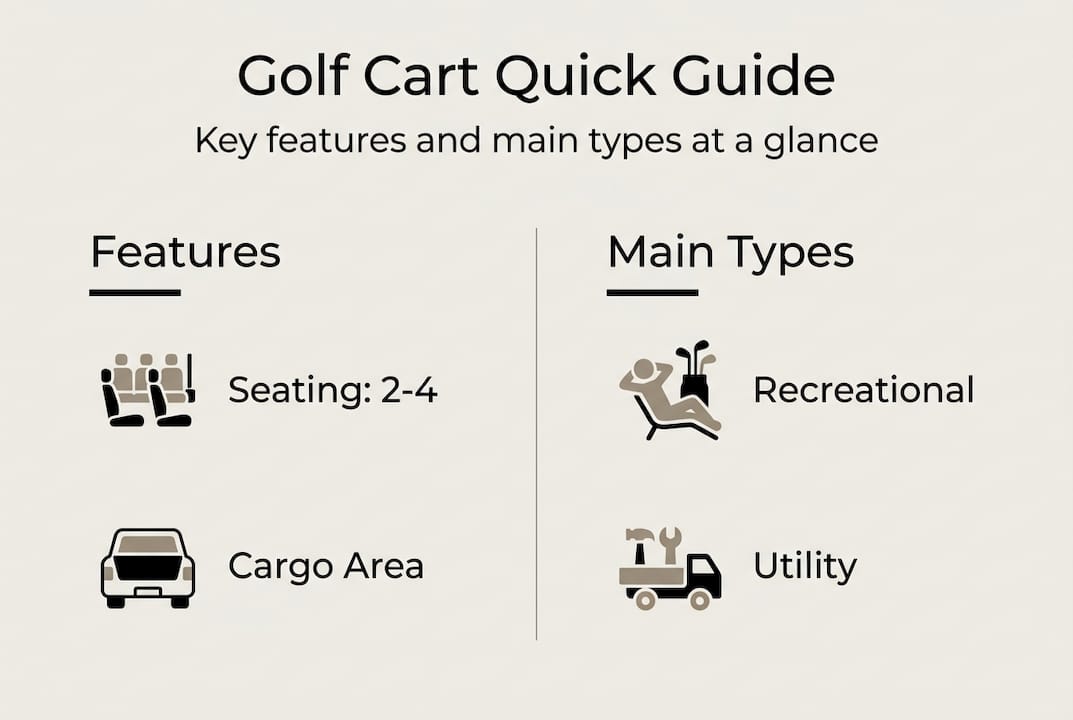
Most standard golf carts seat two to four passengers and include a rear cargo area or bag holder. Many come with a roof (called a canopy or top), a windshield, and basic headlights as standard or optional equipment. The frame is typically made from steel or aluminum, keeping weight manageable while still supporting a useful payload.
Here’s a quick reference for the key physical specs of a standard golf cart:
| Specification | Typical Range |
|---|---|
| Length | 8 ft |
| Width | 4 ft |
| Height | 6 ft |
| Curb weight | 900 to 1,000 lbs |
| Top speed | 15 to 20 mph |
| Seating | 2 to 6 passengers |
| Power options | Electric or gas |
The benefits for golfers are well-documented, but the broader appeal comes from how easily these vehicles adapt to different environments. A golf cart’s compact frame and low operating cost make it a sensible choice for any setting that requires short, frequent trips with moderate cargo or passenger loads.
Main types of golf carts and their uses
Now that you know what a golf cart is, let’s break down the different types available and where each excels.
The two main categories are recreational golf carts and commercial utility carts, and the differences between them go well beyond looks. Understanding which category fits your situation can save you from buying the wrong vehicle entirely.
Recreational golf carts are light-duty, typically running 4 to 5 horsepower, designed for smooth paths, flat terrain, and passenger transport. Commercial utility carts run 13 to 15 horsepower, often feature four-wheel drive, and use a continuously variable transmission (CVT) for better torque delivery on uneven ground.
Here’s how they compare side by side:
| Feature | Recreational cart | Commercial utility cart |
|---|---|---|
| Horsepower | 4 to 5 HP | 13 to 15 HP |
| Drive type | 2WD | 4WD available |
| Terrain | Flat, paved | Off-road, rough terrain |
| Cargo capacity | Light | Heavy-duty |
| Best for | Golf, neighborhoods | Farms, job sites, industry |
| Typical cost | Lower | Higher |
Beyond golf courses, recreational carts are popular in:
- Gated communities and retirement villages
- Resorts and theme parks
- Campus transportation
- Event shuttle services
Commercial utility carts, on the other hand, are workhorses. You’ll find them hauling equipment on farms, supporting maintenance crews at large facilities, or performing security patrols at industrial sites. They’re also closely related to UTVs, which is worth understanding if you’re weighing your options. The comparison between golf carts vs ATVs is especially useful if your terrain is more rugged than a cart path.

If you’re interested in something that bridges both worlds, lifted golf cart types offer added ground clearance and off-road capability without jumping all the way to a full utility vehicle.
Pro Tip: Before choosing a model, map out the specific terrain and load requirements you’ll face. A recreational cart on a farm job site will underperform and wear out faster than a commercial utility model built for that kind of stress.
Electric vs gas golf carts: which is right for you?
Choosing your golf cart doesn’t end with the model type. You’ll also need to decide on the power source, and this decision affects your operating costs, maintenance schedule, and overall experience.
Electric and gas golf carts both have strong followings, but they serve different priorities. Here’s an honest breakdown:
Electric golf carts:
- Quieter operation, ideal for residential areas and indoor use
- Lower maintenance (no oil changes, spark plugs, or fuel filters)
- Eco-friendly with zero direct emissions
- Lower cost per mile to operate
- Require access to a charging outlet and consistent charging habits
- Best for: neighborhoods, resorts, campuses, golf courses
Gas golf carts:
- More power output, better for heavy loads and steep terrain
- Longer range with quick refueling stops
- No waiting for a charge
- Higher maintenance requirements and fuel costs
- Louder, not ideal for noise-sensitive environments
- Best for: farms, job sites, remote areas without charging access
The market has clearly leaned toward electric. Electric carts now dominate globally, used across resorts, communities, and industries worldwide. That’s largely driven by lower running costs, improving battery technology, and growing preference for quieter, cleaner vehicles in shared spaces.
That said, gas still has a legitimate place. If you’re operating in a remote area, running a cart with heavy cargo needs, or managing a fleet where downtime for charging isn’t practical, a gas model keeps things moving without interruption.
For a detailed side-by-side breakdown, the comparison of electric vs gas golf carts lays out the real cost and performance differences worth reviewing before you buy.
One common mistake buyers make is underestimating their charging infrastructure. If you don’t have a dedicated outlet near your storage area, an electric cart creates daily friction. Factor that in before committing.
Key features to look for when buying a golf cart
Once you’ve chosen the right type and power source, focus on features that match your specific needs. Not all carts are built the same, and a few overlooked specs can make a big difference in day-to-day usability.
Here are the key features to evaluate before you buy:
- Seat capacity. Standard carts seat two. Four and six-passenger models are available and important if you’re transporting groups or families.
- Top speed. Most carts max out at 15 to 20 mph, but street-legal models may require higher speeds and additional equipment like mirrors and turn signals.
- Cargo space. Check rear cargo capacity if you plan to haul tools, equipment, or supplies. Payload ratings vary significantly between models.
- Street legality. If you plan to drive on public roads, the cart must meet local Low-Speed Vehicle (LSV) requirements, including lights, mirrors, and seat belts.
- Safety features. Look for a windshield, headlights, taillights, and seat belts as baseline safety items. These are sometimes optional on base models.
- Battery or engine condition. For electric carts, check battery age and cycle count. For gas, check engine hours and service history.
- Upgrade potential. Some carts accept lift kits, custom wheels, rear seat additions, and cargo attachments. Knowing your upgrade options before you buy prevents compatibility issues later.
Dimensions still matter even after purchase. Standard carts at 4 ft wide and 8 ft long fit comfortably in most storage spaces and trailers, but lifted or extended models add width and length that can create clearance issues.
Before finalizing any purchase, review a proper golf cart inspection guide to know exactly what to look for, especially when buying used.
Pro Tip: If possible, take a test ride before you buy. Ride comfort, steering responsiveness, and brake feel are things you can’t fully judge from a spec sheet or product photo alone.
Why most people underestimate the versatility of golf carts
Beyond specs and buying tips, there’s a bigger story about where golf carts fit in modern life. Most buyers approach them with a narrow use case in mind. But once you own one, the range of applications tends to expand quickly.
Golf carts are now in resorts, communities, and industries around the world, and for good reason. Airports use them for gate-to-gate passenger transport. Universities move equipment across large campuses. Farms use utility models for hauling feed and tools across uneven ground. Event companies deploy them for security patrols, vendor support, and VIP transport.
What surprises most owners is how quickly a golf cart becomes the most-used vehicle on the property. It handles the short trips that would otherwise eat up time in a full-size truck. It fits in places a truck can’t. And it costs a fraction of the fuel.
Customization has also changed the game. Owners are adding lift kits, custom enclosures, sound systems, and cargo beds to suit both work and leisure. The line between a golf cart and a utility vehicle is getting blurrier every year, and that’s exactly why demand keeps growing. Don’t limit your thinking to the golf course. Think about what a low-cost, low-maintenance short-range vehicle could do for your daily routine or business operations.
Ready to choose your golf cart? Start here
If you’re ready to experience the full potential of a modern golf cart, take the next step with these resources. Knowing what to look for is only half the work. Finding the right model at the right price is where it comes together.

At Import Junkies, we carry a wide range of electric and gas options built for real-world use. Whether you’re looking for a clean, quiet electric golf cart for neighborhood or resort use, or a heavy-duty gas utility golf cart capable of handling rough terrain and real work loads, we have options that match the features covered in this guide. Browse our inventory, compare specs side by side, and reach out to our team if you need help narrowing it down.
Frequently asked questions
How fast do golf carts typically go?
Most standard golf carts reach top speeds of 15 to 20 mph. Street-legal models may be modified to go slightly faster to meet low-speed vehicle requirements.
What is the difference between a golf cart and a utility cart?
Recreational golf carts run 4 to 5 HP and are built for light use on smooth terrain, while commercial utility carts run 13 to 15 HP with 4WD capability and are designed for heavy-duty work tasks.
Are electric golf carts better than gas?
Electric carts now lead the market because they’re quieter, cheaper to run, and lower maintenance, but gas models remain the better choice for heavy loads and remote areas without charging access.
What should I look for when buying a golf cart?
Prioritize seat capacity, horsepower, battery condition or fuel efficiency, safety features like lights and seat belts, and upgrade compatibility. Standard specs of 4 ft wide and 8 ft long are a useful baseline for storage and transport planning.
Recommended
- Why choose electric golf carts? Benefits for golfers and courses – Saferwholesale || Import Junkies || Great Sports
- Lifted golf carts: benefits, types, and how to choose – Saferwholesale || Import Junkies || Great Sports
- Golf carts vs. ATVs: Choosing the best utility vehicle – Saferwholesale || Import Junkies || Great Sports
- Best Golf Cart for Neighborhoods: What to Buy – Saferwholesale || Import Junkies || Great Sports


