


 Location
 Login
Login
TL;DR:
- Portable car lifts are versatile, mobile tools supporting up to 15,000 pounds without permanent installation, ideal for home garages. Safety locks are essential, and proper surface, positioning, and maintenance ensure reliable operation for DIY and mobile mechanics. For most home tasks, light trucks, and passenger cars, portable lifts offer a practical, cost-effective solution over fixed systems.
If you’ve ever wondered what is a portable car lift and whether it’s worth the investment for home garage work, you’re not alone. Many DIY mechanics assume these tools are either toys or compromised in safety compared to fixed shop lifts. Neither is true. Portable car lifts are purpose-built tools that support 3,500 to 15,000 lbs depending on the model, require no concrete anchoring, and can be stored away when you’re done. This guide covers every angle: types, operation, safety, buying considerations, and who these lifts actually make sense for.
Table of Contents
- Key takeaways
- What is a portable car lift: types and key features
- How portable car lifts work
- Advantages and limitations compared to fixed lifts
- Choosing the best portable car lift for home use
- Safe practices and routine maintenance
- My take on portable lifts after years of use
- Find quality lifts and automotive gear at Importjunkies
- FAQ
Key takeaways
| Point | Details |
|---|---|
| Portable lifts cover a wide range | Models support from 3,500 to 15,000 lbs with no permanent installation required. |
| Safety locks are non-negotiable | Hydraulic pressure alone is not enough. Mechanical locks must be engaged before working under any vehicle. |
| Match capacity to your vehicle | Choose a lift rated for at least 125% of your vehicle’s GVWR to maintain a safe working margin. |
| ALI certification matters | Look for ALI-certified models to confirm the lift meets recognized safety and load standards. |
| Portability has real trade-offs | Most portable lifts max out at 20 to 30 inches of lift height, which limits certain heavy repair tasks. |
What is a portable car lift: types and key features
A portable car lift is a mechanical or hydraulic lifting device designed to raise a vehicle off the ground without being permanently anchored to a floor or structure. Unlike a two-post or four-post fixed lift that requires bolted installation, a portable lift can be moved, stored, and repositioned as needed. That flexibility is the core selling point, and it’s why home mechanics and mobile service professionals have gravitated toward them.
There are a few distinct types worth understanding before you buy.
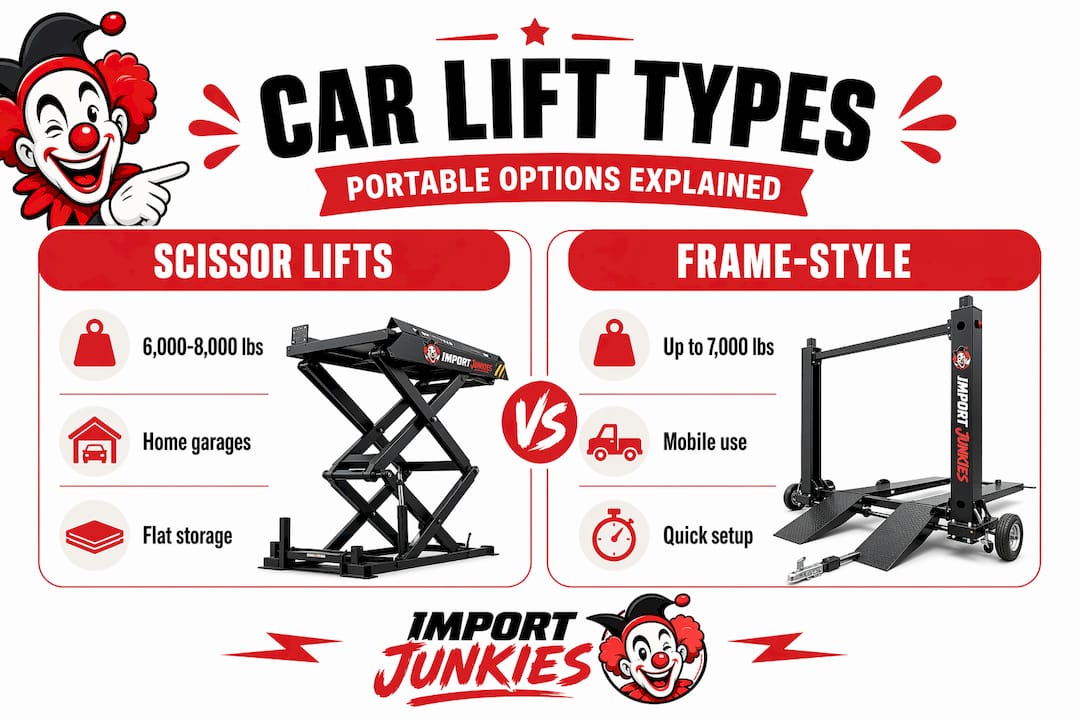
Scissor lifts are the most common portable format for home use. They use a cross-braced arm mechanism, often powered by an electric hydraulic pump, to raise the vehicle from below. The Car Electric Scissor Lift at Importjunkies, for example, handles up to 8,000 lbs with a max height of 39.5 inches, which puts it toward the higher end of portable scissor-style performance.
Frame-engaging lifts like the QuickJack system use two separate low-profile platforms that slide under the vehicle and engage at the frame rails. They are especially popular because they store flat and work well in tight garage spaces.
Single-post portable lifts are less common for personal use but show up in mobile mechanic setups where space is a premium.
Here’s a quick comparison of the main types:
| Type | Typical capacity | Max lift height | Best for |
|---|---|---|---|
| Scissor lift | 6,000 to 8,000 lbs | 30 to 40 inches | Home garages, general repair |
| Frame-engaging lift | 3,500 to 7,000 lbs | 20 to 24 inches | Low-clearance cars, storage |
| 4-post portable lift | 8,000 to 15,000 lbs | 68 to 73 inches | Trucks, SUVs, long-term storage |
On the power side, most portable lifts run on either a 110V standard electric outlet or a 12V DC power source. Hydraulic pressure does the heavy lifting, while the electrical system drives the pump. That combination keeps operation simple without requiring special wiring.
How portable car lifts work
The basic operation of a portable car lift relies on hydraulic pressure. An electric or pneumatic pump pushes hydraulic fluid into cylinders, which extend arms or platforms upward with enough force to raise your vehicle. The physics are straightforward, but the safety details are where most accidents happen.
Here is a step-by-step overview of a typical lift operation:
- Position the lift on a level, solid concrete surface. Unstable or soft ground like gravel or uneven asphalt creates dangerous instability under load.
- Identify your vehicle’s OEM lift points. These are manufacturer-specified locations on the frame or subframe. Improper placement can crush rocker panels or bend the frame.
- Align the lift pads or platforms with those lift points. Many lifts include rubber pads or adjustable saddles to protect the vehicle.
- Raise the vehicle slowly while watching for any shifting or instability. Stop immediately if the vehicle moves unevenly.
- Engage the mechanical safety locks before doing any work underneath the vehicle. This step is not optional.
- Release the locks and lower slowly when work is complete, watching clearance around the vehicle on all sides.
The part that gets glossed over in most portable car lift reviews is step five. Mechanical safety locks are what actually hold the vehicle in place. Hydraulic seals can fail, especially with age. If you’re under a car supported only by hydraulic pressure and a seal gives way, the vehicle comes down. That is why every professional mechanic treats lock engagement as a hard rule, not a suggestion.
Pro Tip: Before your first lift with any new unit, test the safety lock engagement at six inches of height with no one underneath. Get familiar with how the locks seat before you trust them with your full body under the vehicle.
Advantages and limitations compared to fixed lifts
Portable lifts offer genuine advantages that a fixed lift cannot match. They also have real limitations that you need to plan around.
Where portable lifts win:
- No installation cost or permit requirements. Portable lifts don’t require floor anchoring, which saves hundreds to thousands of dollars compared to fixed setups.
- Storage flexibility. When not in use, most portable lifts fold, stack, or break down to a fraction of their operational footprint.
- Rental viability. If you’re not sure portable lifts suit your workflow, you can rent a portable car lift from equipment rental companies before committing to purchase.
- Mobile use. Mobile service professionals consider portable lifts a significant upgrade over floor jacks for road-side or client-site service calls.
- Cost accessibility. Prices typically range from $1,200 to $3,000, which is considerably less than a fixed two-post lift once installation is factored in.
Where fixed lifts have the edge:
- Lift height. Standard portable lifts reach 20 to 30 inches, while a proper two-post fixed lift can raise a vehicle to eye level. That matters for transmission removal, differential work, or anything requiring you to stand comfortably under the vehicle.
- Long-term durability under heavy use. A fixed lift bolted to a reinforced floor will outlast most portable units in a high-cycle professional shop environment.
- Capacity for heavy trucks. If you’re regularly working on lifted trucks or commercial vehicles, a fixed four-post lift designed for that load is the safer long-term choice.
The honest summary is this: for the majority of home mechanics doing brakes, suspension, exhaust, oil changes, and tire work on passenger cars and light trucks, a portable lift handles the job. For full frame-off restoration work or daily professional shop use, a fixed lift makes more sense.
Choosing the best portable car lift for home use
Picking the right lift is less about brand loyalty and more about matching specs to your actual needs. Work through these considerations before spending a dollar.
Lift capacity vs. your vehicle weight. Experts recommend choosing a lift rated for at least 125% of your vehicle’s GVWR. If your truck has a GVWR of 6,400 lbs, you want a lift rated for at least 8,000 lbs. That margin accounts for uneven load distribution and provides a real safety buffer.
Maximum lift height for your tasks. Be honest about what you’re doing under the car. Brake pad swaps and filter changes need far less clearance than differential or transmission work. If height is a priority, look at four-post portable options or mid-rise scissor lifts rated above 36 inches.
ALI certification. The Automotive Lift Institute sets independent safety standards for lift design and manufacturing. ALI-certified lifts have been tested to meet those standards. This is a non-negotiable filter when comparing models.
Power requirements. Most portable lifts run on 110V, which means a standard garage outlet. Some heavy-capacity models require 220V. Check this before you buy, especially if your garage wiring is older.
Popular models worth knowing:
- The QuickJack 5000TL raises cars about 21 inches using standard 110V power with no installation. It’s a practical choice for sedan and compact truck owners.
- The GSI 8,000 lb 4-Post Portable Lift available at Importjunkies handles larger vehicles with heavy-duty automotive storage capability built in.
- The GSI 10,000 lb 2-Post Lift is worth comparing if you’re considering a step up to commercial capacity for truck and SUV work.
Pro Tip: Read portable car lift reviews specifically from owners using the same vehicle type and garage setup as you. A lift that works perfectly for a sedan owner in a tight two-car garage may be completely wrong for someone working on a full-size pickup on an unfinished concrete pad.
Budget-wise, treat anything under $800 for a mid-range portable lift with skepticism. Affordable portable car lifts exist in the $1,200 to $2,000 range from reputable brands with real certifications. Below that, the engineering trade-offs tend to show up at the worst possible moment.
Safe practices and routine maintenance
A portable car lift is only as safe as how you use and maintain it. These steps are not suggestions.
- Inspect before every use. Check hydraulic lines for leaks, look for cracks in the arms or platforms, and verify all bolts and pins are properly seated.
- Always engage safety locks. Never work under a vehicle supported only by hydraulic pressure. Engage the mechanical locks every single time.
- Use only on level concrete. Soft or uneven surfaces compromise stability under load. If your driveway slopes, use wheel chocks and confirm the lift is sitting flat.
- Wear proper gear. Safety glasses and steel-toed footwear are minimum requirements when operating any lift.
- Store correctly. After use, release hydraulic pressure fully, clean off any oil or debris, and store in a dry location. Hydraulic seals degrade faster when exposed to moisture and temperature extremes.
- Follow the manufacturer’s maintenance schedule. Most lifts need periodic hydraulic fluid checks, seal inspection, and lubrication of moving joints. Skipping this shortens the life of your equipment significantly.
The maintenance piece is where many home mechanics fall short. You spend $1,500 on a lift and then treat it like it’s maintenance-free. It isn’t. A lift that gets inspected and serviced regularly will perform reliably for a decade or more.
My take on portable lifts after years of use
I’ve used portable lifts across several different garage setups, from a cramped one-car space to a proper three-bay workshop, and my perspective on them has evolved considerably over time.
The biggest thing I’ve learned is that portable lifts genuinely expand what you can accomplish at home without committing to permanent infrastructure. That matters more than most buyers realize before they own one. The ability to lift a car, do a full brake job, drop it back down, and fold the lift away in 15 minutes is practical in a way that floor jacks simply are not.
That said, the height limitation is real and worth planning around. Tasks like transmission removal still have me reaching for a creeper and working from a lower vantage point than I’d like. Some jobs genuinely require standing clearance that most portable lifts don’t provide. I’ve learned to know which jobs fit the portable lift and which ones I’ll either outsource or tackle differently.
My most consistent advice: don’t underestimate surface preparation. Every incident I’ve seen with portable lifts involved either wrong lift points or unstable ground. Get those two variables right and a portable lift is a genuinely safe tool.
— Gary
Find quality lifts and automotive gear at Importjunkies
Whether you’re setting up your first home garage or upgrading your mobile toolkit, having the right lift changes what you can accomplish.

Importjunkies carries a range of automotive lifts including portable scissor-style and multi-post models suited for home mechanics working on everything from compact cars to full-size trucks. Each product listing includes detailed capacity specs, lift height ratings, and power requirements so you can match the lift to your specific vehicle and workspace. Browse the portable lift selection at Importjunkies and compare models side by side. And if you’re into utility vehicles and outdoor equipment alongside your shop work, check out the 400cc UTV with dump bed for serious off-property capability.
FAQ
What is a portable car lift used for?
A portable car lift raises a vehicle off the ground to give you access to the undercarriage for tasks like brake service, oil changes, exhaust work, and suspension repairs. Unlike floor jacks, a portable lift holds the entire vehicle at a stable height, freeing both hands for the job.
How do you use a portable car lift safely?
Position the lift on level concrete, align it with the vehicle’s OEM lift points, raise slowly, then engage the mechanical safety locks before going under the vehicle. Never rely on hydraulic pressure alone to hold a car in the air.
Can you rent a portable car lift?
Yes, you can rent a portable car lift from equipment rental companies, tool rental outlets, and some auto parts stores that offer loaner programs. Renting is a practical way to evaluate whether a portable lift fits your workflow before purchasing.
What lift capacity do I need for my vehicle?
Choose a lift rated for at least 125% of your vehicle’s GVWR. For a vehicle with a 5,000 lb GVWR, that means selecting a lift with at least a 6,250 lb capacity to maintain a proper safety margin.
Are portable car lifts safe for home use?
Yes, when used correctly on level concrete, with proper lift point placement and mechanical safety locks engaged, portable car lifts are safe for home use. Look for models with ALI certification as confirmation that the lift meets recognized safety standards.
Recommended
- Golf cart lift benefits for utility and comfort – Saferwholesale || Import Junkies || Great Sports
- GSI - 8000 lb 4 Post Auto Lift Heavy Duty Automotive Portable Storage – Saferwholesale || Import Junkies || Great Sports
- GSI - Automotive Lift 2 Post Car Vehicle Lift Commercial 10,000 LB GSI – Saferwholesale || Import Junkies || Great Sports
- Lifted golf carts: benefits, types, and how to choose – Saferwholesale || Import Junkies || Great Sports


