


 Location
 Login
Login
TL;DR:
- Street legality in the U.S. depends on federal safety standards and state-specific rules.
- Off-road vehicles require specific equipment and inspections to be legally driven on public roads.
- State regulations vary widely, affecting the recognition and use of street-legal off-road vehicles across states.
Many people assume that as long as a vehicle is registered with the state, it’s automatically legal to drive on public roads. That’s a costly misunderstanding. Street legality in the U.S. is determined by a combination of federal safety standards and state-level rules that go well beyond paperwork. Whether you’re considering a converted ATV, a utility task vehicle (UTV), a scooter, or a golf cart, you need to know exactly what equipment your vehicle must have and how your state handles the process. This guide breaks down what street legal really means, what parts and steps are involved, and how state rules can either open or close the door for off-road conversions.
Table of Contents
- Legal foundations of street legality
- Essential street-legal vehicle equipment
- Step-by-step process to make a vehicle street legal
- State-by-state differences and local rules
- The real-world challenge of street legal conversions
- Explore street-legal options with Import Junkies
- Frequently asked questions
Key Takeaways
| Point | Details |
|---|---|
| Federal guidelines dominate | All vehicles must meet core federal safety standards, but state rules add extra steps. |
| Equipment is essential | Brakes, lights, mirrors, and other safety gear are required for any street-legal vehicle. |
| Off-road conversions cost more | Converting off-road vehicles for public road use is possible but expensive and complicated. |
| States set practical access | State and local laws determine where your vehicle can drive, not just equipment. |
| Legal status isn’t permanent | A street-legal vehicle in one state might not be legal when you cross state lines. |
Legal foundations of street legality
The phrase “street legal” sounds simple, but the legal reality is layered. At the federal level, the National Highway Traffic Safety Administration (NHTSA) sets the baseline through the Federal Motor Vehicle Safety Standards (FMVSS). These are the minimum safety requirements that vehicles sold in the U.S. must meet, and they cover everything from braking performance to lighting, seat belts, and structural integrity.
The federal legal framework is established under 49 USC 30111, which gives NHTSA authority to define and enforce these standards. Crucially, under 49 USC § 30103, states are prohibited from adopting conflicting safety standards, so no state can require less than what FMVSS demands. That said, states do control registration, inspection processes, and enforcement, which is where real variation comes in.
Federal safety standards create the floor. State rules build the walls. You need to satisfy both to legally operate on public roads.
Here’s how the federal and state divide typically works:
- Federal (NHTSA/FMVSS): Sets mandatory safety equipment standards for lighting, brakes, seat belts, structural design, and more
- State DMV: Controls registration, title issuance, safety inspection schedules, and emissions testing
- Local government: May impose additional restrictions, such as prohibiting certain vehicles on specific roads or in city limits
Off-road vehicles are a special case. Vehicles like ATVs, UTVs, and kit cars are not factory-built to FMVSS standards, which means they’re generally exempt from full federal compliance when used off-road. However, if you want to operate them on public streets, they need to be modified to meet applicable standards, and your state must have a process in place to certify them.
NHTSA also provides a low-volume manufacturer exemption for specialty vehicles, which allows small-batch builders to apply for modified FMVSS compliance. This is less relevant for most consumers but matters if you’re importing a non-standard vehicle or building something custom.
If you’re focused on a specific vehicle type, reviewing the golf cart street legal rules for your state is a practical starting point, since golf carts have their own distinct set of requirements that vary widely by location.
Essential street-legal vehicle equipment
With the legal framework set, the next big question is: what actual parts and features must your vehicle have to be considered street legal?
For standard passenger vehicles, core safety equipment is required by federal and state law and includes:
- Foot brakes and a working parking brake
- Headlights, taillights, brake lights, and turn signals (per FMVSS 108)
- A functioning horn
- At least one exterior mirror and one interior rearview mirror
- A windshield free of major cracks or obstructions
- Seat belts for all seating positions (per FMVSS 208)
- A valid Vehicle Identification Number (VIN) per 49 CFR § 565.13
- Emissions compliance based on your state’s standards
- Active insurance and current registration
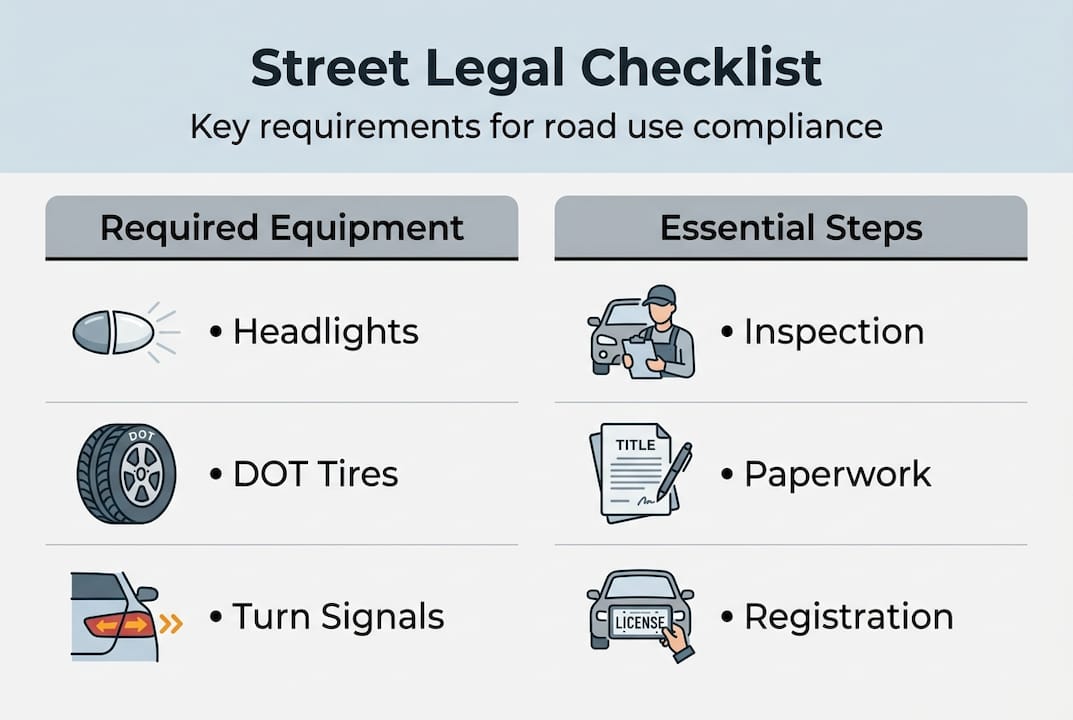
For off-road vehicles being converted for street use, the list narrows to what’s often called the “Big 7.” According to conversion cost data, the Big 7 equipment for UTVs and ATVs includes headlights, taillights and brake lights, turn signals, side mirrors, a horn, a license plate light, and a windshield. Some states also require DOT-rated tires. Total conversion costs typically run between $1,130 and $2,730, depending on your vehicle and the state’s specific requirements.
Here’s a quick comparison of what standard vehicles and off-road conversions need:
| Equipment | Standard vehicle | Off-road conversion |
|---|---|---|
| Headlights | Required | Required |
| Turn signals | Required | Required |
| Seat belts | Required (all seats) | Required (varies) |
| DOT tires | Required | Required in some states |
| Windshield | Required | Required |
| VIN | Factory-issued | Must be verified/assigned |
| Emissions compliance | Required | Required in most states |
| Insurance | Required | Required |
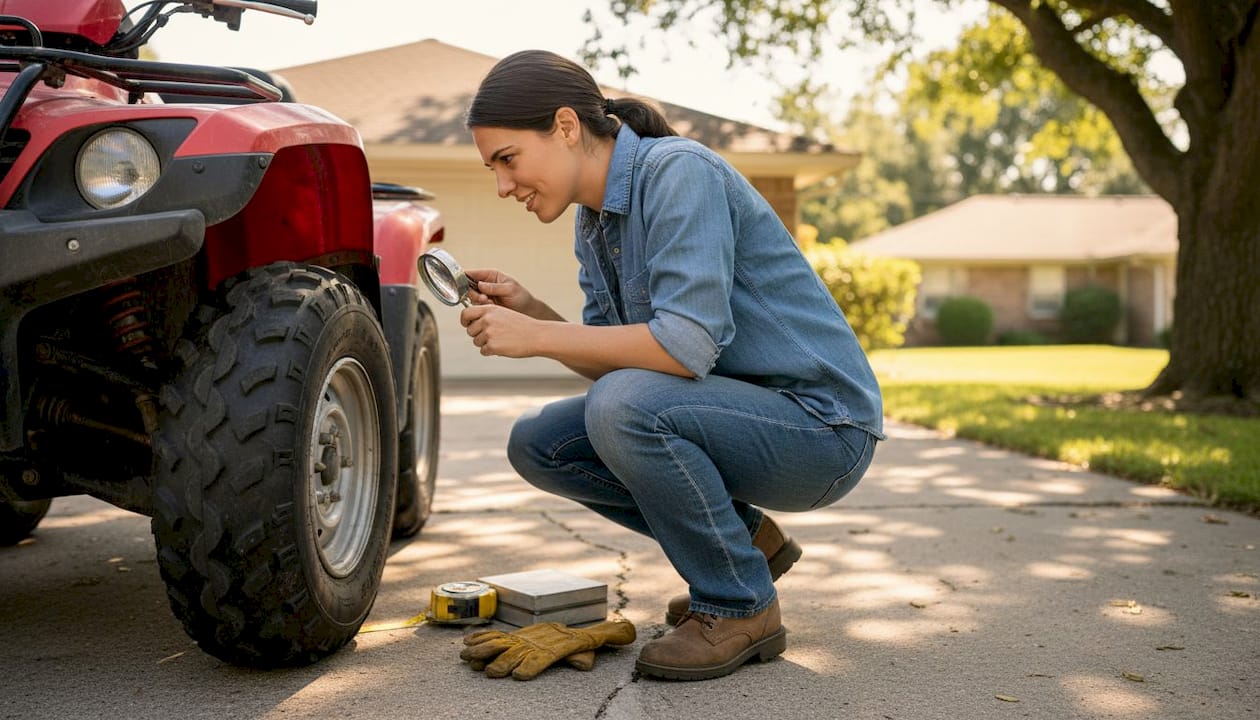
Pro Tip: The most common items that cause off-road vehicles to fail a street-legal inspection are missing DOT-rated tires, non-compliant lighting that doesn’t meet brightness or angle standards, and absent or improperly placed mirrors. Address these first before scheduling any inspection.
If you’re looking at specific vehicle categories, golf cart requirements differ from standard ATVs, and scooter equipment standards add yet another layer based on engine displacement and speed capability.
Step-by-step process to make a vehicle street legal
Once you know what your vehicle needs, here’s how to actually get it street legal, step by step.
The general process varies by state, but most follow this sequence:
- Identify your state’s requirements. Start at your state DMV website or call directly. Some states have a specific off-road to street-legal conversion program; others simply don’t allow it.
- Upgrade your equipment. Install all required lights, mirrors, seat belts, horn, and any state-specific additions like DOT tires or a windshield wiper. Use components that are explicitly rated to meet FMVSS or DOT standards.
- Get a safety inspection. Most states require a certified inspection at an approved station. Inspectors will check every piece of required equipment against your state’s checklist.
- Handle emissions testing. States with emissions programs (like California and Colorado) require a passing emissions test before registration. Gas-powered off-road vehicles often struggle here.
- Obtain a title and VIN verification. If your vehicle doesn’t have a factory-issued title, you’ll need a VIN inspection and potentially a bonded title. A Manufacturer’s Certificate of Origin (MCO) is often the starting document for titling imported or specialty vehicles.
- Register the vehicle and obtain plates. Once you pass inspection and have a title, you register the vehicle and receive a license plate.
- Purchase insurance. Most states require at minimum liability insurance before you can legally operate on public roads.
Pro Tip: The most common reason off-road conversions fail at the inspection stage is incomplete paperwork, not missing equipment. Make sure your title, VIN documentation, and MCO are all in order before you even show up for inspection. Missing a single document can push your timeline back by weeks.
Timelines vary widely. In permissive states like Montana or South Dakota, the process can move in a few days. In stricter states, expect several weeks and potentially multiple inspection visits.
State-by-state differences and local rules
Although requirements are set at the federal level, your state and even local rules can dramatically impact what is possible.
When it comes to off-road vehicles like UTVs, the range of state policies is striking. Roughly 20 states allow full street-legal UTVs, meaning you can register them and drive on public roads without speed restrictions. States like Montana, South Dakota, Arizona, Utah, and Wyoming fall into this category. Another 25 states allow limited use, typically restricting UTVs to roads with speed limits of 35 to 45 mph. And then there are 5 to 9 states, including California and New York, that effectively prohibit street-legal UTVs altogether except for narrow agricultural or emergency uses.
Here’s a simplified breakdown of where states fall:
| Category | Examples | What’s allowed |
|---|---|---|
| Full access | MT, SD, AZ, UT, WY | Street legal with full equipment |
| Limited use | TX, CO, ID, KS | Low-speed roads only (35-45 mph max) |
| Prohibited | CA, NY, IL | Off-road only; no public road use |
Some important nuances that often catch people off guard:
- Local ordinances override state law. Even if your state allows street-legal UTVs, your city or county can ban them from local roads entirely.
- Out-of-state plates don’t transfer automatically. A vehicle legally registered in Montana may not be recognized as street legal in California, regardless of the equipment it carries.
- Speed limits matter. Some states allow UTVs only on roads with specific speed limits, so a vehicle that’s legal on a rural county road may be prohibited on a state highway.
For Utah specifically, the Utah ATV street-legal process requires passing an ATV safety inspection plus standard registration fees, making it one of the more straightforward states for conversions.
If you’re comparing vehicle types for property or business use, understanding UTV state laws and how they differ from golf carts vs ATVs can help you choose the right platform before you invest in a conversion.
The real-world challenge of street legal conversions
Having explored the rules and requirements, let’s look at what really happens in practice, especially for those considering conversions.
Here’s the part most guides skip: even when you do everything right, street-legal conversions can create unexpected problems the moment you cross a state line. The Utah DMV’s ATV program illustrates this well. Utah requires a safety inspection and registration, but that registration is not recognized in neighboring California or New York. Out-of-state plates don’t carry legal weight in restrictive states, and local law enforcement in those states can and do cite out-of-state off-road vehicles for operating illegally.
For small business owners using UTVs for property maintenance or service operations, the stakes go up. Insurance policies for converted off-road vehicles often carry exclusions for road use, and some insurers won’t cover them at all on public streets, regardless of state registration. You need to specifically confirm road coverage with your insurer before assuming you’re protected.
The bottom line is that a street-legal conversion is genuinely worth it in permissive states with consistent enforcement. But in mixed or restrictive environments, you may spend $2,000 on a conversion that limits where you can actually operate the vehicle. Do the research before you spend the money.
Explore street-legal options with Import Junkies
If you’re considering making the leap to a street-legal vehicle, here are some concrete options and guidance to get you started.

At Import Junkies, we carry vehicles that are built with street-legal compliance in mind, so you’re not starting from scratch. The MSA 300cc 4x4 ATV is a solid option for buyers in permissive states looking for a capable utility vehicle. If you need more capacity, the 400cc street-legal UTV offers four-wheel drive and utility features that work for both personal and business use. Browse our full street-legal inventory to compare models, pricing, and specs, and reach out to our team with questions about state-specific compliance for any vehicle you’re considering.
Frequently asked questions
What is the difference between state and federal street-legal requirements?
Federal standards set the baseline for vehicle safety equipment, while states control registration, inspection schedules, and enforcement. Off-road vehicles not factory-built for road use may qualify through NHTSA low-volume or specialty exemptions, but must still meet state-level processes.
Are all-terrain vehicles (ATVs) or utility task vehicles (UTVs) ever street legal?
Yes, in many states. About 20 states allow fully street-legal UTVs when equipped with required safety gear, while 25 others permit limited road use; states like California and New York prohibit street operation almost entirely.
What is the typical cost to convert an off-road vehicle to street legal?
Based on required equipment and inspection fees, conversion costs for UTVs and ATVs typically range from $1,130 to $2,730. The final cost depends on how many of the Big 7 components your vehicle already has and whether your state requires DOT tires.
Can a vehicle be street legal in one state but not in another?
Absolutely. State reciprocity for off-road vehicles is limited, meaning a UTV registered in Montana may not be recognized as street legal in California or New York, where local and state rules are far more restrictive.
Recommended
- Street Legal Golf Cart Requirements Explained – Saferwholesale || Import Junkies || Great Sports
- Street legal scooters explained: Requirements, types, and tips – Saferwholesale || Import Junkies || Great Sports
- Low Speed Electric Vehicle Buying Guide – Saferwholesale || Import Junkies || Great Sports
- How to inspect used golf carts: a step-by-step guide – Saferwholesale || Import Junkies || Great Sports


