


 Location
 Login
Login
TL;DR:
- Registering a utility vehicle in the U.S. varies by state, vehicle type, and intended use, affecting registration processes and restrictions. Owners must understand their vehicle’s classification, gather specific documents, and ensure compliance with both state and local ordinances before registration. Proper preparation helps avoid delays, fines, and legal issues when registering and using utility vehicles on public roads.
Registering a utility vehicle in the United States is not a one-size-fits-all process, and that surprises more owners than you might expect. The rules differ by state, by vehicle type, and by how you plan to use the vehicle, whether on your private property, on public trails, or on public roads for commercial purposes. Skip one step or misread one classification, and you could face delays, fines, or worse, a vehicle that sits unused while you sort out paperwork. This guide walks you through the entire process clearly, so you can get your vehicle registered correctly the first time.
Table of Contents
- Understanding state classifications and requirements
- What you need before you register: Documents, inspections, and key requirements
- Step-by-step: Registering your utility vehicle for personal vs. commercial use
- Common roadblocks and how to avoid them
- What most utility vehicle owners get wrong about registration
- Your next step: Get the right utility vehicle—and register with confidence
- Frequently asked questions
Key Takeaways
| Point | Details |
|---|---|
| Check your vehicle’s classification | State definitions for utility vehicles directly impact your registration path. |
| Prepare all documents first | Have your title, inspections, and certificates ready before visiting the DMV. |
| Distinguish personal vs. commercial | Registration and inspection needs differ if your vehicle is used for business. |
| Look up local rules | City or county ordinances may require steps beyond state registration. |
| Street use requires more steps | Making your utility vehicle street-legal usually means extra equipment, insurance, and documentation. |
Understanding state classifications and requirements
Before you collect paperwork or complete any forms, it’s crucial to understand exactly how your utility vehicle is defined by law in your state.
Not every state uses the same labels. One state might call your side-by-side a UTV (utility task vehicle), while another classifies it as an ATV (all-terrain vehicle), an off-highway vehicle (OHV), or a low-speed vehicle (LSV). Each label carries its own registration rules, fee structure, and operational restrictions. Understanding the different utility vehicle types before you visit your DMV is one of the most useful steps you can take early in this process.
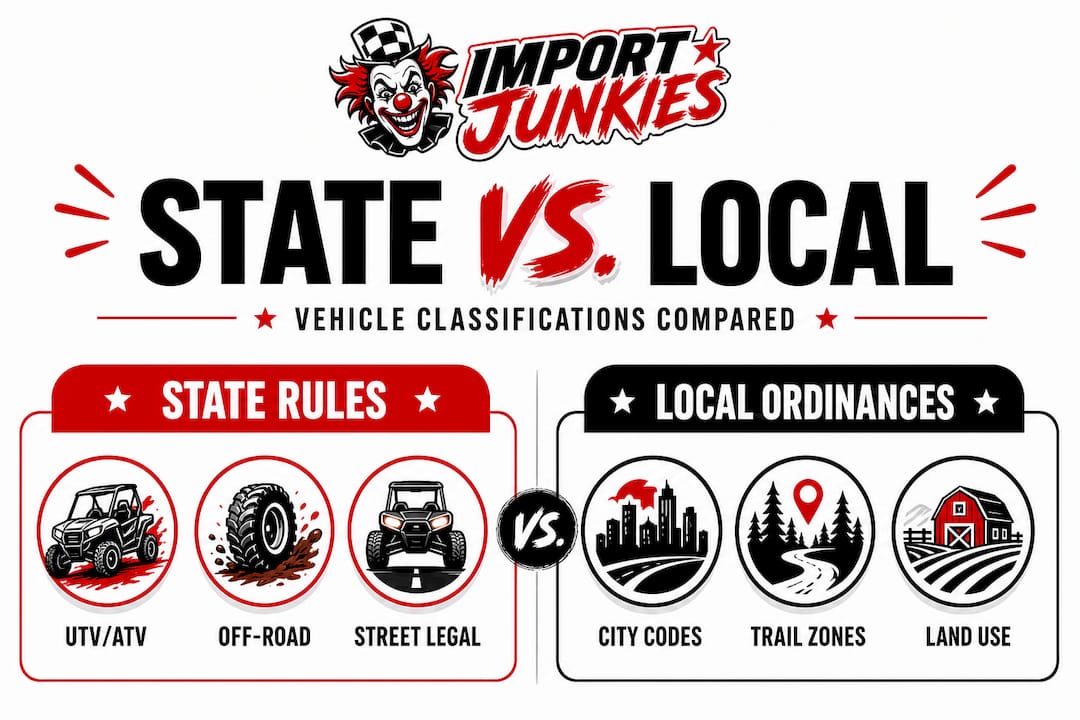
As a starting point, registering a utility vehicle begins with determining how your state classifies it, because the required steps and documents differ significantly depending on that classification. This is not a minor distinction. An ATV registered for trail use in one state may be considered a completely different vehicle class when you cross a state line or move to a new county.
Here is how common classifications compare across states:
| Vehicle type | Common classification | Typical registration path | Street legal? |
|---|---|---|---|
| Side-by-side UTV | ATV, OHV, or utility vehicle | OHV sticker or DMV title | Usually no |
| Low-speed vehicle (LSV) | LSV or neighborhood electric vehicle | Standard DMV registration | Yes, on certain roads |
| Work utility vehicle | Commercial or utility vehicle | DMV, often with commercial forms | Varies by state |
| Golf cart (modified) | Golf cart or LSV | DMV or local municipality | Limited yes |
Several factors drive these differences:
- State law: Each state legislature sets its own vehicle classification code.
- Engine size and top speed: Many states classify by whether the vehicle tops out below 25 mph or above it.
- Intended use: Personal recreation, property maintenance, and commercial hauling all trigger different rules.
- Local ordinances: A county or city can layer additional restrictions on top of state rules, which means your state approval is not the final word.
Also worth noting: if you plan to explore off-road vehicle registration differences between trail-use vehicles and street-legal vehicles, you’ll find that even within a single state, those two paths involve different forms, different plates, and different insurance requirements.
What you need before you register: Documents, inspections, and key requirements
Now that you know how your vehicle is classified, gather the right documents and ensure your vehicle meets inspection requirements before heading to the DMV.
The document list changes depending on your state, your vehicle’s history, and whether you want street-legal or off-road-only status. That said, most registration applications share a core set of requirements.
Standard documents needed for most utility vehicle registrations:
- Manufacturer’s Certificate of Origin (MCO) for new vehicles, or a clean title for used ones
- Bill of sale showing the purchase price and seller/buyer information
- Proof of insurance (required for street-legal registrations in virtually every state)
- Completed state registration application form
- Payment for applicable registration fees and taxes
- Government-issued ID matching the buyer’s name on the title or MCO
If your goal is street use rather than off-road or trail use only, you typically must satisfy additional equipment requirements and register the vehicle under a street-legal classification. Those extra equipment requirements often include working headlights, tail lights, turn signals, mirrors, a horn, and an approved windshield. Some states also require seatbelts and a roll cage.
For first-time registrations or vehicles new to a state, VIN inspections and additional certificates are often required before the DMV will complete the process. A VIN (vehicle identification number) inspection confirms the vehicle’s identity and that it has not been reported stolen. You can often get this done at a local DMV office, a law enforcement station, or a certified inspection station. Learning more about the VIN inspection process before your appointment will save you time.
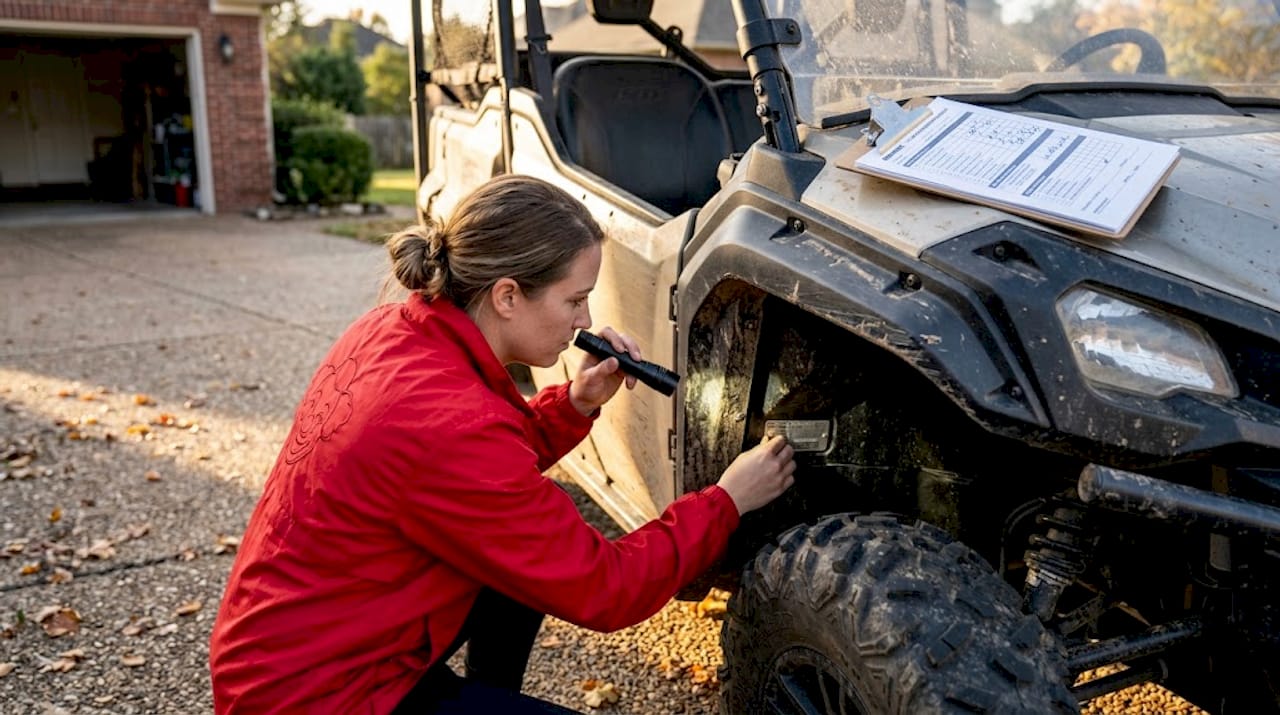
For new vehicles purchased from a dealer, the MCO is the key document. It functions like a birth certificate for your vehicle. Make sure you understand the MCO document requirements before you finalize any purchase, especially for vehicles imported or sold by wholesale dealers.
Commercial vs. personal documentation differences:
| Document | Personal use | Commercial use |
|---|---|---|
| Title or MCO | Required | Required |
| Proof of insurance | Required for street use | Required, often higher coverage limits |
| Business entity info | Not needed | Often required (EIN, LLC paperwork) |
| Weight certificate | Not usually required | May be required for heavy vehicles |
| IRS Form 2290 (HVUT) | Not applicable | Required if vehicle exceeds 55,000 lbs. |
Using a pre-registration checklist tailored to your vehicle type and state is the most reliable way to make sure you do not miss anything before you go.
Pro Tip: Call your local DMV before your appointment and ask specifically about the vehicle’s class code. Bring the VIN number and be ready to describe the vehicle’s intended use. This two-minute call can prevent a wasted trip.
Step-by-step: Registering your utility vehicle for personal vs. commercial use
With your paperwork in hand, you’re ready to begin the registration process. Here’s what to expect and do, step by step.
For personal use registration:
- Confirm your vehicle’s classification with your state DMV, either online or by phone. Ask whether it falls under ATV, OHV, LSV, or another category.
- Gather all required documents, including your MCO or title, bill of sale, and proof of insurance if needed.
- Schedule or complete a VIN inspection if you are registering a new-to-state or first-time vehicle.
- Complete the registration application form specific to your vehicle class. Many states offer this online.
- Submit your application and pay fees at the DMV, by mail, or through the state’s online portal.
- Receive your registration certificate and plate or sticker, and display them as required by your state.
- Verify any local permits or county requirements that may apply even after state registration is complete.
For commercial use registration:
Registration requirements differ for personal vs. commercial use, and states define separate categories such as commercial and heavy vehicles that trigger additional inspections and fees. The commercial path adds several steps:
- Identify your business entity information and have your EIN (Employer Identification Number) ready.
- Determine if your vehicle qualifies as a heavy vehicle under IRS rules, which could trigger the Heavy Vehicle Use Tax (Form 2290).
- Complete commercial-specific registration forms in addition to the standard application.
- Arrange commercial vehicle inspections if required by your state. These are more thorough than standard VIN checks.
- Verify insurance minimums for commercial use, which are typically higher than personal coverage.
- Submit all documents and fees, which are often higher for commercial vehicles.
- Keep copies of all registration records in the vehicle at all times. Commercial vehicles are subject to roadside checks.
Understanding street-legal vehicle steps is especially important if you plan to drive your utility vehicle on public roads for business purposes, because the safety equipment requirements are non-negotiable.
“Owners registering for commercial use should budget extra time for inspections and document review. The DMV process for a business-owned vehicle typically takes longer than a personal registration, and missing one commercial-specific form can send you back to square one.”
For golf cart style utility vehicles specifically, reviewing golf cart requirements by state before you register will help you avoid surprises at the window.
Pro Tip: Keep a digital copy of your registration documents in your email or a cloud folder. If you lose your physical documents while the vehicle is in use, you can pull up proof quickly from your phone.
Common roadblocks and how to avoid them
Even with all steps followed, there are several pitfalls that can stall or nullify your registration. Let’s make sure you avoid them.
One of the biggest sources of confusion is the relationship between state rules and local ordinances. Local rules can override state permission, meaning even when a state allows certain UTV operation, municipalities and counties may adopt ordinances that restrict or regulate where and when the vehicle can be used. You might have a valid state registration and still be prohibited from driving on certain roads within your city limits.
A second major roadblock involves misunderstanding what your current registration actually covers. Trail or off-highway registration does not automatically make a vehicle street-legal. Many owners assume that because their vehicle is registered, they can drive it anywhere. That is not the case. Off-highway registration and street-legal registration are separate processes, often requiring different plates, different insurance coverage, and different safety equipment inspections.
Common mistakes that delay or invalidate registration:
- Submitting an MCO with incomplete dealer information
- Failing to get a VIN inspection before submitting the application
- Assuming out-of-state registration transfers automatically
- Not accounting for county or city permits on top of the state registration
- Using trail registration as proof of street-legal status
- Missing the renewal window and operating on an expired registration
- Failing to update registration after modifying the vehicle (adding a plow, extending the bed, etc.)
“One of the most preventable delays we see is owners who registered their vehicle for trail use years ago and then start driving it on public roads. That mismatch can result in fines, impoundment, or voided insurance claims.”
For owners using utility vehicles on large properties, farms, or for work like landscaping, the rules may feel less urgent, but operating on even a short stretch of public road without proper registration is a legal risk. Understanding how property maintenance UTVs relate to registration rules can help you stay compliant while still getting the work done.
Pro Tip: Before you drive after registering, contact your county clerk or local law enforcement non-emergency line and ask one simple question: “Are there any local ordinances that restrict where I can operate a registered UTV or utility vehicle?” It takes five minutes and can save you a significant headache.
What most utility vehicle owners get wrong about registration
Having seen the registration process from all angles, here’s what too many people learn the hard way.
The most common mistake is trusting a generic checklist someone posted on a forum. State rules change. Local ordinances get updated. A checklist that was accurate two years ago in one county may be entirely wrong for your situation today. State agency websites themselves can lag behind recent legislative changes, so even official-looking online guides are not always current.
The second mistake is treating off-highway registration as a finish line. A vehicle with an OHV sticker is legal on trails. That is it. The moment you pull onto a public road, you need a different plate, different insurance, and in many states, a different classification on file with the DMV. We have seen owners who put an entire season of use at risk because they misread the scope of their registration. They drove confidently on public roads with an OHV sticker, only to be cited and have to restart the street-legal registration process from scratch, including additional inspections and back-dated insurance.
The third issue is underestimating local authority. Understanding the regulatory nuance for utility vehicles at the county and city level matters just as much as understanding state law. We have seen owners in suburban counties who had valid state registrations but were cited under a local ordinance they never knew existed. The rule existed on the county website, but no one at the state DMV mentioned it.
The practical takeaway: treat state registration as a foundation, not a complete solution. Verify local rules independently, and if you are ever unsure, ask your local DMV office or law enforcement directly rather than relying on secondhand information. Getting it right the first time is far less costly than fixing it after the fact.
Your next step: Get the right utility vehicle—and register with confidence
If you’re ready to put this knowledge into action, make sure your next utility vehicle purchase fits your registration needs from the start.
At Import Junkies, we sell vehicles that come with the documentation you need to start the registration process without guesswork. Every unit ships with proper paperwork, including MCO documentation accepted in all 50 states.
Whether you need a capable workhorse like the 300cc 4x4 utility ATV with four-wheel drive and snow plow capability, or a versatile electric golf cart UTV that fits both recreational and light commercial needs, we have options that are built to meet registration-ready standards. The paperwork is organized, the VINs are clear, and our team is available to answer documentation questions before you buy. Browse the full selection at Import Junkies to find a vehicle that is ready to work and ready to register.
Frequently asked questions
Can I use my utility vehicle on public roads if it’s only registered for off-highway or trail use?
No. Off-highway registration does not make a utility vehicle legal for public roads. You will need to complete a separate street-legal registration process, which typically requires different equipment, a different plate, and additional insurance.
What documents do I need for first-time utility vehicle registration?
You typically need a completed title or MCO, a bill of sale, proof of insurance for street use, and a VIN inspection report if required. According to Utah DMV guidelines, VIN inspections and additional certificates are often required for first-time registrations, especially for vehicles new to a state.
How do local ordinances affect my utility vehicle registration?
Local rules can restrict when and where you may operate your vehicle, even when state registration is valid. Always check with your county or city before operating on local roads.
Do commercial vehicle registration requirements differ from personal use?
Yes. Commercial registration typically involves additional forms, higher insurance minimums, commercial-specific inspections, and in some cases the Heavy Vehicle Use Tax if your vehicle exceeds a certain weight threshold.
Recommended
- The ultimate utility vehicles checklist for smart buyers – Saferwholesale || Import Junkies || Great Sports
- Utility Vehicles Explained: Uses, Types, and Right Fit – Saferwholesale || Import Junkies || Great Sports
- What makes a vehicle street legal? A complete guide – Saferwholesale || Import Junkies || Great Sports
- Street legal scooters explained: Requirements, types, and tips – Saferwholesale || Import Junkies || Great Sports


